
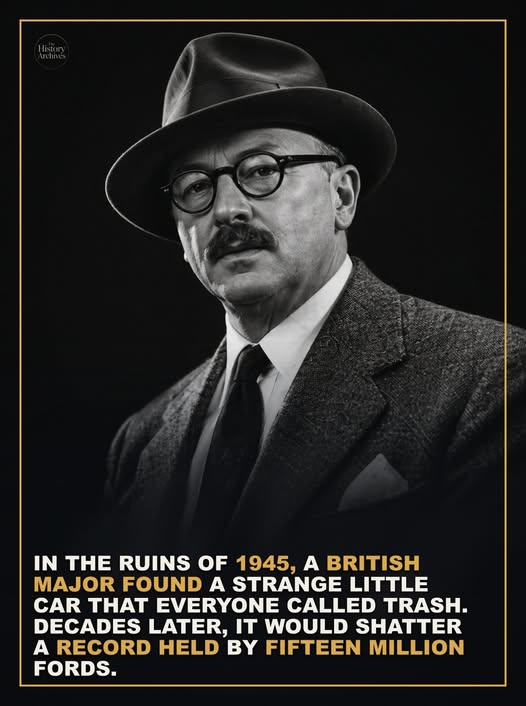
The year was 1945, and Major Ivan Hirst of the British Army was standing in a graveyard of industrial dreams.
He was surrounded by the jagged, bombed-out remains of a factory in a German town that didn’t even have a name yet.
Rain leaked through the shattered roof, soaking the floor where a peculiar, rounded vehicle sat covered in dust and debris.
It was the car that was supposed to change the world, yet it looked more like a motorized insect than a revolution.
To the rest of the Allied forces, this factory was a nuisance—a pile of rubble that had once been the centerpiece of a dictator’s propaganda machine.
To Hirst, it was a puzzle.
He watched as a few German workers, starving and desperate, tinkered with the air-cooled engine located in the back of the car.
This was the “People’s Car,” the dream sold to millions of German families who had traded their hard-earned marks for savings stamps that eventually became worthless.
During the war, the factory hadn’t built cars for families. It had been a place of misery, using forced labor to produce military vehicles and parts for V-1 rockets.
Now, the British didn’t know what to do with it. They offered the entire operation to the Americans, the French, and the British motor industry for free.
Sir William Rootes, head of the Rootes Group, looked at the rounded machine and dismissed it with a sneer.
“The vehicle does not meet the fundamental technical requirement of a motor-car,” Rootes declared. “It is quite unattractive to the average buyer.”
Henry Ford II was equally unimpressed, reportedly telling his advisors that the factory wasn’t worth a cent.
Hirst, however, saw something they didn’t. He saw a machine that was simple, rugged, and remarkably easy to fix.
He convinced the British military to order 20,000 of the cars to use as transport for their occupation forces.
That single order saved the factory from being dismantled and shipped away as war reparations.
But the real miracle began in 1948, when a man named Heinrich Nordhoff took the reins.
Nordhoff was a visionary who understood that if this car was going to survive, it had to be more than just cheap transport.
He obsessed over quality. He turned the factory’s dark past into a pursuit of perfection, creating a service network that would eventually span the globe.
When the car finally arrived on American shores in the 1950s, it looked like a toy compared to the chrome-heavy, gas-guzzling monsters of Detroit.
But that was exactly why people began to love it.
By the 1960s, the “Beetle” had undergone a radical transformation in the public mind.
The car designed by a regime of rigid conformity became the ultimate symbol of rebellion and individual expression.
It was painted with flowers, driven to music festivals, and embraced by a generation that rejected everything the car’s original creators had stood for.
It was the ultimate irony of the 20th century: a machine born from the darkness of the Third Reich became the chariot of the “Summer of Love.”
On February 17, 1972, the world watched as a small, blue Beetle rolled off the assembly line in Wolfsburg.
A cheering crowd of workers surrounded the vehicle as it was decorated with wreaths and streamers.
This wasn’t just another car. It was the 15,007,034th unit produced.
In that moment, the “ugly” little car that the experts said nobody would want officially surpassed the Ford Model T.
It had become the most produced single model of car in human history.
Major Hirst, the man who had stood in the ruins decades earlier, lived to see his gamble pay off in ways he could never have imagined.
The bug hadn’t just survived the wreckage of war; it had conquered the world.
It was no longer a symbol of a broken promise. It was a testament to how the most unlikely things can find a new soul in the right hands.
Sources: Volkswagen Group Heritage Archive / The British Museum of Transport