
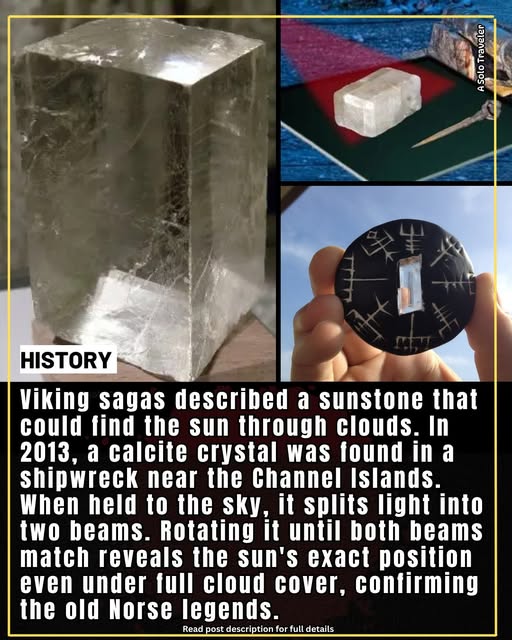
For more than a thousand years, the Viking “sunstone” was treated as legend, a detail from old Norse stories that sounded too precise to be real.
The sagas spoke of a mysterious object called a sólarsteinn, a stone that could reveal the position of the sun even when the sky was completely overcast. Historians debated it for generations. Some thought it was symbolism. Others dismissed it entirely.
Then the ocean offered something unexpected.
In 2013, archaeologists examining the wreck of a 16th-century ship near the Channel Islands uncovered a small but remarkable object among its navigational tools. The ship had sunk in 1592, long after the Viking Age, yet alongside dividers and measuring instruments sat a clear crystal identified as Iceland spar.
It was not there by accident.
Iceland spar has a unique optical property known as birefringence. When light passes through it, the crystal splits that light into two separate rays. By rotating the crystal and observing how those rays change in brightness, it becomes possible to identify the exact direction of the sun—even when it is hidden behind clouds, fog, or low light conditions.
At a specific angle, both rays appear equally bright. That point reveals where the sun is.
Researchers, including teams from University of Rennes, tested this idea under controlled conditions. Their findings showed that the method could determine the sun’s position with an accuracy of about one degree, even under fully overcast skies.
For sailors navigating open ocean without compasses, that level of precision could mean everything.
The Viking Age, roughly spanning 793 to 1066 AD, saw Norse explorers travel vast distances across the North Atlantic, reaching Iceland, Greenland, and even parts of North America centuries before many other European voyages. Historians long wondered how they maintained such reliable navigation without magnetic tools, which did not become common in Europe until later.
The sunstone provides a compelling answer.
What makes the Channel Islands discovery even more significant is its date. The shipwreck from 1592 suggests that this knowledge did not disappear with the Vikings. It endured, quietly, as practical seamanship passed from one generation to another.
The old sagas describe rulers like Olaf II of Norway using a sunstone on cloudy days to confirm the sun’s position. For centuries, those accounts were read as poetic storytelling.
Now they read differently.
What once sounded like myth aligns closely with what physics allows.
The Vikings were not simply explorers relying on instinct or luck. They were careful observers of the natural world, using tools that were simple in form but sophisticated in function. A small crystal, held up to the sky, became a compass when no compass existed.
Sometimes, the line between legend and science is not as wide as it seems.