
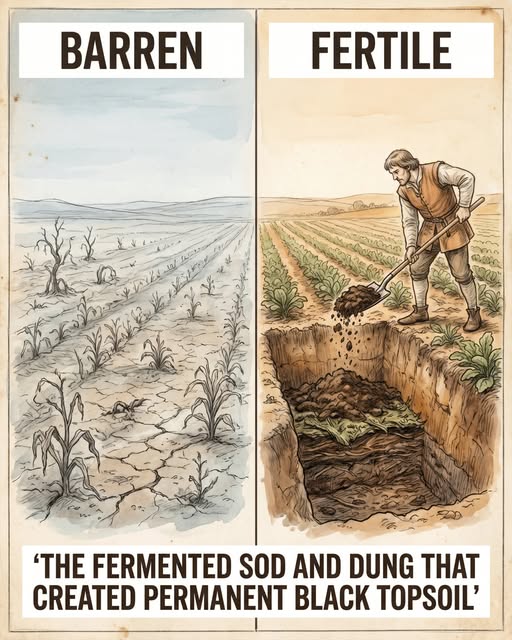
You think building deep topsoil requires buying expensive bags of chemical fertilizers. But heritage farmers engineered the richest dirt on earth without synthetic inputs.
Meet the forgotten art of Plaggen anthrosol engineering. Plaggen (from the German ‘plagg’ for sod) anthrosol (one of the 30 soil groups in the classification system of the Food and Agriculture Organization (FAO). Anthrosols are defined as any soils that have been modified profoundly by human activities) engineering means the deliberate creation or modification of soil by repeatedly adding sod, turf, manure, and other organic material over time to build up a fertile, thicker topsoil.
In plain terms, it is a form of human-made soil building used especially in medieval northwestern Europe, where farmers cut sod from nearby land, mixed it with manure, and spread it on fields to improve poor sandy soils.
For Australian conditions, the closest idea is not a natural soil type but a managed system of improving soil fertility and structure through repeated organic additions; the term itself is mainly used in European soil science.
Medieval European builders constantly harvested raw forest sod and concentrated sheep dung.
(In this context, sod means a slice or mat of grass-covered topsoil, with the roots and earth still attached—basically turf that can be cut and laid elsewhere. Relative to Australian English, the closest everyday word is turf rather than “sod”.)
They continuously layered these specific organic materials deep inside massive earthen pits. This deliberate biological fermentation slowly digested the raw matter into thick humus. It created a one-meter-thick layer of hyper-fertile, self-sustaining black topsoil.
This biological earth still outperforms chemical agriculture over a thousand years later.
Chemical powders wash away while this living earth remains forever.