
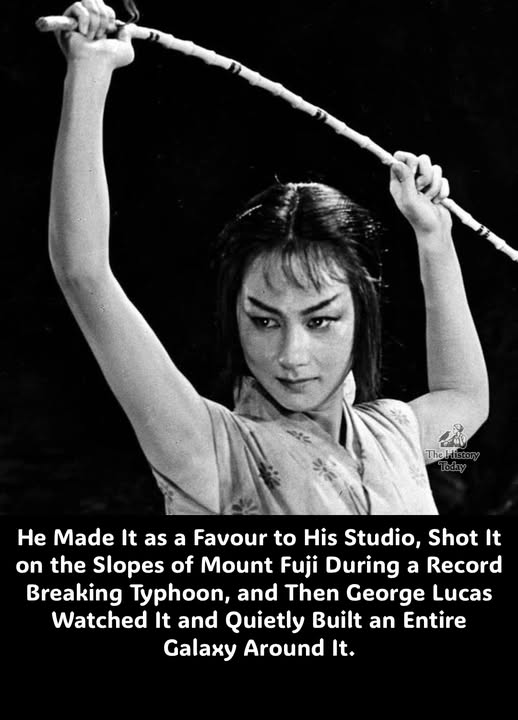
In 1958, Akira Kurosawa made a decision that would ripple through cinema for decades in ways nobody in that era could have predicted.
He owed Toho Studios.
They had backed his riskier, more personal work. Films like Rashomon, which had confused studio executives and astonished the rest of the world. So when Toho asked for something more commercial, more accessible, something audiences would actually come out to see in large numbers, Kurosawa delivered.
He gave them The Hidden Fortress.
It became the fourth highest-grossing film in Japan that year and the most successful of his career up to that point. A rousing, energetic adventure built around two bickering peasants escorting a disguised princess and a disgraced general through enemy territory. Crowd-pleasing in the best sense of the word, without sacrificing an ounce of craft.
The making of it was its own kind of adventure.
Key sequences were shot in Hōrai Valley in Hyōgo and on the slopes of Mount Fuji, where a record-breaking typhoon rolled in and stopped production in its tracks. Bad weather. Delays. A director who was already known for shooting slowly and precisely and refusing to rush.
Toho’s frustration reached a point where the following year Kurosawa formed his own production company, though he continued distributing through the studio. The partnership survived. The tension never fully disappeared.
There is a detail from the production that stays with you.
Misa Uehara, who played the princess, described her first makeup session. Kurosawa walked into the dressing room carrying a photograph of Elizabeth Taylor. He held it up and explained, using that image, exactly what he was looking for in his princess. The precision of the vision. The specificity. A director who knew down to the finest detail what he wanted every frame to look like, including the face at the center of it.
That was Kurosawa.
And then, nearly twenty years later, a young filmmaker in America sat down and watched The Hidden Fortress and something clicked.
His name was George Lucas.
What caught Lucas was a specific technique. Kurosawa had chosen to tell his story through the perspective of the two lowliest characters in it. Not the general. Not the princess. The two peasants, Tahei and Matashichi, bumbling and squabbling their way through a story much larger than either of them understood.
Lucas took that structure and carried it into space.
Tahei and Matashichi became C-3PO and R2-D2. Princess Yuki became Princess Leia. The hidden fortress became the Death Star plans. Lucas has acknowledged the influence openly and without hesitation.
What is less widely known is that his original plot outline for Star Wars bore an even closer resemblance to The Hidden Fortress than the final film did. That earlier draft was eventually reworked and became the basis for The Phantom Menace in 1999.
A film made in 1958 as a commercial favour to a frustrated studio, shot in typhoon weather on the slopes of Mount Fuji, quietly seeded two of the most successful science fiction films ever made.
Akira Kurosawa was trying to repay a debt.
He ended up changing the shape of storytelling itself.