
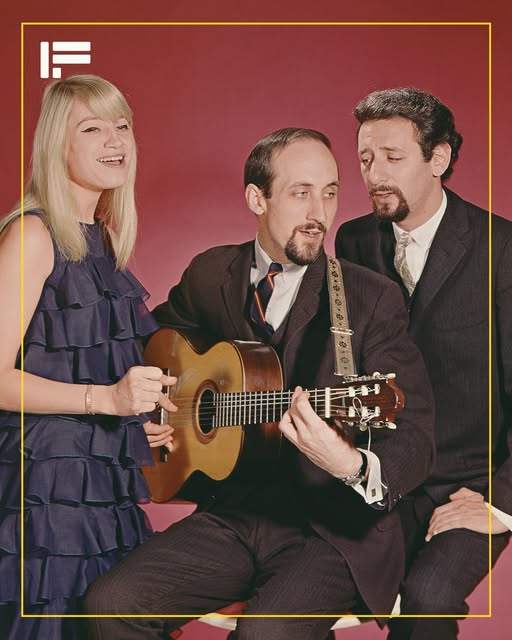
He wrote it in one hour. He gave away every penny it ever made. And it became the most beloved wedding song in America.
In the fall of 1969, Paul Stookey got a phone call that would quietly change his life — though he had no idea at the time.
His bandmate and close friend Peter Yarrow was getting married. Peter was one-third of Peter, Paul and Mary, the folk trio that had helped define a generation. His bride was Marybeth McCarthy, niece of Senator Eugene McCarthy. Peter asked Paul a simple question: would he write a song and sing it at the ceremony?
Paul said yes immediately.
But privately, he knew something. This was not a song he could write on his own. Not this one. This needed something beyond his ability.
A short time before the wedding, Stookey went down to the small basement studio of his Connecticut home. He picked up his twelve-string guitar, sat in the quiet, and prayed.
“Lord,” he said, “nothing would bless this wedding ceremony more than Your presence. How would You manifest Yourself?”
Then he picked up a pencil.
For the next hour, words came. Not slowly. Not with struggle. They arrived as though they had been waiting. Stookey later said he did not feel like he was composing. He felt like he was transcribing. The pencil moved across the page and all he had to do was allow it.
The first words he wrote were: “I am now to be among you at the calling of your hearts.”
Just one hour before the ceremony, he sang it for his wife Betty. She loved it, but she caught something. “They won’t understand ‘I am now to be among you,’” she told him. “They’re going to think you’re presuming to be God.”
Stookey thought about it. She was right. He changed one word.
“He is now to be among you at the calling of your hearts. Rest assured this troubadour is acting on His part.”
On the evening of October 18, 1969, at Saint Mary’s Catholic Church in Willmar, Minnesota, Paul Stookey stood before the congregation as Peter Yarrow’s best man. He held his guitar and sang the song for the first time.
It was meant to be a private gift. A blessing between friends. He assumed it would never be sung again.
Several weeks later, backstage before a Peter, Paul and Mary concert, Peter leaned over and made a request. His wife was in the audience. Would Paul sing the song for her?
Paul stepped to the microphone and played. The audience went still. There was something in that simple melody — unhurried, vulnerable, honest — that reached people in a way no one had expected.
He kept singing it. And people kept asking.
When the trio took a leave of absence from performing in 1970, Stookey recorded the song for his debut solo album, Paul And…. The single, “Wedding Song (There Is Love),” was released in 1971. It entered the Billboard Hot 100 and climbed to number 24. On the Easy Listening chart, it reached number 3.
But here is where the story becomes extraordinary.
Paul Stookey refused to claim the song as his own.
He had a dilemma. He believed the song had been given to him, not created by him. If he copyrighted it under his name, he would profit from something he felt was never his. But if he claimed nothing, the record company would simply keep the royalties.
So he found a third path. He established the Public Domain Foundation, a charitable trust to receive every royalty the song would ever generate as a composition. He kept none of the songwriting income.
The record company called him with exciting news — The Tonight Show wanted him to perform “Wedding Song” on national television. They told him it could launch a solo career.
“No, thanks,” Stookey said.
Over the decades, the Public Domain Foundation has distributed more than two million dollars to charitable organizations across the United States — soup kitchens, children’s programs, hospitals, music education, and causes Stookey will never see the results of. That two-million-dollar figure was reported in the 1990s. The total has only grown since.
“Wedding Song (There Is Love)” has been covered by Petula Clark, Captain and Tennille, Mary MacGregor, Nana Mouskouri, and many others. It has been performed at countless weddings across America and around the world for more than fifty years. Acoustic guitarists learn it. Brides request it. It has become, for many families, the song that means the beginning.
And Paul Stookey has never taken a cent of the songwriting royalties.
Every year, he turns down requests to perform the song at weddings around the country. His answer is always the same.
“It’s not my song,” he says. “It belongs to every bride and groom who ever had a good friend strum a guitar and sing at their wedding. God gave me a song. It was mine to give away.”
When asked how he explains the song’s origin, Stookey keeps it simple.
“Into every songwriter’s life comes a song, the source of which cannot be explained by personal experience.”
He wrote it in one hour in a basement in Connecticut. He sang it once for two people he loved. He gave away everything it ever earned.
And more than fifty years later, that hour of work is still blessing strangers on the most important day of their lives.
Some songs are written.
Some songs are given.
The difference is what you do with them after.