
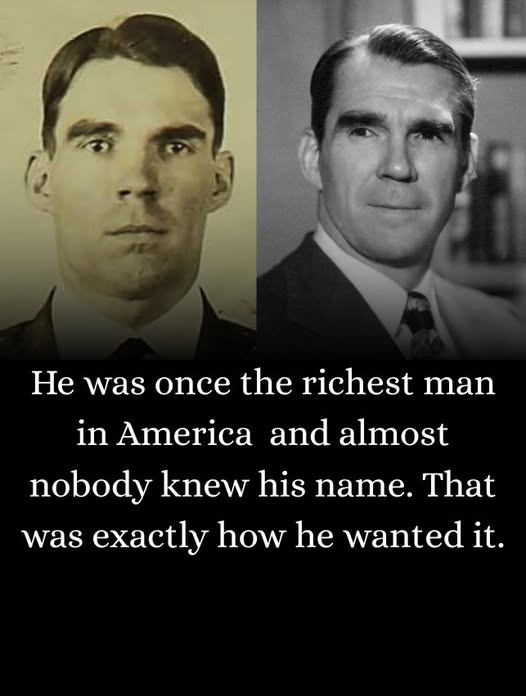
In 1982, Forbes magazine published its very first list of the 400 wealthiest Americans.
At the top of that list sat a name that most of the country had never heard.
Daniel Keith Ludwig.
Net worth: approximately $2 billion. Age: 85. Public profile: essentially zero. In an era when wealthy Americans were beginning to cultivate media presence and personal brands, Ludwig had spent six decades doing the precise opposite — building one of the largest private fortunes in American history while remaining so deliberately invisible that even many of his business partners had never met him face to face.
He was not hiding from anything specific. Secrecy was simply his operating philosophy. And it had worked extraordinarily well.
Ludwig grew up in South Haven, Michigan, the son of a real estate broker. He had almost no formal education beyond high school — he dropped out early and went to work. At the age of nine, he had already bought a small boat and begun charging for rides. By his mid-twenties he owned his first ship. By his thirties he had identified the single insight that would make him one of the most consequential figures in the history of global commerce.
The insight was this: if you could guarantee future cargo, you could finance ships before they were built.
It sounds simple stated plainly. It was revolutionary in practice. Banks would not traditionally lend against ships that didn’t exist. Ludwig figured out how to pre-sell the carrying capacity of vessels still on the drawing board to major oil companies — then used those contracts as collateral to finance construction. He effectively invented a new model of asset financing, and he used it to build a fleet of supertankers at a time when supertankers were reshaping how oil moved around the planet.
He built his own shipyards in Japan when American yards couldn’t build ships fast enough or cheaply enough for his ambitions. He became one of the primary architects of the modern supertanker industry — the vessels that made it economically possible to move crude oil from the Middle East to refineries across the world at the scale the post-war economy required.
He did all of this while maintaining a workforce that numbered in the tens of thousands without ever giving a single major press interview.
But Ludwig’s ambitions extended beyond the ocean.
In the 1960s and 1970s, he turned his attention to something that made his shipping empire look modest by comparison: the Amazon rainforest. He purchased an area of jungle in northern Brazil the size of Connecticut — approximately 1.6 million acres — and set out to build a fully integrated industrial ecosystem from nothing. A pulp mill. A kaolin mining operation. Rice paddies. Roads. A company town. He shipped an entire pulp mill — pre-built in Japan — up the Amazon River on barges to install it on-site.
The Jari Project was one of the most audacious private development undertakings of the 20th century. It was also, ultimately, one of the most expensive failures. The jungle resisted industrialization with a thoroughness that even Ludwig’s resources could not overcome. Soils that seemed fertile proved fragile. Exotic tree species imported for fast-growth pulpwood failed to thrive. The infrastructure costs were staggering. By the early 1980s, Ludwig had absorbed losses approaching $1 billion — an almost incomprehensible sum for a single private venture — and sold the project to a Brazilian consortium.
He barely discussed it publicly. He absorbed the loss and moved on.
Because for Ludwig, money had long since stopped being the point.
In 1971 — two decades before his death — Ludwig founded the Ludwig Institute for Cancer Research, endowing it with the resources to become one of the largest private cancer research organizations in the world. He structured his estate so that the vast majority of his fortune would flow into cancer research and related medical science upon his death. When he died on August 27, 1992 at the age of 95, that is precisely what happened.
The Ludwig Institute for Cancer Research today operates across multiple countries, has contributed to fundamental discoveries in cancer biology, and has helped develop cancer therapies that have reached patients worldwide. It is, by almost any measure, one of the most substantial private contributions to medical science in the 20th century — funded by a man who made his money moving oil across oceans in ships he built using financing models he invented from scratch with no formal education.
He never sought credit. He never gave speeches about his philanthropy. He gave no interviews about his legacy.
He simply built it — the fortune, the ships, the empire, the institution — and then directed it toward something he believed mattered more than his own name.
Daniel Keith Ludwig was the richest man in America in 1982.
Most people reading this have never heard of him.
He would have considered that a success.