
On July 27, 1986, something happened in Budapest that nobody in that stadium would ever forget.
Hungary was still living under a communist government. The country sat behind the Iron Curtain — that invisible but very real wall that separated Eastern Europe from the rest of the world. Western music existed there, but it arrived carefully filtered, quietly passed around on worn cassette tapes, whispered between friends rather than played freely in the open. For many young Hungarians, a song from a Western band was not just entertainment. It was a window. A reminder that somewhere beyond the borders, the world was moving differently.
When Queen announced they would perform in Budapest as part of their 1986 Magic Tour, the news spread like wildfire. Tickets — priced between 160 and 300 forints — sold out in two days. People saved. People sacrificed. People traveled from every corner of the country. For many of them, this would be the first time in their lives they had ever seen a world-class rock band perform live. Not on a grainy television screen. Not on a borrowed tape. Live, in person, under the same sky.
Queen were one of the very few Western bands willing to cross that line. Concerts in Czechoslovakia and the Soviet Union had been discussed and had fallen through. Hungary was the only stop on the entire tour that lay behind the Iron Curtain. The band knew what they were walking into. They chose to go anyway.
They traveled from Vienna to Budapest by hydrofoil down the Danube — the same river that had watched centuries of Hungarian history unfold along its banks. When they arrived, they did not rush to the venue and close themselves off in hotel rooms. They explored. They listened. They paid attention to where they were.
And Freddie Mercury began asking questions.
Somewhere during those days in Budapest, Freddie discovered a song. Its name was ”Tavaszi Szél Vizet Áraszt” — Spring Wind Floods the Water. It was a traditional Hungarian folk song, the kind every Hungarian child grows up hearing, the kind that carries the specific weight of a people’s memory and identity. It was not a pop song. It was not a hit. It was something older and deeper than that.
Freddie decided he wanted to sing it.
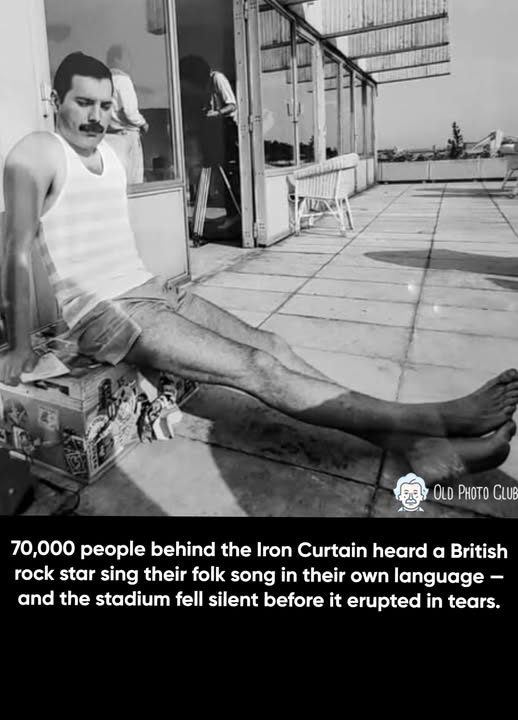
Not as a gimmick. Not as a party trick to win over the crowd for a moment and move on. He genuinely wanted to learn it — the melody, the syllables, the feeling behind it. Footage exists from those days in Budapest showing Freddie practicing the song in a quiet room, barefoot and relaxed, with Brian May accompanying him on acoustic guitar. He turns to his close friend Mary Austin beside him, checking his pronunciation, asking if he is getting it right, laughing when he stumbles and trying again.
He was not asked to do this. Nobody required it. There was no management instruction, no strategic calculation. It came entirely from him — from a man who understood, perhaps better than most, what it means to want to be seen and heard exactly as you are.
On the night of the concert, 70,000 people filled the Népstadion — the largest Western rock concert ever staged behind the Iron Curtain. The air was electric in the way that only a truly historic night can be. Queen played with the full force that had made them one of the greatest live bands in the world. The lights, the sound, the sheer scale of it — it was everything those fans had hoped for and more.
Then, during the acoustic section of the set, something shifted.
Freddie stepped forward to the microphone, and said simply: ”Tonight, for the first time — this is a very special song, from Queen, to you.”
He had written the lyrics on the palm of his hand. He looked down once, then looked up at 70,000 people, and began to sing.
In Hungarian.
For a brief moment, the stadium went still. It took a second for people to understand what they were hearing. Their song. Their ancient, beloved folk song. In their language. Sung by one of the most powerful voices in rock history, on a stage in their own capital city.
Then the crowd erupted.
People sang along through tears. Some stood frozen, unable to fully process the moment. Others held each other. In a brief interview with the Hungarian press afterward, when asked if this was the beginning of the band’s friendship with Hungary, Freddie replied simply: ”If I’m still alive, I’ll come back.” Kafkadesk
He never did. Freddie Mercury died in 1991 at age 45, from complications related to AIDS. Kafkadesk
The Budapest concert was so significant that Hungarian authorities brought together the country’s top film crew, requisitioning all seventeen 35mm cameras available in the country and 25 miles of film to record it. The Magic Tour The resulting concert film was eventually remastered and released worldwide in 2012 as Hungarian Rhapsody: Queen Live in Budapest — and it still moves people to tears today.
What Freddie did that night was not complicated. He did not make a speech about politics or freedom. He did not lecture anyone about walls or borders. He simply learned a song that belonged to the people standing in front of him — and he gave it back to them, in their own words, in their own voice.
That is what genuine respect looks like. Not a grand gesture performed for applause, but a quiet effort made in private, before anyone is watching, because you want the person in front of you to feel that you truly see them.
In a time when so much of the world was defined by division — by what side of a border you were born on, by what music you were allowed to hear, by what you could and could not say out loud — one man with a microphone and a song written on his palm made 70,000 people feel, for a few extraordinary minutes, completely and utterly seen.
That memory has outlasted every wall.
It is still outlasting them now.