
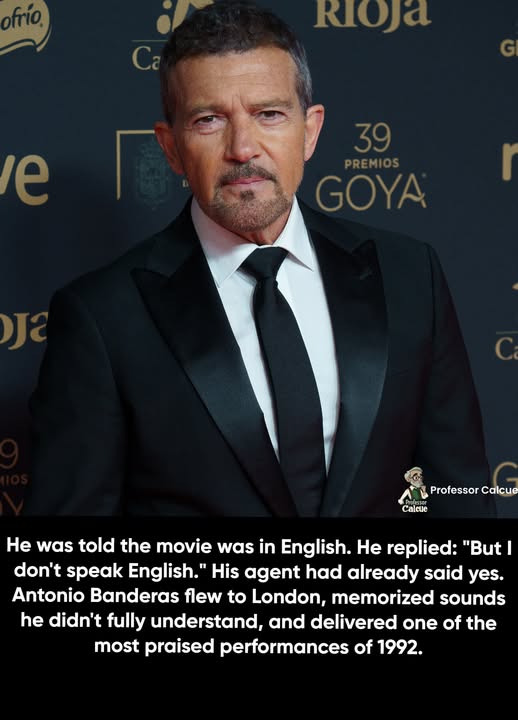
He had moved to Hollywood in 1989 from Málaga, Spain, with a reputation built entirely in Spanish cinema. Eight years of working with director Pedro Almodóvar had made him one of the most exciting actors in Europe — a performer known for physical boldness, emotional honesty, and an instinctive grasp of complicated, difficult characters. Women on the Verge of a Nervous Breakdown had been nominated for the Academy Award for Best Foreign Language Film. European critics celebrated him. Spanish audiences loved him.
None of that translated into English.
And in Hollywood, English was everything.
The opportunity arrived in an unlikely way. During a trip to Los Angeles for the Almodóvar Oscar nomination, someone at a talent agency introduced Banderas to a young Cuban-American who worked delivering coffee in the office. The young man offered to represent him. Banderas barely understood a word of what was being said in the room. He nodded and said yes to everything.
He went back to Spain. Then the phone rang.
There was a film. Based on a Pulitzer Prize-winning novel by Oscar Hijuelos. A director named Arne Glimcher wanted to meet him in London. Banderas asked the obvious question: the movie was in Spanish, right? No, came the answer. It was in English. And his representative had already told the director that Banderas spoke some English.
He did not speak English.
He flew to London anyway.
The meeting with Glimcher happened through a translator. The director told Banderas to spend one month working on his English before a screen test opposite Jeremy Irons. Banderas worked. He took the screen test. He got the role of Nestor Castillo — a young Cuban musician who flees Havana for New York City, chasing music and a lost love — in The Mambo Kings (1992).
Then came the real work.
He learned every line phonetically. Not word by word, with comprehension attached to each one, but sound by sound — the rhythm and shape of syllables in a language he could not yet think in. He worked with a dialect coach throughout pre-production and filming. Direction on set came through translation, through fragments, through watching how other actors responded and calibrating accordingly. He studied his scene partners the way a musician studies a melody — listening for the beat before understanding the words.
The risk was not theoretical. A performance doesn’t hide language gaps. If the sounds came out wrong, or landed at the wrong emotional moment, or carried the wrong weight, it would be immediately visible to every English-speaking person watching. There was no editing trick that fixed a line reading that missed its meaning.
The work held.
Critics praised him with a specificity that made the achievement even more striking. The Los Angeles Times said he gave a ”quietly effective” performance. Newsweek declared that he had learned English for the role, but that you would not know it — that he found all the nuances of charm and self-pity in his character’s melancholic soul. Entertainment Weekly called his performance ”surprisingly confident and subtle.”
He was delivering a performance in a language he did not yet speak. The audience had no idea.
What followed — Philadelphia (1993), Interview with the Vampire (1994), Desperado (1995), The Mask of Zorro (1998), the Spy Kids franchise, the voice of Puss in Boots heard by generations of children around the world — was built on that foundation. A foundation poured not from readiness, but from the decision to act before it arrived.
But what Banderas himself remembered most from those early years was not the performance. It was everything around it. The ordinary moments that the phonetic trick could not fix. Being invited to the homes of actors he admired — Sharon Stone, Tom Hanks, people he had watched for years and finally found himself standing next to — and having nothing to offer back in conversation. Knowing what he wanted to say in Spanish with full precision and nuance, and having none of it available in English. Feeling, as he put it directly, like he might come across as stupid to people who had no way of knowing he wasn’t.
That was the price. Not the performance — he had tools for that, however improvised. The price was the private life on the other side of the set, where no coach could help and no phonetic memorization covered the gap.
He took intensive English courses. His fluency grew. The language that had been a wall became a door, and then a room he lived in comfortably. He eventually gave interviews in English with the kind of relaxed precision that only comes from genuine comfort — not translation, not performance, but actual thought.
In 2019, more than 25 years after The Mambo Kings, Banderas received an Academy Award nomination for Best Actor for Pain and Glory — a Pedro Almodóvar film, in Spanish, playing a character loosely based on the director himself. He had traveled all the way around the world and come back to the language he started in, now carrying everything the years between had given him.
He received the Cannes Film Festival Award for Best Actor for that role. He won the Goya Award — Spain’s highest film honor.
He accepted those awards in a language he had always spoken perfectly.
What his story captures is something worth sitting with. The assumption that preparation must precede opportunity is reasonable. It is also often wrong. Opportunity does not schedule itself around readiness. It arrives on its own timeline, under its own conditions, with a set of requirements you may not yet meet.
The question is not whether you are ready. The question is whether you are willing to learn — even mid-performance, even with the cameras rolling, even when the gap between what you know and what is required is visible enough to fail in front of everyone watching.
Banderas said yes to an English-language film in English he could not speak. He memorized sounds before he understood them. He worked with coaches, studied his scene partners, listened for the beat of scenes he could not fully read. He built from there.
Three decades later, he was still building.