
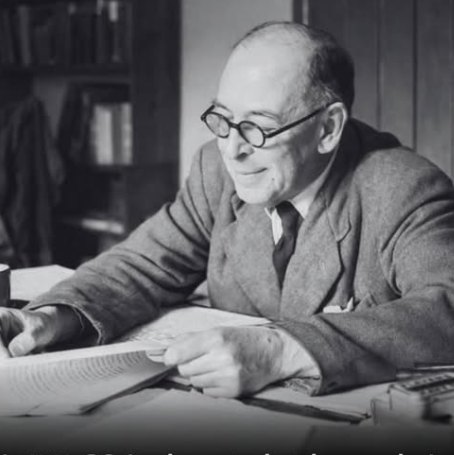
In 1942, a British author sat down and wrote a book from the devil’s point of view.
Not a horror story. Not a fantasy. A quiet, deeply unsettling instruction manual — written as a series of letters from a senior demon named Screwtape to his inexperienced nephew Wormwood, who has been assigned one task: lead a human soul toward ruin.
The book is called The Screwtape Letters. C.S. Lewis wrote it during World War II, in a world without television, without smartphones, without the internet. And somehow, he described the 21st century with a precision that should stop us cold.
Here’s the remarkable part.
Screwtape doesn’t instruct Wormwood to make his target commit terrible crimes. He doesn’t tell him to fill the man’s heart with hatred or drag him toward dramatic, obvious evil.
He tells him something far simpler, and far more effective:
Keep him distracted.
“It doesn’t matter how small the sins are,“ Screwtape explains, “provided that their cumulative effect is to keep the man from… his real end.“
You don’t need to destroy a person. You just need to keep them busy enough that they never get around to becoming who they were meant to be.
Lewis identified two specific weapons Screwtape uses to do this.
The first: jargon instead of thought.
Screwtape advises his nephew not to let the patient evaluate ideas on their merits — whether they’re actually true or false, wise or foolish. Instead, train him to react to labels. To sort every idea instantly into a category and respond accordingly — without ever really thinking.
Reading that in 2025, it’s hard not to feel the recognition land like a stone.
How many ideas do we actually think through anymore? How often do we hear a word — one loaded word — and know immediately, reflexively, whether we’re supposed to agree or dismiss? The label arrives before the argument does, and for most of us, the label is enough. The thinking never begins.
Screwtape would consider that a victory.
But his second weapon is even more powerful, and even more familiar.
He calls it the stream of immediate sense experiences.
Keep the patient’s attention fixed on the immediate. The surface. The constantly moving, constantly refreshing flow of new stimulation. What’s happening right now. What people are outraged about today. The latest news, the newest controversy, the thing that just broke ten minutes ago.
Keep him in the stream — and he’ll never step back far enough to ask the questions that actually matter.
What is true? What is good? What does my life mean? How should I live it?
Lewis was writing about newspapers, radio, and the busyness of modern life when he described that stream.
But think about that phrase again.
The stream of immediate sense experiences.
We literally named it the feed.
The social media feed. The news feed. The infinite scroll that never runs out, never pauses, never asks you to stop and reflect. Just the next thing, and the next thing, and the next thing, each one engineered to hold your eyes for exactly long enough to pull you to the one after it.
Lewis didn’t predict the technology. He predicted the principle behind it.
And then he wrote something even harder to shake:
“The safest road to hell is the gradual one — the gentle slope, soft underfoot, without sudden turnings, without milestones, without signposts.“
That’s what distraction is. A gentle slope.
Not a dramatic fall. Not a sudden choice to abandon everything good. Just an hour on the phone instead of a real conversation. Just one more scroll instead of the book on the nightstand. Just another evening absorbed in the feed instead of being present with the people sitting next to you.
The tragedy isn’t that distraction feels bad. It’s that it feels like nothing at all.
That’s the slope. Soft underfoot. No warning signs.
And here is the truth Lewis was circling, the one that makes this more than just a clever literary connection:
Distraction is never neutral.
Every hour given to the stream is an hour not given to something real. A conversation you didn’t have. A person you didn’t help. A thought you never finished. A version of yourself you never got around to becoming.
We aren’t just “wasting time“ when we disappear into the feed for hours.
We are choosing — passively, habitually, almost without noticing — not to do the good we could be doing.
Screwtape understood that completely.
And Lewis, writing eighty years ago in the middle of a world war, understood it too.
So the question he leaves us with — the one worth sitting with, away from the screen, in actual quiet — is this:
What are you being distracted from?
Not in a vague sense. Specifically. What conversation, what relationship, what meaningful work, what deeper version of yourself is waiting on the other side of the habit of constant scrolling?
Because Screwtape’s strategy only works with our cooperation.
We can close the feed. We can put the phone in a drawer. We can choose, even for one hour, to let our attention belong to us again — and point it toward something that actually lasts.
Lewis believed that where your attention goes, your life follows.
He wrote that in 1942.
We’re still learning whether we believe it in 2025.