
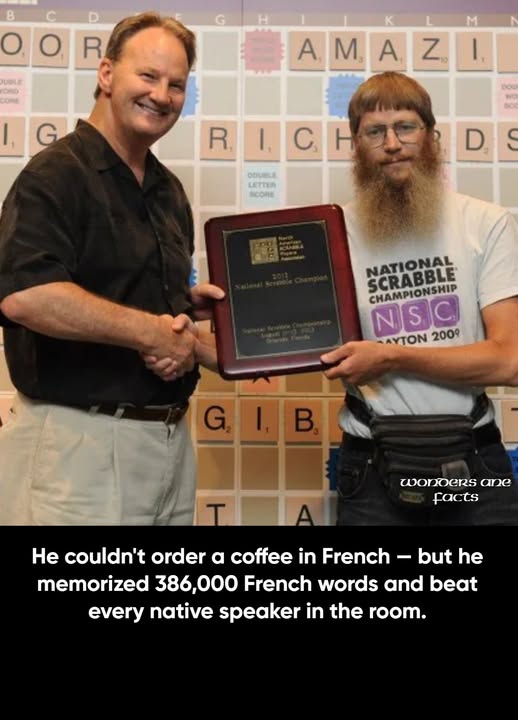
In July 2015, a quiet man from New Zealand walked into a Scrabble tournament in Belgium. He sat down across from the best French-speaking Scrabble players on Earth. He could not ask them how their day was going. He could not read a French menu. By his own friends’ account, he could barely count to ten and say “bonjour.”
Nine weeks earlier, Nigel Richards had decided to do something that no one in the history of competitive Scrabble believed was possible. He would enter the French-language Scrabble World Championship — without speaking a single word of French.
His method was as audacious as it was simple. The French Scrabble dictionary contains roughly 386,000 words — more than double the 187,000 in the North American English version. Richards did not learn what any of them meant. He sat with the dictionary and absorbed the words as pure visual patterns — sequences of letters arranged on a page. He didn’t need to know that “miauler” means “to meow.” He just needed to know it existed and where its letters could land on a board.
How was this possible? People who have known Richards for decades say his brain simply works differently than most. The secretary of his first Scrabble club in Christchurch explained that Richards can look at a page and retain the whole thing, like a photograph. Richards himself once described it more precisely: he can recall images very easily, but only if he’s seen them. If he’s only heard a word, it doesn’t stick. But if he sees it once on a page, he can bring it back.
He won 14 of 17 preliminary games. Then he defeated the previous year’s runner-up in the final. The French Scrabble Federation’s official announcement switched to English just to say: “Congratulations Nigel, you’re amazing!”
But Richards wasn’t finished.
He won the French championship again in 2018, proving the first time was no fluke.
Then he turned his attention to Spanish.
He spent about a year memorizing the Spanish Scrabble word list. When he arrived at the 2024 Spanish World Championship in Granada, native speakers doubted whether a non-Spanish speaker could seriously compete at the highest level. Richards answered by winning 23 of his 24 games. The defending champion, who finished second with 18 wins, called it a humiliation for every native speaker in the competition. The tournament organizer said Richards had simply shut their mouths completely.
One competitor captured what it feels like to face him. He said that when Nigel Richards sits down at a table, everyone loses their nerves — even the biggest champions. That playing against him is like playing against a computer.
What makes Richards truly extraordinary isn’t just the memorization. It’s everything surrounding it. He already held five English-language World Scrabble Championships when he decided to conquer French. He has won nearly 200 tournaments across his career. He once simultaneously held the World, American, and British titles. In competitive Scrabble, there is Nigel Richards, and then there is everyone else.
Yet he does not give interviews. He does not seek attention. He reportedly lives simply in Malaysia, without television or radio, spending hours cycling and studying word lists. When journalists request interviews through his friends, he declines because he doesn’t understand what all the fuss is about. When asked after one tournament what he planned to do next, he mentioned there was a very good library nearby.
His mother once told a New Zealand newspaper something that says everything about how his mind works: she didn’t think her son had ever read a book, apart from the dictionary.
He was introduced to Scrabble at twenty-eight because his mother was tired of him counting cards when they played the card game 500. She thought Scrabble would be harder for him because he’d never been good at English in school. She was wrong. He joined a local club in Christchurch and was very soon beating everyone there. For his first national championship in 1997, he cycled 220 miles to the tournament — and won.
Nigel Richards doesn’t see words the way you and I do. He doesn’t see meaning. He sees structure. He sees possibility. He sees patterns where others see a foreign language, and solutions where others see an impossible wall.
He reminds us of something we too easily forget: that the boundaries we accept are often the boundaries we build. He didn’t speak French. He didn’t speak Spanish. He didn’t need to. He found another path — one built on discipline, memory, and the quiet certainty that what everyone else called impossible was simply a problem he hadn’t solved yet.
The next time you tell yourself something can’t be done, remember the man who memorized hundreds of thousands of words he couldn’t understand and defeated every native speaker in the room.
Then ask yourself what you might accomplish if you stopped believing in the wall.