
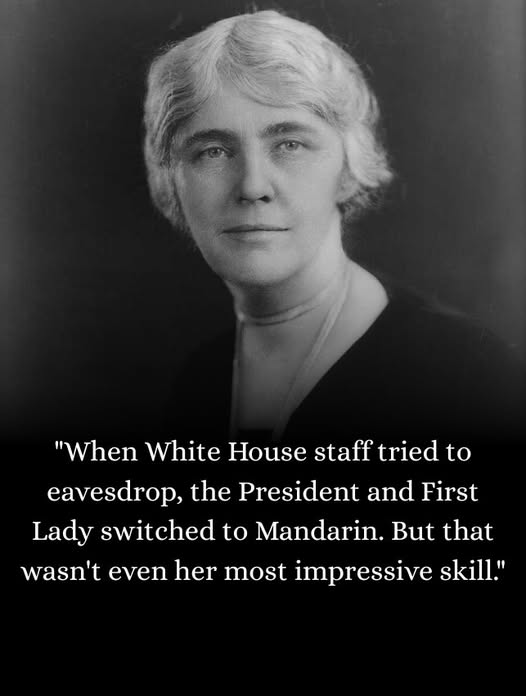
When White House staff tried to eavesdrop, the President and First Lady switched to Mandarin. But that wasn’t even her most impressive skill.
Tianjin, China.
Lou Henry Hoover crouched in a makeshift bunker as bullets ricocheted off the walls outside. The Boxer Rebellion had turned the city into a war zone. She was 25 years old, newly married, and under siege.
Most American women would have fled at the first sign of danger. Lou grabbed a rifle and helped defend the foreign quarter.Between firefights, she treated wounded soldiers. She organized food distribution. And every night, she sat with her husband Herbert and studied Mandarin by candlelight—because if they were going to live in China, they were damn well going to speak the language properly.
This wasn’t a woman who did anything halfway.Lou Henry had been the first woman to earn a geology degree from Stanford University in 1898. At a time when women were expected to study literature or domestic science, she was cracking rocks with hammers and analyzing mineral compositions in labs.
She met Herbert Hoover in a geology lab. He was the only male student who didn’t treat her like she was lost.
They fell in love over rock samples and geological surveys.After graduation, Herbert got a job as a mining engineer that would take him around the world. He proposed by telegram from Australia. Lou said yes without hesitation.
Their honeymoon was a steamship to China.For the next 20 years, the Hoovers lived wherever mining took them—China, Australia, Burma, Russia, Egypt. Lou could have stayed in California, waiting for her husband to visit between assignments.
Instead, she learned mining engineering alongside him. She became fluent in Mandarin, and later picked up enough Latin to translate Renaissance texts.
In 1900, during the Boxer Rebellion siege, Lou and Herbert used their Mandarin skills to communicate with Chinese Christians seeking refuge. While other foreigners huddled in fear, the Hoovers built trust through language.
Years later, when Herbert became President in 1929, White House staff noticed something strange.Sometimes, mid-conversation, President and Mrs. Hoover would switch to rapid Mandarin. Servants couldn’t understand. Advisors were baffled. The press speculated about “secret communications.”
It wasn’t sinister. It was just a couple who’d learned to speak privately in a language they’d studied together 30 years earlier while under literal gunfire.
But Lou Hoover’s greatest intellectual achievement had nothing to do with politics.
In 1907, the Hoovers were living in London when Herbert brought home a problem. He’d been reading De Re Metallica—a massive 1556 Latin text by Georgius Agricola about mining and metallurgy. It was the most important book in the history of mining engineering.
But there was no complete English translation. The Latin was dense. The technical terminology was archaic. Professional translators had tried and failed for centuries.“We should translate it,“ Lou said.
Herbert thought she was joking. She wasn’t.
For the next five years, Lou Hoover sat in libraries across Europe, translating 16th-century Latin into English. Not just the words—the meaning. Renaissance mining terms that hadn’t been used in 300 years. Chemical processes described in language that predated modern chemistry.
Herbert handled the technical explanations—how the smelting processes actually worked, what the engineering diagrams meant. Lou handled the Latin, turning complex Renaissance prose into clear, readable English.
In 1912, they published their translation. It was 640 pages. It had detailed footnotes explaining every technical term. It included reproductions of Agricola’s original woodcut illustrations.
It immediately became the standard English edition.
Today—over 110 years later—it’s still the standard edition. Historians, engineers, archaeologists, and mining scholars still use the Hoover translation. No one has matched it.
The Mining and Metallurgical Society of America called it “the greatest translation ever made of a technical work.”
Think about that. A First Lady produced scholarship that’s still cited by experts a century later.
Lou Hoover didn’t translate De Re Metallica to boost her husband’s political career—he wasn’t in politics yet. She did it because she was a geologist who wanted to read the most important book in her field, and she refused to let the fact that it was written in 16th-century Latin stop her.
When Herbert Hoover became President in 1929, Lou was one of the most academically accomplished First Ladies in American history.
She’d survived a war. Learned Mandarin. Earned a geology degree when universities barely admitted women. Produced a scholarly translation that’s still used today.
But here’s what makes Lou Hoover’s story remarkable: nobody talks about her.
History remembers Herbert Hoover—usually negatively, because of the Great Depression. But Lou? She’s a footnote. “The president’s wife.”
She was so much more than that.
She was a geologist. A linguist. A scholar. A survivor. A woman who chose adventure over comfort, learning over leisure, and intellectual challenge over social expectation.
In 1899, while bullets flew outside, she studied Mandarin by candlelight.
In 1912, she published a translation that no professional scholar has been able to improve in over a century.
In 1929, she spoke Mandarin in the White House because she and her husband had built a life based on shared curiosity and intellectual partnership.
Lou Henry Hoover died in 1944.
Her translation of De Re Metallica is still in print. Still cited in academic papers. Still used by researchers trying to understand Renaissance mining techniques.
The first woman to study geology at Stanford built a legacy that outlasted her husband’s presidency, her own lifetime, and every expectation anyone ever had for a “First Lady. ”She wasn’t just the President’s wife. She was one of the most remarkable scholars of her generation. And it’s time we remembered her that way.