
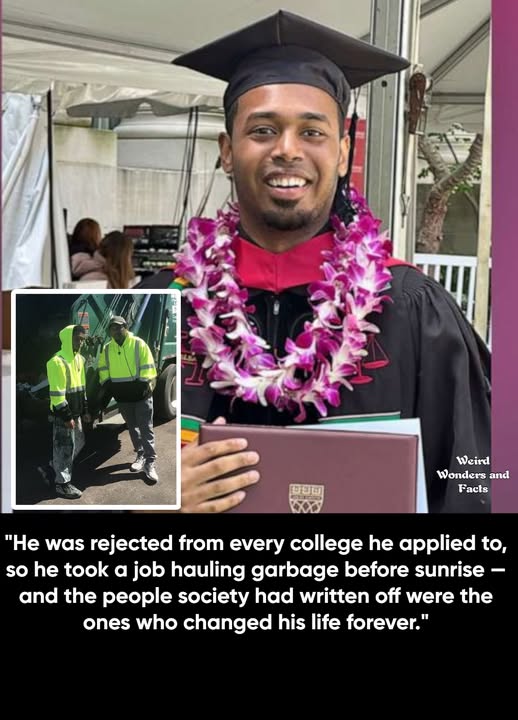
He was rejected from every college he applied to, so he took a job hauling garbage before sunrise — and the people society had written off were the ones who changed his life forever.
Until he was eight years old, Rehan Staton had a good life. He grew up in Bowie, Maryland, in a stable, middle-class home. He went to private school. He had two parents, a big brother named Reggie, and every reason to believe the future would be kind.
Then his mother left. She moved out of the country and didn’t come back.
Overnight, everything unraveled. Rehan’s father, now raising two boys alone, worked as many as three jobs at a time just to keep the lights on. Sometimes there wasn’t enough food. Sometimes the heat went out in winter, and Rehan slept in a heavy jacket because there was no other way to stay warm. His grades collapsed. The anger and hunger followed him into every classroom.
When a teacher suggested Rehan be placed in remedial classes, his father refused to accept it. He found an aerospace engineer at a local community center who offered to tutor Rehan for free. Within months, the boy was back on the honor roll. The teacher who had recommended remedial classes wrote his father an apology.
Rehan poured himself into boxing and martial arts through high school, winning national competitions and dreaming of going pro. Then, during his senior year, he suffered severe rotator cuff injuries in both shoulders. Without health insurance, physical therapy wasn’t an option. His path to professional sports was gone.
He scrambled to apply to colleges. Every single one rejected him.
So at eighteen years old, with no degree, no prospects, and a family struggling to survive, Rehan Staton took a job at Bates Trucking & Trash Removal. He collected garbage. He cleaned dumpsters. He started work before the sun came up.
Most of his co-workers were older men. Many were formerly incarcerated. Society had largely written them off. But these were the people who did something no teacher, no church leader, no guidance counselor had ever done for Rehan — they looked at him and saw potential.
They told him he was smart. They told him he was too young to be there. They said go to college, and if it doesn’t work out, this job will still be here.
It was the first time in his life that anyone outside his family had believed in him.
One of his co-workers connected him with the owner’s son, Brent Bates, who helped Rehan reach out to a professor at Bowie State University — a school that had previously rejected him. The professor was impressed and helped convince admissions to reverse their decision.
Then Rehan’s older brother Reggie made a decision that would alter the course of both their lives. Reggie was already enrolled at Bowie State. He saw the promise in his younger brother. And he dropped out of college so that Rehan could attend instead. Reggie went back to work to support their father and keep the family afloat — sacrificing his own education so his little brother could have a chance.
Rehan did not waste that chance.
He earned a 4.0 GPA. He transferred to the University of Maryland. He became president of the undergraduate history association, served on the dean’s cabinet, and was chosen as the commencement speaker for the class of 2018. The entire time, he kept working sanitation — waking before dawn to collect trash and clean dumpsters from 4 a.m. to 7 a.m., then rushing to class. Sometimes there was no time to shower between shifts, and he would sit in the back of the lecture hall in his yellow sanitation uniform, hoping no one would notice.
Then his father suffered a stroke. Rehan and Reggie both returned to work at the trash company to save their home and cover medical bills. Even then, Rehan didn’t stop. He graduated, took a job at a political consulting firm in Washington, D.C., studied for the LSAT, and applied to law schools.
He was accepted to the University of Southern California, Columbia, the University of Pennsylvania, Pepperdine — and Harvard Law School.
When the news went viral, Rehan was uncomfortable with how the media framed it. The headlines all said the same thing: “Garbage Man Gets Into Harvard.” But that wasn’t the story he wanted to tell. He wasn’t self-made. He said so himself. His father worked three jobs. His brother gave up his own education. Sanitation workers — men the world had discarded — were the first to lift him up. A tutor volunteered his time for free. A professor fought to get him admitted. A co-worker’s boss opened a door.
Then filmmaker Tyler Perry saw the story and offered to pay Rehan’s tuition at Harvard.
At Harvard Law, Rehan didn’t forget where he came from. During his second year, he was walking to class and greeted a custodian in the hallway. The woman looked stunned and said she was sorry — she didn’t realize he was talking to her. Students, she said, usually looked at the wall rather than acknowledge her.
That moment stayed with him. Rehan used savings from his summer law firm job to buy gift cards for every custodian, food service worker, and support staffer at the law school. He wrote each one a handwritten thank-you note. And he founded an initiative called The Reciprocity Effect — an organization dedicated to recognizing and honoring the service workers who keep universities and institutions running but are too often invisible.
In May 2023, Rehan Staton graduated from Harvard Law School.
When reporters asked him about his journey, he didn’t talk about grit or willpower or pulling himself up by his bootstraps. He said something that cut straight to the truth of it all: “Although I get credit for working hard, working hard was the easy part because that I could control. I just happened to be around people who cared enough about me.”
Rehan Staton’s story isn’t really about one man beating the odds. It’s about what happens when the people the world overlooks — a struggling father, a selfless brother, a group of sanitation workers with criminal records — choose to believe in someone. And what happens when that someone spends the rest of his life making sure he never forgets it.
Not every hero wears a suit. Some of them wear yellow sanitation uniforms and start work before the sun comes up.