
Twelve men sat down to breakfast knowing their meal was poisoned—and they ate it anyway, three times a day, for five years.
Today, we open our refrigerators without fear. We pour milk for our children without hesitation. We scan ingredient labels out of habit, not desperation. But there was a time in America when every meal was a gamble.
If you walked into a grocery store in 1902, you would find no expiration dates, no ingredient lists, and very little truth. Milk often contained formaldehyde—the same chemical used to preserve corpses—added to keep it from spoiling in the summer heat. Butcher’s meat gleamed bright red, not from freshness, but from borax dust used to hide the gray of decay. Canned vegetables sparkled with copper sulfate, and candy glittered with lead and mercury.
This wasn’t a scandal at the time; it was standard business practice.
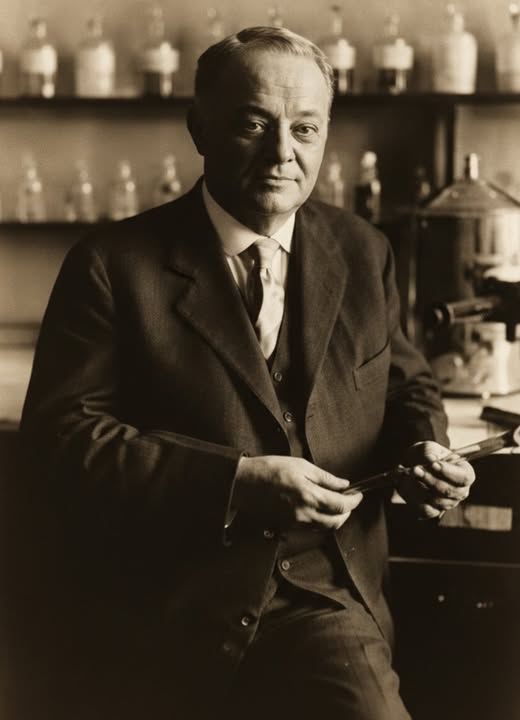
Dr. Harvey Washington Wiley, chief chemist at the Department of Agriculture, carried this knowledge like a weight on his chest. He knew families were unknowingly feeding poison to their children at every meal, and there was no law—none—to stop companies from doing it.
He needed proof. He needed real, undeniable evidence that these “preservatives“ were destroying human bodies. So, in the basement of his Washington, D.C. office, he did something radical: he set up an elegant dining room with white tablecloths and fine china, and put out a call that stunned the nation.
He needed twelve healthy young men willing to eat poison for science.
The terms were brutally honest: free meals three times a day in exchange for consuming measured doses of borax, formaldehyde, salicylic acid, and sulfurous acid—the very chemicals hidden in America’s food supply. They would be human test subjects in an experiment with no precedent and no guarantee of survival. They even had to sign away their right to sue if the experiment killed them.
Dr. Wiley expected silence, or perhaps a few desperate souls. Instead, people lined up. Government clerks, college students, and postal workers raised their hands. They weren’t reckless; they were patriots who understood that someone had to prove the truth.
The press gave them a name that echoed across the country: The Poison Squad.
At first, the meals looked normal—roasted chicken, fresh bread, and vegetables. The chemicals were hidden inside the food. Later, to ensure exact dosages, the men swallowed gelatin capsules filled with the toxins. They tried to keep their spirits up, joking about their “daily dose of death,“ but as weeks became months, the laughter died away.
The poison did exactly what Dr. Wiley feared. Healthy young men turned pale and gaunt. They lost their appetites, and their weight melted away—ten, fifteen, twenty pounds. They suffered from violent nausea, splitting headaches, and stomach cramps so severe some could barely stand. They were being slowly destroyed in plain sight for all of America to witness.
Every morning they were weighed, and every day they provided medical samples. The humiliation was matched only by the physical agony. Yet, not one man quit.
Newspapers ran daily updates. Headlines screamed about their suffering. A popular song even mocked their misery: “O, they may look dead, but they don’t die / They’re only experimentin’ / For the Pure Food Law they’re inventin’.“
To the public, it was entertainment. To the men at that table, it was torture endured for strangers—for children not yet born and families a century into the future.
The food industry watched with growing panic. They had everything to lose, so they sent observers to find flaws and hired armies of lawyers and lobbyists. They published articles claiming these chemicals were perfectly safe. But the evidence mounted like an avalanche.
After five brutal years, Dr. Wiley had to stop the experiments; the men were simply too sick to continue. But he finally had what he needed: scientific proof that these “harmless“ preservatives were destructive.
The results shocked the nation into action. The food industry fought back with money and power, but they couldn’t overcome the image of those twelve young men who sacrificed their health for the truth.
In 1906, the Pure Food and Drug Act became law—the first federal regulation of food and drugs in American history. For the first time, companies had to list ingredients and could no longer lie about what was in the bottle. This became the foundation of the FDA, the agency that now protects over 330 million Americans.
Dr. Wiley had won, but the victory belonged to the young men who sat at his table. They returned to their quiet lives and never sought fame or monuments. They volunteered because they believed ordinary people deserved to know what they were feeding their families.
Every time you flip over a box to read the ingredients, you are seeing their legacy. Every time you check an expiration date, you are protected by their sacrifice. You can trust that your food won’t kill you because of the foundation they built with their suffering.
They took the poison so we wouldn’t have to.
The next time you glance at a nutrition label, pause for just a moment. Remember that twelve men willingly destroyed their health so you could have that simple piece of paper. They didn’t march or petition; they sat down, picked up their forks, and ate poison—three times a day, for five years.
Because of that quiet, terrible courage, we get to eat our breakfast in peace. Their sacrifice deserves to be remembered.
(Tom: We might be able to eat our breakfast in peace, providing it does not include nitrate loaded meats, margerine or cooked in seed oils. And despite the efforts of the people in this article we now need to read the labels on foods and be informed as to the dangers contained in all too many of those ingredients!)