
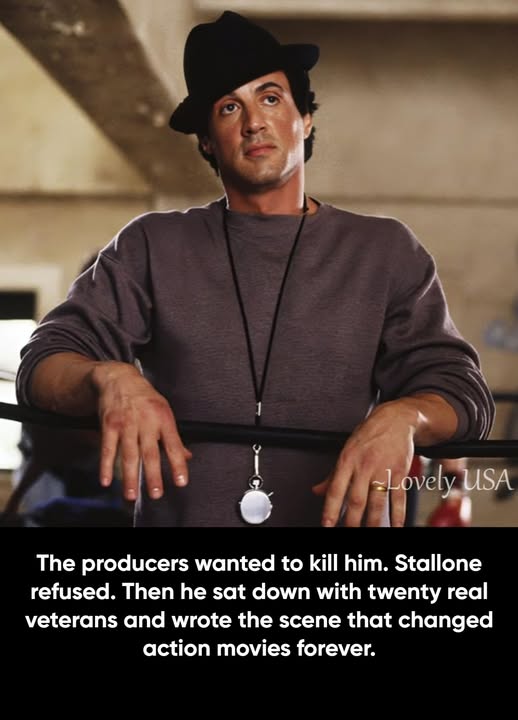
The producers wanted to kill him. Stallone refused. Then he sat down with twenty real veterans and wrote the scene that changed action movies forever.
When Sylvester Stallone signed on to star in First Blood in 1982, the ending was already written. John Rambo was supposed to die. In the original script, based on David Morrell’s 1972 novel, Colonel Trautman would shoot Rambo in the police station. Credits roll. The end.
Kirk Douglas, who was originally cast as Trautman, demanded that Rambo die. He believed it was the only artistic choice. Stallone disagreed. The two clashed so intensely that Douglas quit the production. Richard Crenna was brought in to replace him at the last minute.
But Stallone wasn’t just fighting over a plot point. He was fighting for something bigger.
He told the producers directly that if Rambo died, every Vietnam veteran watching the film would walk away with the same message: the only thing waiting at the end is death. He refused to let that stand.
So he rewrote the ending himself.
He sat down and conducted twenty interviews with real Vietnam veterans. He listened to their stories about coming home to a country that didn’t want them. About the nightmares that never stopped. About friends who died in their arms from booby traps and bombs. About the guilt of surviving when others didn’t.
Then he took everything he heard and compressed it into a single monologue. A stream of consciousness that would come pouring out of a character who had barely spoken a word for the entire film.
When the scene was filmed, Rambo — cornered in the police station, surrounded by armed men — finally broke. For four raw minutes, Stallone delivered one of the most emotionally devastating performances in action movie history. He talked about friends who never came home. A buddy named Danforth who dreamed about cruising Las Vegas in a red 1958 Chevy convertible. A shoeshine boy in Saigon whose box was wired with explosives. The moment everything changed and could never be put back together.
The producers didn’t want the scene. They told Stallone to cut it. He refused.
The first cut of First Blood was three hours long and more drama than action. Stallone hated it so much he reportedly tried to buy the negative just to destroy it. But they kept cutting, reshaping, tightening, until the film became a lean ninety-minute experience where Rambo’s near-total silence made that final monologue hit like a freight train.
When the film screened for a test audience in Las Vegas, they loved it. But when they screened the original ending where Rambo dies, the audience turned hostile. One voice reportedly said that if the director was in the theater, he should be strung up from the nearest lamppost.
The ending with the monologue stayed. Rambo lived.
Years later, the author of the original novel said something remarkable. He said that Rambo’s emotional breakdown in that scene had helped save the marriages of countless Vietnam veterans. Men who had never been able to express what they carried inside watched Stallone weep on screen and, for the first time, learned how to cry again.
Stallone didn’t channel his own Hollywood rejections into that scene. He channeled the real voices of men who had been silenced by a war and forgotten by their country. He fought the producers, fought the director, fought the original ending, and won — not for himself, but for every veteran who needed to hear that their pain was real and that someone was listening.
He later told The Hollywood Reporter that all he wanted was for people to leave the theater with some sense of hope. He said he didn’t want his heroes to die.
That’s why the scene still hits forty years later. It wasn’t acting. It was testimony.