
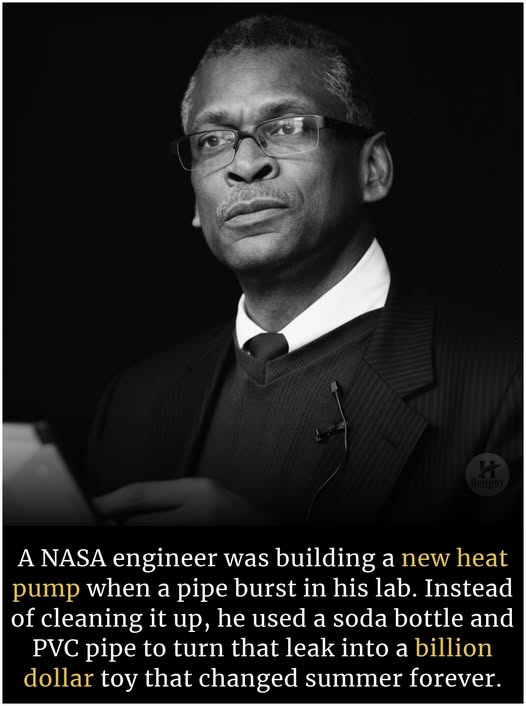
In 1982, a NASA engineer’s malfunctioning heat pump shot water across his bathroom and into history. Instead of cursing the mess, he saw an opportunity that would change the world of play forever.
Lonnie Johnson was a brilliant aerospace engineer working for the Jet Propulsion Laboratory. He spent his days solving complex problems for spacecraft, but his off-hours were spent in his home workshop.
He was experimenting with an environmentally friendly heat pump that used water instead of hazardous chemicals. It was a serious scientific pursuit aimed at modernizing home cooling systems.
But during a test, a high-pressure nozzle burst and sent a powerful stream of water arching across the room. The force was unlike anything available on the toy market at the time.
He watched the water hit the wall with incredible pressure. He saw the potential. He saw a way to bring high-tech physics to his own backyard.
Lonnie didn’t just see a leak. He saw the future of fun. He saw a chance to create something legendary.
However, the path from a bathroom leak to a toy store shelf was not an easy one. Lonnie took his prototype to several toy companies, only to be met with constant rejection.
For seven long years, he heard the word “no.“ Major manufacturers didn’t think parents would pay for a high-powered water gun, or they simply didn’t understand his vision.
He faced skeptics. He faced financial hurdles. He faced a market that wasn’t ready for a 2-liter soda bottle attached to PVC piping.
But he refused to give up on his invention. In 1989, he finally found a partner in a small company called Larami Corp.
The legendary meeting that sealed the deal with Larami Corp. is a piece of toy history. Lonnie Johnson didn’t just walk in with a sales pitch; he walked in with a suitcase.
When he opened that suitcase, he pulled out his homemade prototype. It was a crude-looking device made of PVC pipe, Plexiglas, and a recycled soda bottle.
He didn’t need a PowerPoint presentation. He simply pumped the handle and fired a high-powered stream of water across the boardroom.
The executives were stunned. They had never seen that kind of range or power in a handheld toy.
The toy was first released in 1990 as the “Power Drencher,“ but sales were modest. It wasn’t until a rebranding in 1991 that the world finally took notice.
Once it was renamed the Super Soaker, the gadget became a cultural phenomenon, generating $200 million in sales in just one year.
The boy who used to take apart his toys to see how they worked had now created the most successful water gun in history. His persistence turned a lab mistake into a billion-dollar legacy.
Today, Lonnie holds over 100 patents and remains a titan of American innovation. His story reminds us that sometimes, life’s biggest leaks lead to its greatest rewards.
One accidental splash changed the face of summer fun for generations.
Later in life, Lonnie successfully sued for $73 million in unpaid royalties from Hasbro, ensuring his financial legacy matched his creative one. He continues to use his wealth to fund research into green energy technology.
His workshop is still a place where accidents are treated as discoveries.
Sources: National Inventors Hall of Fame / Smithsonian Magazine