
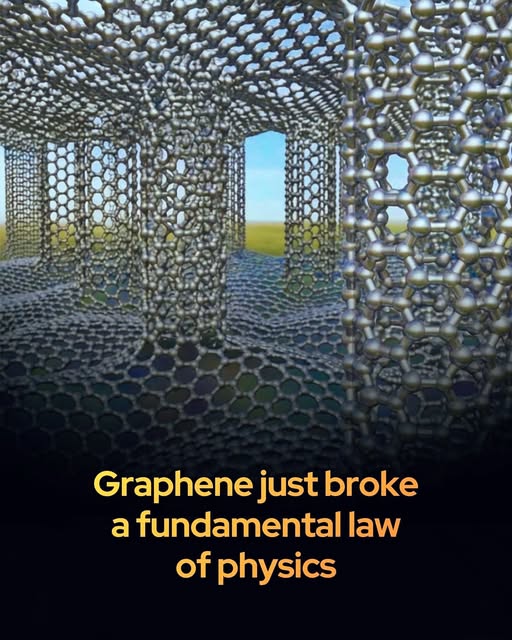
Electrons in graphene have done something physicists thought was impossible. They were seen flowing like a nearly perfect quantum liquid; one so strange, it defies the rules taught in physics textbooks for over a century.
This happened at a critical point in graphene called the Dirac point. At that moment, the material isn’t quite a metal, nor an insulator; and inside it, electrons stop acting like individual particles. They move together, like water. Only smoother.
Researchers measured a viscosity so low, it’s closer to the early-universe plasma created in particle colliders than anything we see in solid matter.
But the real shock? Heat and electric charge went their separate ways.
In every ordinary metal, heat and electricity flow together, following a rule known as the Wiedemann-Franz law. But in graphene’s quantum fluid, that law completely breaks down. The researchers saw the biggest violation ever measured: more than 200 times off the expected value.
That makes graphene more than a material. It’s a window into the quantum universe. A single sheet of carbon atoms, one layer thick, behaving like a testbed for black hole physics, quark-gluon plasma, and quantum entanglement. Things once thought untouchable outside particle accelerators or astrophysics.
And there may be practical uses, too. This kind of ultra-clean, ultra-responsive quantum behavior could power a new generation of sensors that detect vanishingly small electrical or magnetic signals.
Read the study:
“Universality in quantum critical flow of charge and heat in ultraclean graphene.” Nature Physics, 13 August 2025