
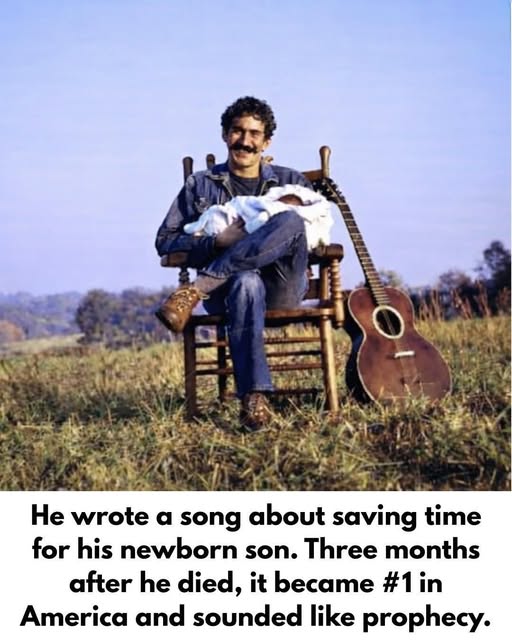
He wrote a song about saving time for his newborn son. Three months after he died, it became number one in America and felt like a warning from the future.
In September 1971, Jim Croce held his newborn son for the first time. The feeling was heavy and unreal at the same time. A.J. was small, perfect, and completely dependent on a father who was often away from home.
Jim sat down with his guitar and began to think. He thought about all the moments he would miss. First steps, first words, and bedtime stories were already slipping away. The road always pulled him from home, and music demanded everything from him. But now, holding his son, Jim wanted something music had never given him. He wanted time.
So he started to write the song. The first line came quietly, almost like a whisper from the heart.
“If I could save time in a bottle…”
The melody was soft, like a lullaby meant to calm a child. The words were a father’s wish, gentle but impossible. He wanted to save every moment and make days last forever. He wanted the clock to slow down and give him a chance to stay.
“It was a prayer more than a song,” his wife Ingrid later said. Jim Croce understood how cruel time could be because he had spent years chasing a dream while time kept moving on.
The long road before success was not easy. Before fame, Jim Croce lived a hard and simple life. He hauled lumber, drove trucks, and taught at small colleges. He did whatever he could to survive while chasing music that few people noticed.
He played in smoky bars where people talked through his songs. Late at night, he packed up his guitar and drove home alone, wondering if any of it mattered. Once, he said, “Every song I write is like a little movie. Only mine ends in diners and bars instead of sunsets.”
His songs were filled with people America would later love. There were dreamers in dive bars and hustlers with bad reputations. There were telephone operators connecting broken hearts and ordinary people living fragile lives. Then, in 1972, everything finally changed.
When fame arrived, it came quickly. “You Don’t Mess Around with Jim” hit the radio and felt honest and familiar. People heard something real in his voice, shaped by struggle and lived experience. “Operator (That’s Not the Way It Feels)” touched hearts across the country, and “Bad, Bad Leroy Brown” played everywhere.
For the first time, Jim Croce was not just getting by. He was succeeding, but fame did not feel like home. The stages were loud, and the crowds were large. Jim was tired of hotels and tired of being away from Ingrid and A.J. He was tired of missing his son’s childhood for short songs.
He wrote letters home from the road. “I’m tired of being away from you and the boy. When this tour ends, I’m coming home for good.” He was thirty years old and ready to slow down. He told himself it would be just one more tour, then home, then time. Enough time at last.
He never made it home. On September 20, 1973, Jim finished a concert at Northwestern State University in Natchitoches, Louisiana. The crowd loved him, and he felt tired but satisfied. There were only a few more shows left before he could return home.
He boarded a small charter plane with five others, including his guitarist, Maury Muehleisen. Minutes after takeoff, the plane hit a pecan tree in the darkness and crashed. Everyone on board died instantly, and a deep silence followed.
When time stopped for Jim Croce, the song began to live. “Time in a Bottle” had been recorded in 1972 but was never released as a single. It stayed quietly on an album until after his death. When the song was used in a film, radio stations began to play it, and people listened in a new way.
“If I could save time in a bottle
If I could make days last forever
If words could make wishes come true…”
Three months after Jim Croce died, “Time in a Bottle” reached number one in America in December 1973. The song he wrote for his son became a song for anyone who had lost someone too soon. What once sounded gentle now felt like a prediction.
Jim Croce never got more time, but he gave something lasting to others. His songs still play in kitchens where couples dance slowly. They come through car radios on long drives and speak to anyone who has wished for one more day or one more chance.
His son, A.J. Croce, grew up to become a musician as well. The child Jim wrote the song for now plays his father’s music and keeps it alive. Jim sang for dreamers, struggling artists, and fathers who just wanted to come home.
His life ended too soon, but his voice continues to be heard. “Time in a Bottle” reminds us that we never have as much time as we think. Jim Croce spent years chasing success, and when it finally came, he was ready to choose something more important.
He never got that chance, but his song became a gift. It reminds us not to wait, not to assume tomorrow is promised, and not to trade what matters most for what only feels urgent. Jim Croce showed that a person does not need a long life to leave a lasting mark.
He wanted to save time in a bottle for his son. Instead, he saved a moment for all of us. It is a short song with a lasting message that time is the one thing we can never get back, so we should use it while we still can.