
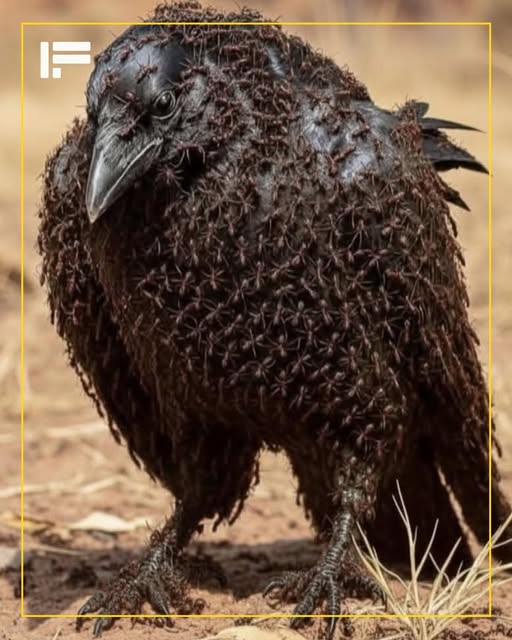
When a crow feels unwell, irritated, or burdened by parasites, it doesn’t panic. It doesn’t flee. And it doesn’t rely on chance.
Instead, it seeks out an ant colony.
This behavior, strange at first glance, is one of the most elegant examples of natural intelligence in the animal world. Rather than hunting the ants, the crow deliberately allows them to crawl across its body. What looks like surrender is actually strategy.
The crow spreads its wings, lowers itself to the ground, and positions its feathers carefully. It remains mostly still, shifting only slightly, as ants swarm over its body. This is not accidental. The crow knows exactly what it is doing.
As the ants move through the feathers, they release formic acid, a chemical they naturally produce as a defense mechanism. For the crow, this substance acts as a powerful, natural disinfectant. Formic acid helps kill bacteria, fungi, mites, lice, and other parasites that can weaken birds over time. It also reduces irritation and may soothe inflamed skin beneath the feathers.
Scientists call this behavior anting, and it has been observed in over 200 bird species, including crows, jays, starlings, and sparrows. There are two main forms. The first, known as passive anting, is when the bird simply lies down and allows ants to crawl freely through its feathers. The second, active anting, is even more remarkable.
In active anting, the crow picks up individual ants in its beak and deliberately rubs them onto specific areas of its body, especially under the wings and along hard-to-reach feather lines. Before doing so, the bird often squeezes the ant gently, triggering the release of formic acid before application. The motion closely resembles how humans apply topical medicine.
This is not instinctive chaos. It is targeted treatment.
Researchers believe anting serves multiple purposes. It helps control parasites, may inhibit the growth of harmful microorganisms, and could even help condition feathers by neutralizing substances that interfere with preening oils. Some studies also suggest it may provide relief during molting, when new feathers cause discomfort and itchiness.
What makes this behavior extraordinary is that the crow is not born knowing chemistry. Yet through observation, evolution, and learning, it has mastered a biological partnership that functions like a living pharmacy. The ants defend themselves. The crow heals itself. Neither species invents the system, yet both benefit from its existence.
This knowledge is not written anywhere. It is passed down silently, generation to generation, through behavior rather than language.
In a world that often underestimates animals, anting is a quiet reminder that intelligence does not always look like problem-solving puzzles or tool use. Sometimes it looks like knowing exactly where to go when your body is failing you.
The crow does not call it medicine.
But it works.