
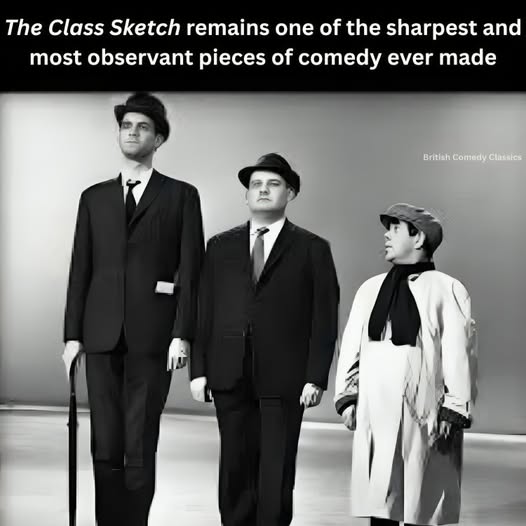
First broadcast in 1966 on The Frost Report, The Class Sketch remains one of the sharpest and most observant pieces of British television comedy ever written. In barely two minutes, it manages to expose the absurdities and cruelties of the British class system with a precision that many longer dramas have failed to match.
Performed by John Cleese, Ronnie Barker and Ronnie Corbett, the sketch uses height as its central visual joke. Cleese’s tall, patrician figure represents the upper class, Barker’s average build the middle class, and Corbett’s small stature the working class. Their physical positioning does most of the work before a word is spoken.
The dialogue is deceptively simple. Each character explains how they view those above and below them, culminating in Corbett’s perfectly judged line: “I know my place.” When the others list what they “get” from the class system — superiority, status, security — Corbett’s character quietly concludes: “I get a pain in the back of my neck.” It’s a punchline that lands because it’s funny, but also because it’s painfully true.
What makes the sketch so enduring is its economy. Written by Marty Feldman and John Law, it avoids topical references and instead focuses on something deeply ingrained in British culture. The humour doesn’t rely on fashions or politics of the moment; it relies on attitudes that, for many viewers, still feel familiar.
More than half a century on, the sketch continues to be referenced because Britain’s relationship with class has never quite loosened its grip. Accents, education, wealth and background still shape opportunity and perception. The idea that people instinctively “look up” or “look down” remains embedded in everyday life, even if the symbols have changed.
That’s why The Class Sketch still feels relevant today. It has been cited in discussions about politics, inequality and even football, and it continues to circulate online among audiences far younger than its original viewers. Its brilliance lies in how effortlessly it reveals a system that many would rather pretend no longer exists.
Ultimately, The Class Sketch endures because it does what the best comedy always does: it tells the truth quickly, clearly, and with a laugh. It is not just one of the funniest sketches ever made, but one of the most perceptive — a reminder that while Britain has changed in countless ways since 1966, its uneasy relationship with class remains stubbornly intact.