
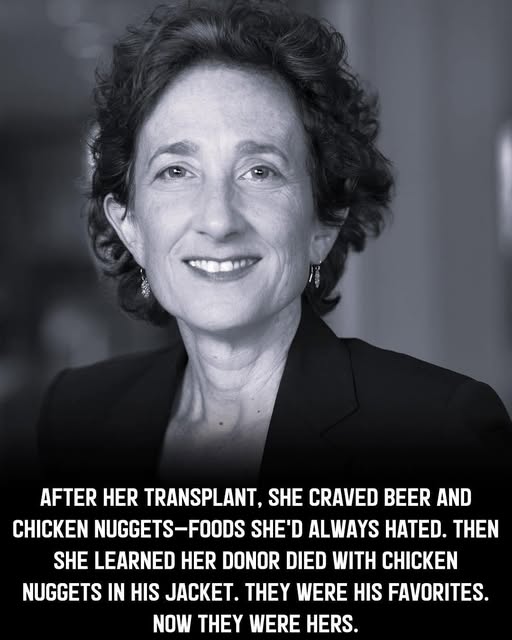
She woke up craving beer. She’d never liked beer. Then came the chicken nuggets. And the green peppers. And a walking stride that wasn’t hers. Inside her chest: the heart of an 18-year-old boy who died with chicken nuggets in his jacket. What happened next made doctors run when they saw her.
May 1988. Claire Sylvia was dying.
At 47, the professional dancer could barely breathe. Primary pulmonary hypertension—dangerously high blood pressure in her lungs—was killing her. Her heart was failing from the strain.
Without a transplant, she had weeks. Maybe days.
Then Yale-New Haven Hospital called. They had a donor. Heart and lungs. She’d be the first person in New England to receive both organs at once.
The surgery took three hours. When she woke up, a reporter asked what she wanted most now that she’d received this miracle.
“Actually,” Claire heard herself say, “I’m dying for a beer right now.”
The words shocked her as they left her mouth.
She had never liked beer.
That was just the beginning.
Within days of leaving the hospital, Claire stopped at Kentucky Fried Chicken—something she’d never done before—and ordered chicken nuggets. With green peppers.
She’d always hated green peppers. Would pick them out of any salad.
Now she craved them.
Her daughter noticed her walk had changed. Claire moved differently—a heavier, more lumbering stride. More masculine.
Her energy exploded. At 50, she backpacked through Europe, something the delicate dancer she’d been would never have considered.
She felt restless. Hyperactive. Like her heart was running faster than it should.
And she kept having the same dream.
A young man. Tall. Sandy hair. The initials T.L.
In one dream, she kissed him and inhaled him into her body.
She woke up knowing—somehow knowing—that Tim L. was her donor.
But transplant recipients are never told their donors’ names. Privacy laws protect both families.
The hospital refused to tell her anything except that the donor died in a motorcycle accident in Maine.
Claire couldn’t let it go.
Nine months after the transplant, she had another dream. In it, her friend Fred Stern dreamed about an obituary for Tim L. the night before they met at a local theater.
When she told Fred about the dream, he was stunned. He’d had the exact same dream.
They went to the public library together and searched through Maine newspapers from the week before her transplant.
And there it was.
Timothy Lamirande. Age 18. Saco, Maine. Killed in a motorcycle accident. The day before her transplant.
Claire stood there reading and felt her knees go weak.
Tim L. from her dreams was real.
She wrote to the Lamirande family. Asked if she could meet them.
They said yes.
When Claire walked into their home, Tim’s sisters gasped.
The way she moved. The way she carried herself. Her energy.
“It’s like meeting my brother all over again,” one sister said. “Seeing him alive.”
Claire started asking about Tim’s personality. His habits. His likes and dislikes.
The family confirmed everything.
Tim had been hyperactive since childhood. So energetic his parents kept him on a leash as a toddler or he’d run off. At 18, he was working three jobs while attending college.
And yes—he loved beer.
Claire mentioned her strange craving for chicken nuggets.
Tim’s sister stared at her. “Are you kidding? He loved them. But what he really loved was chicken nuggets.”
The green peppers?
Tim’s favorite.
Then the family shared one more detail.
When they collected Tim’s belongings from the accident, there was a box of chicken nuggets under his jacket.
He’d died with them.
Now Claire was craving the exact food that had been with him in his final moments.
The implications were staggering.
How could she crave foods she’d never liked? Foods that happened to be her donor’s favorites?
How could she dream about a man named Tim L. before she knew his name?
How could her walking stride change to match his?
Claire spent the next decade researching. She found other transplant recipients with similar experiences.
One woman received a heart and developed an inexplicable craving for the donor’s favorite foods.
A man received a kidney and suddenly took up his donor’s hobby.
A child received a heart and began having nightmares about the donor’s murder—details that proved accurate when investigators checked.
Claire formed a support group for transplant recipients. Not everyone experienced these changes—most wanted to forget about their donors and move on.
But enough did that she couldn’t dismiss it.
In 1997, she published her story: A Change of Heart: A Memoir.
The medical community was split.
Some doctors dismissed it entirely. Coincidence. Suggestion. The power of belief.
Others weren’t so sure.
Dr. Paul Pearsall documented 74 cases of transplant recipients experiencing personality changes matching their donors. Heart recipients seemed most affected, but kidney and liver recipients reported changes too.
The theory: cellular memory.
The idea that cells—particularly heart cells with their complex nervous system—might store memories, preferences, even personality traits.
It sounds impossible. Memories are in the brain, we’re told. Not in organs.
But the heart has 40,000 neurons. It sends more signals to the brain than the brain sends to it. It responds to emotions before the brain registers them consciously.
What if organs remember more than we think?
Claire never claimed to fully understand what happened to her.
“I’m not saying I know the answer,” she wrote. “I’m just telling you what happened.”
The Lamirande family believed her completely.
Joan Lamirande, Tim’s mother, said: “As long as she was living, it was as if my son was still alive.”
Claire kept in touch with Tim’s family for the rest of her life. She’d call on his birthday. They’d share memories—hers from after the transplant, theirs from before.
She learned Tim’s favorite colors were blue and green. She’d been drawn to those colors since the transplant.
The Lamirandes were French Canadian. Claire developed an inexplicable desire to visit France.
On what would have been Tim’s 22nd birthday, Claire dreamed about 22 motorcycles revving up for a commemorative ride. She woke up, realized the significance, and asked a friend to take her on a motorcycle ride.
It was exhilarating, she said. Something the old Claire would never have done.
In 1998, ten years after the heart-lung transplant, Claire received a kidney transplant from a former dance partner.
The same thing happened.
She suddenly developed a love for cooking and baking—activities she’d never enjoyed. Her donor’s mother had been an avid cook.
“Doctors run when they see me,” Claire joked in interviews. “They don’t know how to take it.”
She appeared on Oprah, The Today Show, 20/20. Her book was published in 12 languages and made into a TV movie starring Jane Seymour.
Claire died in August 2009 at age 69, 21 years after receiving Tim Lamirande’s heart and lungs.
Joan Lamirande said through tears: “Now that she’s gone, I know that my son is gone.”
But Tim’s sister Jackie had said it best years earlier:
“Why would she dream about her donor unless God was trying to tell her who we were? To show that there was good out of everything.”
Science still hasn’t explained Claire Sylvia’s story.
Maybe it’s cellular memory. Maybe it’s coincidence. Maybe it’s something we don’t have words for yet.
But one thing is certain: Claire Sylvia craved chicken nuggets and green peppers after her transplant.
Timothy Lamirande died with chicken nuggets under his jacket.
And that’s not a coincidence you can explain away.