
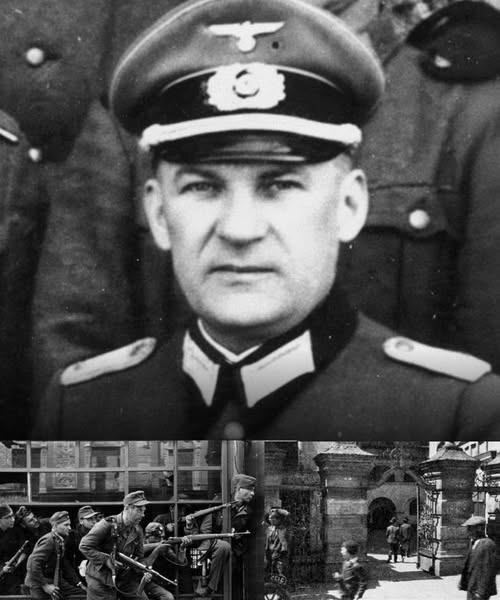
On that day, the rules of war were broken. For one shocking, unbelievable moment, the unthinkable happened: German soldiers aimed their rifles directly at the notorious SS. The Nazi regime was suddenly fighting itself.
In the middle of World War II, a strange and tense standoff took place on a bridge in Przemyśl, Poland.
At the center of this conflict was a 51-year-old lawyer turned army officer named Albert Battel.
He was wearing the wrong uniform for a hero. But on that day, he decided that saving lives was more important than following orders.
The Jewish quarter of Przemyśl had been closed off with barbed wire for a long time. The people inside were terrified.
Everyone knew that when the SS trucks arrived, it meant “resettlement”—a polite word the Nazis used for deportation to death camps.
In July 1942, the order came down. The SS was coming to empty the ghetto.
Albert Battel was a Wehrmacht (regular army) officer stationed in the town.
He wasn’t a young, hot-headed soldier. He was a middle-aged man who had lived a quiet life practicing law before the war.
But when he heard the SS was coming to take the Jewish workers and their families, something inside him refused to accept it.
As the SS convoy roared toward the bridge over the River San, which was the only entrance to the ghetto, they found the way blocked.
Battel had ordered his own soldiers to lower the barrier.
When the SS commander demanded to pass, Battel refused. He didn’t have permission from his superiors.
He didn’t have orders from Berlin. He simply stood his ground. The situation became incredibly dangerous. The SS threatened him, but Battel played his final card.
He ordered his machine-gunners to aim their weapons. He told the SS that if they tried to cross the bridge, his men would open fire.
It was a moment of total silence. German soldiers aiming at German police. The SS commander, realizing Battel was serious, backed down. The trucks turned around.
Blocking the bridge was only the first step. Battel knew the SS would come back eventually. He needed to act fast.
He took his own military trucks and drove straight into the Jewish ghetto. He wasn’t there to arrest people; he was there to save them.
He knocked on doors and told families to grab what they could.
Using a loophole in the rules, he claimed these people were “essential” to the war effort. He loaded up to 100 Jewish families—men, women, and children into the army trucks.
He drove them out of the ghetto and into the safety of the local military barracks.
For that day, and the days that followed, those families were safe under the protection of the Wehrmacht.
News of what happened reached the highest levels of the Nazi government. Heinrich Himmler, the head of the SS, was furious. He ordered an investigation into Battel.
Himmler wrote a note in Battel’s file, promising to have him arrested and expelled from the Nazi party the moment the war was over.
Battel was eventually removed from his command and forced into retirement early due to heart problems.
He lost his career and his reputation among his peers.
Albert Battel survived the war, he died in 1952 in West Germany. At the time of his death, he was largely forgotten.
He never wrote a book about his actions or bragged about standing up to the SS.
However, the people he saved did not forget.
Years later, survivors began to tell the story of the officer who blocked the bridge.
In 1981, Yad Vashem (The World Holocaust Remembrance Center) recognized Albert Battel as Righteous Among the Nations.
Albert Battel’s story teaches us a powerful lesson about courage.
Courage is not about being fearless. Battel was likely terrified of being shot for treason
He was operating inside a system built on total, terrifying obedience. In Nazi Germany, the principle was rigid: Befehl ist Befehl (An order is an order), and questioning authority meant execution. Yet, in that impossible vacuum, Battel found the tiny, crucial space to rebel.
His action shatters every excuse used to justify inaction during the war. It proves that the final, most powerful authority belongs not to the general, the state, or the uniform, but to the individual conscience.
In a time of darkness, one man stopped a convoy of death simply by saying, “Not today.”
Even when the entire world is screaming at you to conform, the choice between simple obedience and fundamental decency remains entirely, beautifully, and terrifyingly yours.
Battel showed that even in the worst circumstances, we always have a choice between doing what is told and doing what is right.
We Are Human Angels
Authors
Awakening the Human Spirit
We are the authors of ‘We Are Human Angels,’ the book that has spread a new vision of the human experience and has been spontaneously translated into 14 languages by readers.
We hope our writing sparks something in you!