To those who bought silver when its price was higher, or to those who want to make some capital gains… …read this.
https://www.zerohedge.com/precious-metals/silvers-endgame-almost-too-obvious

Tom's Blog on Life and Livingness
To those who bought silver when its price was higher, or to those who want to make some capital gains… …read this.
https://www.zerohedge.com/precious-metals/silvers-endgame-almost-too-obvious

I was in Brussels three weeks ago for a closed-door meeting with European finance officials. One senior official said words that made my blood run cold: “We thought freezing their assets would bring them to their knees. Instead, we have created a monster we cannot control.”
He was right. Because what Europe did with $105 billion in Russian assets has triggered a chain reaction that will reshape global finance—and almost nobody understands what’s really happening.
In this video, we expose how the EU’s May 2024 decision to seize interest earnings from frozen Russian reserves triggered Russia’s surgical mirror retaliation—targeting $105 billion in European corporate assets including Volkswagen ($3.5B), Raiffeisen Bank ($2.8B), and dozens more. From the death of property rights to the acceleration of de-dollarization, we break down why this might be the greatest strategic blunder in financial history.
In this video, we uncover:
The $105B Seizure: How the EU’s May 2024 decision to confiscate Russian asset interest earnings—$3B annually for Ukraine—crossed a line that can never be uncrossed and broke the sacred principle of property rights.
The Mirror Retaliation: Why Russia’s decree within 48 hours to seize equivalent European corporate holdings ($200B+ exposure) is strategic genius—exploiting divisions, rewarding hesitant countries, punishing aggressive ones.
The Corporate Panic: How Volkswagen, Raiffeisen, Danone, Shell, and BP are now screaming at their governments—caught in the crossfire of a financial war they never chose.
The Global Precedent: Why every central bank from Asia to Latin America is now asking “if they did it to Russia, could they do it to us?”—and quietly diversifying away from Western assets.
The headlines say Europe stood firm. The reality is Europe sacrificed the credibility of its entire financial system for $3B/year that won’t change the war’s outcome. Watch to understand the long-term cost.
Click to view the video: https://www.youtube.com/watch?v=yDmu7Frv0Yk

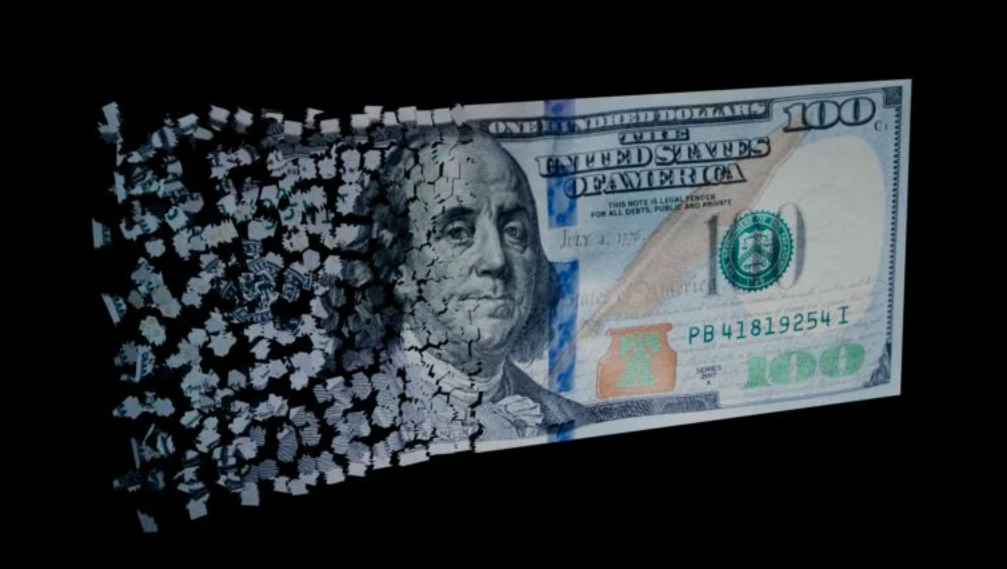
What was the Bretton Woods Monetary System?
Why the international monetary system based on a fiat U.S. dollar has provided the United States with some exorbitant economic privileges.
Many central banks have been gradually reducing their stocks of dollar-denominated Treasury bills and bonds in their official reserves relative to gold.
In the United States and in other economies, lax fiscal and monetary policies could trigger financial crises and an important economic downturn.
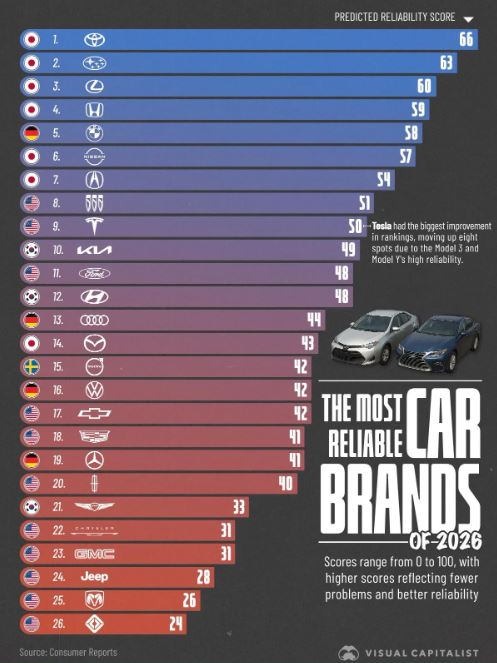
Toyota vehicles are engineered to last well beyond 200,000 miles with proper maintenance, thanks to rigorous quality control at every stage of production and simplified powertrain designs that reduce potential failure points.
Finish reading: https://www.zerohedge.com/technology/toyota-remains-worlds-most-reliable-car-brand-rivian-least
The man leading Microsoft’s AI sprawling efforts is sounding the alarm over imminent mass labor disruptions, warning that the overwhelming majority of white-collar professional work could vanish to automation far sooner than most business and policy leaders are willing to admit – something we’ve been concerned about since early 2023.
In an interview with the Financial Times, Microsoft AI CEO Mustafa Suleyman forecasted that within the next two years a vast swath of desk-bound tasks will be swallowed by AI.
“I think we’re going to have a human-level performance on most, if not all, professional tasks – so white collar where you’re sitting down at a computer, either being a lawyer, accountant, or project manager, or marketing person – most of the tasks will be fully automated by an AI within the next 12 to 18 months,” Suleyman said when asked about the time table for Artificial general intelligence, commonly known as AGI.
(Tom: And this cam to me this week.)
I strongly suggest that you read it and forward it to those you feel should have the data.
By Matt Shumer • Feb 9, 2026
Run It Hot: Trump, the Fed, and the Coming Currency Debasement https://internationalman.com/articles/run-it-hot-trump-the-fed-and-the-coming-currency-debasement/
Seems like there is a buying opportunity for those who are not risk averse… https://x.com/felixprehn/status/2017961132967731359?s=20
’Rock Now Beats Paper’: Making Sense Of “Silver Friday’s” Utterly Rigged Nonsense https://www.zerohedge.com/precious-metals/rock-now-beats-paper-making-sense-silver-fridays-utterly-rigged-nonsense
There is a veracious appetite from big banks for gold and, in the case of silver, industrial users for the metal. I am still bullish on gold and silver, and my target on gold by 2030 is $10,000 per ounce. https://www.zerohedge.com/markets/never-seen-risk-my-career-ed-dowd-warns

The University of Michigan Consumer Sentiment Index is one of the clearest windows into how the average American actually feels about the economy.
Each month, the university surveys households across the country, asking straightforward questions about personal finances, job prospects, inflation, and expectations for the future. Those responses are distilled into a single number that captures the public’s economic mood. Because it has been tracked for decades, the index offers a long-running reality check on confidence at the household level.
Today, the University of Michigan Consumer Sentiment Index is sitting near record lows — decisively below levels seen during the 2008 financial crisis, the dot-com bust, and even the deep recessions of the early 1990s and 1980s.
How can stock market valuations be at or near historical highs while the average American is about as pessimistic as they’ve ever been?
This contradiction is a perfect illustration of the financial fun house — and the extreme distortions that relentless money printing has pumped into the system.
If fiat currency is a dishonest measuring stick — and it is — then how do we accurately measure the stock market?
The best option is to measure value in gold, honest money that no politician can arbitrarily debase.
If measuring in fiat is like looking into a fun house mirror, then gold is a mirror of truth. And when we measure the stock market in gold, that truth becomes clear. Below is a chart of the S&P 500 measured in gold going back to 1950.
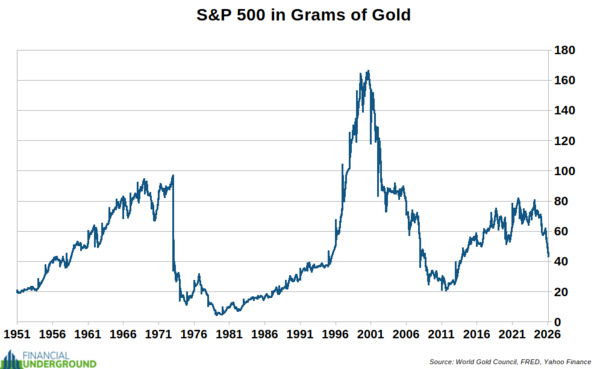
Viewed through the lens of gold, the stock market tells a very different story than it does in fiat terms — and this chart makes that unmistakably clear.
The most striking feature of the chart is what isn’t there: a sustained upward trend. The S&P 500 today is worth the same amount of gold it was in 1995.
Despite decades of nominal gains, the stock market has repeatedly given back those gains when measured against gold. In other words, the rising stock market was more a reflection of currency debasement than of real wealth creation.
This helps explain the disconnect at the heart of today’s market. In fiat terms, stock prices appear to be at record highs. But in gold terms — a unit that cannot be printed — the market looks far less extraordinary.
Measured in gold, US stocks peaked in 1999, when the S&P 500 was worth just over 164 grams of gold. Today, the index is worth 43 grams — a decline of more than 73% from its 1999 peak.
More recently, the S&P 500 peaked at about 82 grams of gold in late 2021. Today, it’s worth roughly 43 grams. In other words, despite the recent melt-up and the stock market ripping to new nominal all-time highs, when measured in gold, the S&P 500 is down more than 47% since late 2021 and sitting at roughly the same level it was in 1995.
In other words, when we look at the stock market through a mirror of truth rather than a fun house mirror, it becomes clear that it is in a deep bear market. It’s no wonder consumer sentiment is near an all-time low.
Despite the nominal melt-up in stocks, most Americans are becoming poorer when measured in real, honest money — not fake government confetti.
I expect this dynamic — a nominal stock market melt-up alongside Americans becoming poorer — to accelerate in 2026. I expect the stock market to go higher and valuations to become even more insane — but I expect gold to rise even faster.
Currency debasement is driving this trend, and unfortunately, all signs point to much more of it in 2026.
This is exactly why positioning matters far more than headlines in the years ahead. If stocks continue rising only because the dollar is being sacrificed, then real gains will increasingly come from assets that benefit from that debasement rather than from it being disguised.
Gold has already been signaling this shift — and within the gold space, select opportunities stand to outperform dramatically as this trend accelerates into 2026.
Source: https://internationalman.com/articles/the-melt-up-trap-why-stocks-must-rise-until-the-dollar-breaks/