
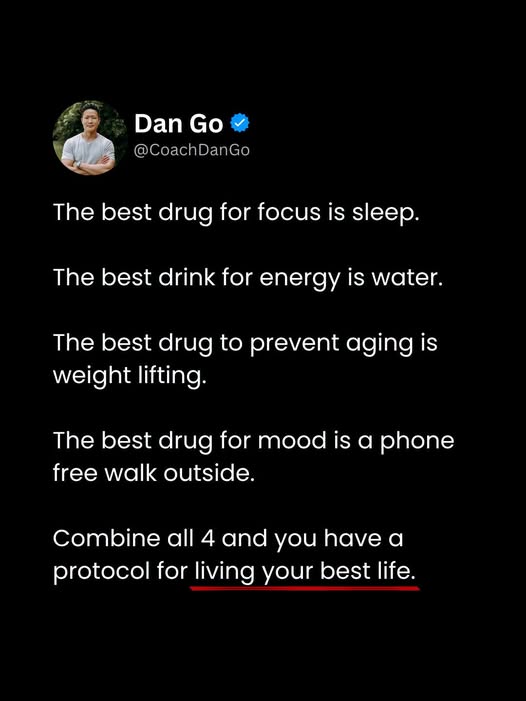
The Best…
Your Doctor Is Not A Healer
Quote of the Day
“We should every night call ourselves to an account: What infirmity have I mastered today? What temptation resisted? What virtue acquired?
Our vices will abate of themselves if they be brought every day to the shrift.”
Lucius Annaeus Seneca – Philosopher, Statesman, Dramatist (5 BC – 65 AD)
Author Of US Bioweapons Act Dies

“The COVID-19 mRNA injections contain derivatives of illegal military gene function research. As a result the COVID-19 injections qualify by definition as a military biologic weapons system.”
Click to view the video: https://www.facebook.com/share/v/1CE59UbucS/
It’s Not Just Sugar!

Dr. Laurie Marbas writes:
You swapped the cookies for crackers.
You skipped the soda and had juice instead.
You have been trying so hard.
And your energy still crashes at 3pm.
Here is what nobody told you.
It is not just sugar that spikes your blood glucose.
It is anything that breaks down quickly into glucose once it enters your body.
Think of your bloodstream like a bathtub with a slow drain. Pour in a small cup of water slowly, the drain keeps up. Dump in a full bucket at once, and it overflows.
Refined crackers, white bread, fruit juice, and even some ‘healthy’ granola bars can hit that drain just as fast as a cookie does. Your pancreas does not read the label. It only sees how much glucose just arrived and how fast.
Picture someone who swaps dessert for a big bowl of puffed rice cereal with oat milk and a glass of orange juice. On paper it looks like progress. Inside the body, the glucose flood is nearly identical.
The fix is not perfection. It is pairing. Add beans, lentils, or a small handful of walnuts to any meal that feels ‘light.’ Fiber and plant protein slow that drain so glucose rises gently instead of all at once.
Sunbathe Your Mushrooms
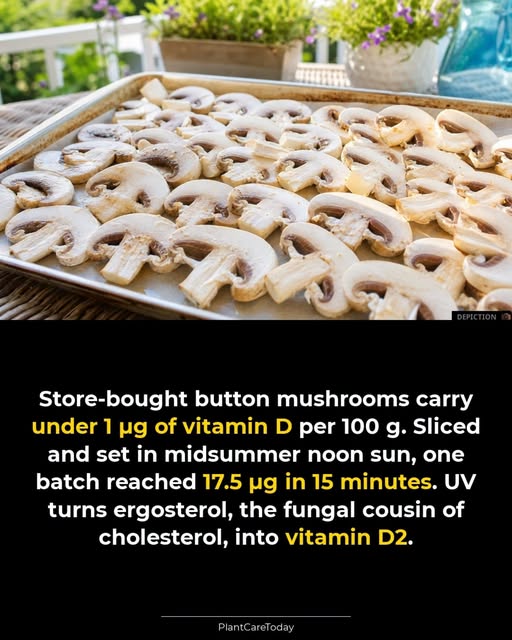
Before your next batch of mushrooms hits the pan, give them a short sunbath. Fresh button mushrooms from the store usually carry less than 1 microgram of vitamin D per 100 grams. Their cells are packed with ergosterol, which plays the role cholesterol does in animals, and ultraviolet light converts it into vitamin D2, much like sunlight makes vitamin D in your skin. In a German test at midday in midsummer, sliced mushrooms reached 17.5 micrograms per 100 grams after 15 minutes outdoors and 32.5 after an hour. Slicing matters because it exposes more surface to the light, so slices beat whole caps given the same sun.
The honest caveat: results swing with season, latitude, time of day and cloud cover, so a gray spring afternoon won’t match those numbers. The good news is that the vitamin holds up afterward. A 2018 review in the journal Nutrients found sun-treated mushrooms usually stay above 10 micrograms per 100 grams through their best-before date, and pan-frying without oil for five minutes kept about 88 percent. Fifteen minutes on a sunny patio table, and your dinner borrows a trick from your own skin.
BMJ Publishes Cholesterol Study
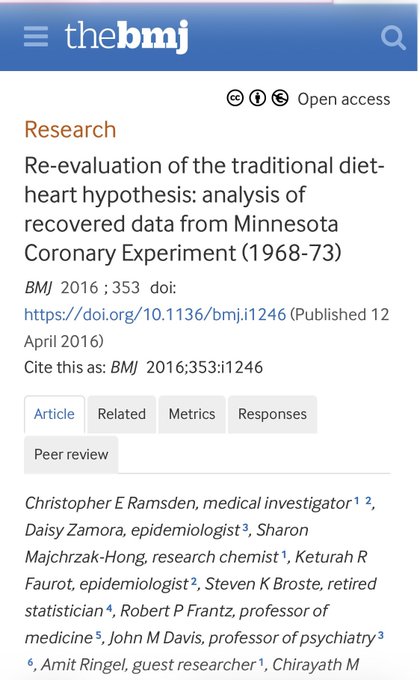
(Tom: The only cholesterol study you will ever need to read.
For every 30 point drop in cholesterol, death risk rose 22 percent.
Read that again.
For every 30 point drop in cholesterol, death risk rose 22 percent.)
In 1968, researchers ran the largest randomised trial ever done on saturated fat.
Over 9,000 people in Minnesota state hospitals were split between animal fat and corn oil for years.
The corn oil group’s cholesterol dropped hard.
The full results never got published.
The raw data sat on magnetic tapes in a basement for over forty years.
A researcher named Christopher Ramsden tracked those tapes down in 2013 and ran the numbers the original team never released.
For every 30 point drop in cholesterol, death risk rose 22 percent.
The lower the cholesterol fell, the faster people died.
In the over 65s, each drop of roughly half a point on the cholesterol scale carried a 35 percent higher death risk within two years.
The trial is real.
It was double blind.
It was the gold standard design.
And it found the exact opposite of what dietary guidelines were about to be built on.
It sat unpublished for over forty years while the low fat, high vegetable oil advice became national policy.
This was not a small study lost in the noise.
It was the largest of its kind.
And the finding that mattered most never reached a single doctor’s desk for four decades.
Vaccines In Food Supply

Vitamin C plus DMSO
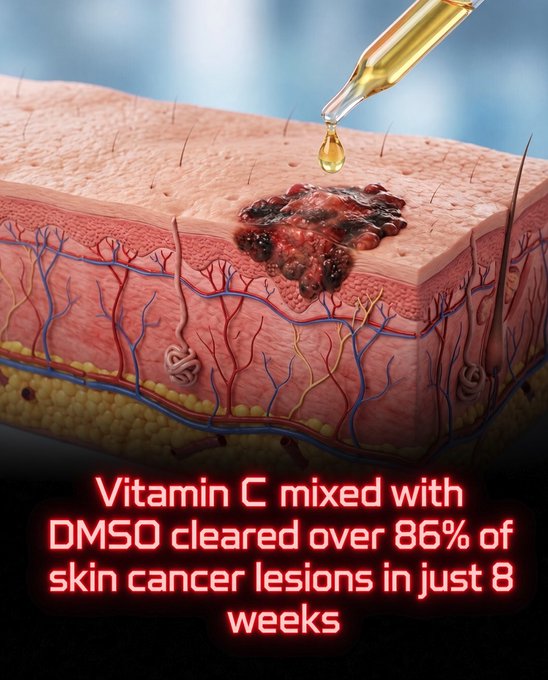
A 30 percent vitamin C solution dissolved in DMSO cleared 86 percent of basal cell skin cancer lesions within eight weeks in a clinical trial. In a randomized study published in Biomedicine & Pharmacotherapy, researchers tested a topical mix of high-concentration ascorbic acid and dimethyl sulfoxide, a solvent that helps substances penetrate deeply into the skin.
Applied twice daily for eight weeks, the combination produced complete clearance in 13 of 15 lesions (86.7 percent) among patients with low-risk basal cell carcinoma. This rate exceeded that of the standard topical treatment imiquimod, which cleared 8 of 14 lesions (57.1 percent). The vitamin C–DMSO formulation also caused fewer side effects and avoided the lasting skin hypopigmentation sometimes seen with conventional topical therapies.
Because basal cell carcinoma is the most common form of skin cancer worldwide, these early results suggest a possible low-cost, non-invasive option. Larger trials are still required before the approach can be adopted as standard care.
[Burke, B., & Bailie, J.-E. (2022). Randomized trial of topical ascorbic acid in DMSO versus imiquimod for the treatment of basal cell carcinoma. Biomedicine & Pharmacotherapy, 148, 112710. DOI: 10.1016/j.biopha.2022.112710]