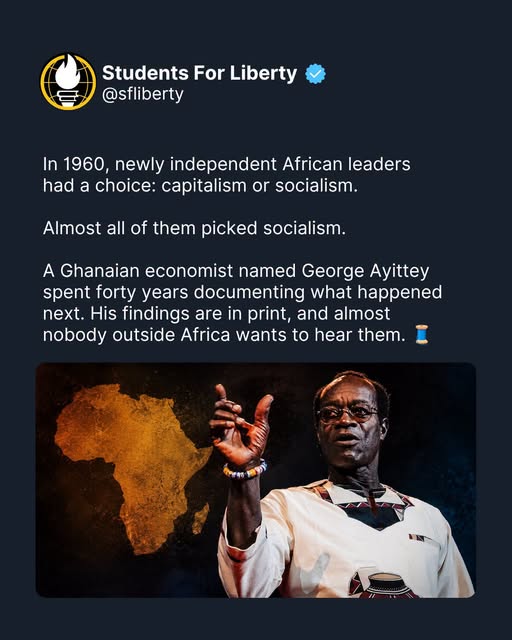
George Ayittey on Socialism In Africa

George Ayittey

The reasoning in 1960 looked airtight. Colonialism had been run by Western capitalists. So capitalism was a tool of oppression. Socialism, its opposite, would be the path to liberation.

Kwame Nkrumah in Ghana, Julius Nyerere in Tanzania, Sékou Touré in Guinea, Mengistu Haile Mariam in Ethiopia, and Robert Mugabe in Zimbabwe all reached the same conclusion through the same logic.

The logic was tidy. The results were catastrophic.

In Ghana, Nkrumah’s government built 64 state enterprises before his overthrow in February 1966. Only three or four were profitable.

By 1970, the Ghanaian state was setting prices on nearly 6,000 items across more than 700 product groups.

In Tanzania, Julius Nyerere called the program ujamaa, a Swahili word for familyhood.
By 1976, the state had relocated more than 11 million peasants into roughly 8,000 collective villages. Much of the relocation was done at gunpoint. Government bulldozers flattened old houses so families could not return.

Tanzania exported 540,000 tons of maize in 1970. By 1974 it was importing 300,000 tons.
Within a few years a country that had been able to feed itself was depending on Western grain shipments to survive.

Ayittey then asked the question he considered most important: how do the rich get rich in the United States compared to Africa?

In the United States, the wealthiest people are builders.

Elon Musk built Tesla and SpaceX. Jeff Bezos built Amazon. Roughly two thirds of American billionaires founded the company that made them rich.

In socialist-era Africa, the wealthiest people were heads of state and their ministers.
– Mobutu Sese Seko of Zaire (now the Democratic Republic of Congo): estimates of stolen wealth ranged from 1 to 5 billion dollars.
– Sani Abacha of Nigeria: around 5 billion.
– Ibrahim Babangida of Nigeria: roughly 12 billion.
– Hosni Mubarak of Egypt: estimates ran as high
as 40 billion.
– Muammar Gaddafi of Libya: estimates reached 200 billion.

Ayittey put it plainly. The combined net worth of every American president from George Washington through Barack Obama, all 43 of them, was about 2.7 billion dollars in 2010 figures.

Sani Abacha alone stole more than that in five years in office. African socialism built a ruling class that created nothing and extracted everything.

The argument Ayittey most wanted Africans to hear, and the one almost nobody quotes, is that socialism was never African. Pre-colonial Africa had open markets, long-distance trade, and private enterprise. Cloth-weaving, iron and gold smelting, regional commerce. Property was held by extended families and clans, not by the state. Nyerere and his peers took kinship-based property and relabeled it communism. They confused village solidarity with state ownership. They imported a nineteenth-century European industrial ideology and applied it to agricultural societies that already had functioning markets older than the modern European state. Shortages, political prisons, and a parasitic ruling class followed.

South Africa in 2026 is preparing the same policies. The Expropriation Act was signed in January 2025. The MK Party introduced a constitutional amendment bill this April to push land restitution claims back to 1652 and remove compensation from the property clause.

Zimbabwe ran this experiment in 2000. Tobacco export earnings fell from 600 million dollars to 175 million by 2009. Maize production did not return to pre-seizure levels until 2017.

Ayittey warned about this for thirty years. He died in January 2022. South Africa is doing it anyway.

Classes of Assets

I saw a post that listed 15 assets and one positive feature of each. One can quibble about aspects of it but it is interesting starting point for a discussion with your kids.
1 Stocks = Compound wealth
2 ETFs = Simple investing
3 Land = Long-term appreciation
4 Business = Financial leverage
5 Skills – Lifetime income
6 Books = Better decisions
7 Digital products = Passive income
8 Rental property = Cash flow
9 Brand = Trust and influence
10 Health = Long-term performance
11 Audience = Opportunity access
12 Networking = Hidden wealth
13 Technology = Faster productivity
14 Knowledge = Competitive advantage
15 Time = Greatest asset

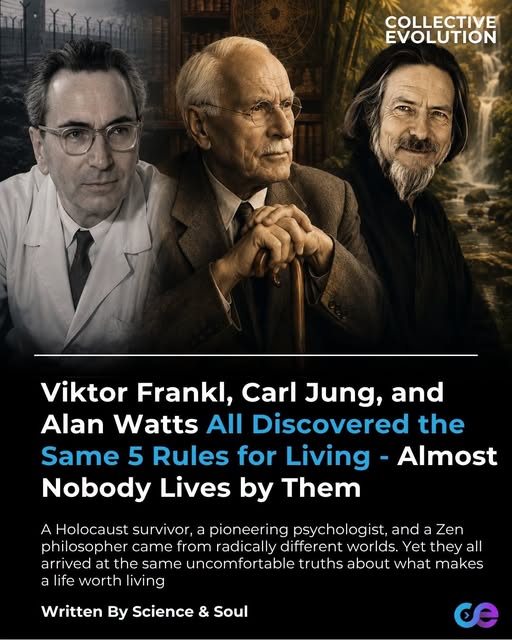
Frank, Jung and Watts

Frank, Jung and Watts

(Tom: The following are wise words yet despite their wisdom, these three distinguished gentlemen did not adequately pursue the source of man’s pain to arrive at the ultimate resolution, the discovery of and technique to erase the reactive mind, the hidden source of what ails man. To discover this for yourself, get a copy of Dianetics and read it. Discover the truth for yourself.)

From a Collective Evolution post on Facebook:

There is a strange moment that happens as you grow older.

One day, you realize your life isn’t changing because you’re making better decisions.

It’s changing because you’re repeating the same unconscious ones.

The same arguments.

The same fears.

The same habits.

The same invisible story about who you are.

You promise yourself that next year will be different.

It rarely is.

Here’s the unsettling part.

Nearly a century ago, three of the most influential thinkers of the modern era—Viktor Frankl, Carl Jung, and Alan Watts—approached this mystery from completely different directions.

One survived Nazi concentration camps.

One spent his life exploring the unconscious mind.

One translated Eastern philosophy for the Western world.

Different cultures.

Different professions.

Different beliefs.

Yet they kept arriving at remarkably similar conclusions.

Not about success.

Not about happiness.

But about the hidden psychological traps that quietly steal an entire lifetime.

Most people don’t ignore these lessons because they’re difficult.

They ignore them because accepting them would require becoming someone entirely different.

Here are the five principles they all seemed to discover.

Rule 1: Stop Searching for Happiness. Search for Meaning.

Modern culture has convinced us that happiness is the goal.

Frankl believed the opposite.

People can survive astonishing suffering if they know why they’re suffering.

Without meaning, even comfort begins to feel unbearable.

Jung observed that many psychological disorders weren’t simply illnesses—they were crises of meaning.

Watts argued that chasing happiness is like trying to smooth water with your hand.

The harder you chase it, the further it slips away.

This explains a strange paradox of modern life.

Never before have people had so much convenience.

Never before have so many reported feeling empty.

Perhaps the problem isn’t that life has become harder.

Perhaps we’ve mistaken pleasure for purpose.

Meaning often arrives disguised as responsibility.

Rule 2: Everything You Refuse to Face Eventually Controls You

Most people think avoidance protects them.

Psychology says the opposite.

Jung famously argued that what remains unconscious doesn’t disappear—it shapes your life from behind the curtain.

Frankl saw people imprisoned physically while remaining inwardly free.

Others lived in freedom while becoming prisoners of fear.

Watts repeatedly warned that resisting reality creates suffering beyond the original pain.

The emotion you suppress.

The conversation you postpone.

The grief you never process.

The insecurity you hide beneath achievement.

None of it vanishes.

It simply changes form.

Anxiety.

Burnout.

Perfectionism.

Control.

The monster isn’t under the bed.

It’s inside the room you’ve refused to enter.

Rule 3: Your Identity Is More Flexible Than You Think

One of the most dangerous sentences in the English language is:

“This is just who I am.”

It sounds like self-acceptance.

Often, it’s surrender.

Jung believed the self isn’t fixed.

It’s continually unfolding through a lifelong process of integration.

Frankl insisted that even in the most horrific conditions, people retained one freedom:

The freedom to choose their response.

Watts challenged the idea that the isolated ego is who we truly are.

Your identity isn’t a prison.

It’s a story.

And stories can be rewritten.

The future isn’t created by discovering yourself.

It’s created by becoming someone your past couldn’t predict.

Rule 4: Life Begins to Change When You Stop Trying to Control Everything

Control feels safe.

It also becomes exhausting.

We attempt to control outcomes.

Other people.

Time.

Money.

Reputation.

Our own thoughts.

The result?

Constant tension.

Watts argued that trying to control life is like trying to hold your breath forever.

Eventually, reality wins.

Frankl distinguished between what belongs to fate and what belongs to personal choice.

Jung believed psychological maturity comes not from mastering the world, but from relating differently to uncertainty.

Ironically, resilience grows precisely where certainty ends.

You cannot control life.

But you can become the kind of person who no longer requires certainty before acting.

Rule 5: The Greatest Prison Is the One You Can’t See

The most dangerous prison rarely has walls.

It has assumptions.

That your worth depends on achievement.

That everyone is judging you.

That success guarantees fulfillment.

That comfort equals security.

These beliefs quietly shape careers, relationships, and entire identities.

Jung called for making the unconscious conscious.

Frankl encouraged people to answer life rather than demand answers from it.

Watts reminded us that many of our perceived problems exist because we’ve mistaken our thoughts for reality itself.

Most people spend decades trying to escape external circumstances.

Few realize they’re carrying the prison with them.

Freedom doesn’t begin when your environment changes.

It begins when your perception does.

The Uncomfortable Truth

People often ask what the secret to a meaningful life is.

Perhaps that’s the wrong question.

The better question is:

What illusion are you still protecting?

Frankl didn’t promise a painless life.

Jung didn’t promise a simple one.

Watts certainly didn’t promise certainty.

Instead, they pointed toward something both harder and more liberating.

Life is not something you conquer.

It is something you participate in.

The tragedy isn’t that life is short.

The tragedy is that many people never truly live it because they’re too busy defending the version of themselves they created years ago.

Every day you delay confronting that truth, the unconscious writes another page of your future.

The question is no longer whether your life will change.

It will.

The only question is whether you’ll choose the change—or wait until life chooses it for you.

Two Alternatives – One Choice

Singapore

Two countries split from the same colonial body in 1965. One picked economic freedom. The other picked handouts and racial spoils. You already know how this ended.

Singapore had no oil, no farmland, no hinterland. Just a swamp and a port. Lee Kuan Yew looked at that and trusted trade, low taxes, and hard money. A meritocracy. Central planners hate what he did.

Malaysia has the world’s largest gold mine and abundant mineral and oil resources. Yet it went the other way. In 1971 Kuala Lumpur launched the New Economic Policy, a state program handing quotas, contracts, and university seats to ethnic Malays. Politicians decided who got what. A commissar fantasy dressed in liberal language.

Now let’s look at the numbers. In 1965 both places sat around $500 per capita. Today Singapore clears $84,000. Malaysia sits near $13,000. Same climate, same starting line, one sixth the result.

The Singapore dollar holds its value because the Monetary Authority of Singapore manages it against a currency basket and refuses to print its way out of trouble. The ringgit has lost roughly two thirds of its value against the Singapore dollar since 1981.

You cannot subsidize your way to wealth. You cannot redistribute what you never let people produce. Every ringgit funneled through a quota is a ringgit some bureaucrat spent on his own vision instead of a customer’s.

Malaysia bet on planners deciding outcomes. Singapore bet on people deciding for themselves. The gap between $84,000 and $13,000 is your answer.

Billionaire’s WARNING: I’m SELLING. The Crash Is Already Here!

Jeremy Grantham

The man who predicted the dot-com crash and the 2007 housing collapse warns that the AI bubble is the biggest in American history. Billionaire investor Jeremy Grantham reveals why it will burst, the exact strategy to protect your money, and why house prices need to fall 30%.

Jeremy Grantham is the co-founder of GMO, an institutional investment firm in Boston, and serves as the firm’s long-term investment strategist. He is also the chairman of the Grantham Foundation For the Preservation of the Environment, and co-author of “The Making of a Permabear: The Perils of Long-term Investing in a Short-term World”.

Jeremy Grantham’s comments are all his personal opinions.

He explains:

◼ Why Wall Street will never warn you when to get out of the market, and what to do instead

◼ The exact portfolio Jeremy recommends to protect your money before the crash

◼ What everyday chemicals in your food and cosmetics are doing to your fertility

◼ Why house prices need to fall 30%, and what it means for your finances

◼ Why the AI boom won’t automatically lead to higher profits, and what to buy instead

https://www.youtube.com/watch?v=32u5T6lO8qk

Natural Cooling

Natural Cooling

If you don’t understand natural cooling, you don’t understand architecture.
Most buildings are built the wrong way.
First we build the shape.
Then we add AC to fix it.
A glass box in the sun gets hot.
Like a greenhouse.
So we fight the heat with power.
All day. Every day.
The power bill never stops.
And if the power goes out, the building gets too hot to use.
There is a better way.
A building can cool itself.
No AC. Just air, water, plants, and the sun.
Here is how it works:
– Windcatcher: a tower on top. It catches the wind and sends cool air down.
– Solar chimney: the sun heats it. It pulls hot air up and out.
– Earth tubes: air comes in through the cool ground first. So it starts cool.
– Cool water channel: the air passes over water. Now it’s even cooler.
– Green roof and green walls: plants shade the building and cool the air.
Cool air comes in at the bottom.
Hot air goes out the top.
No machine in the middle.
This is not new.
People in old Persia did this 700 years ago.
They made desert homes much cooler. With no power at all.
What is new? Smart sensors and AI.
They watch the wind and the heat.
They open and close each part on their own.
Old ideas. New tools.
A building that needs power to stay cool is not really designed.
It’s just plugged in.
Biotonomy – Nature Based Architecture