Stop planting flowers around your garden and start planting them inside it.
Most companion planting advice puts the helpful flower in a border or a separate bed. The problem is distance. The scent cloud, the trap effect, and the predator recruitment all weaken sharply past a foot or two. A flower planted twenty feet away from the vegetable it’s supposed to protect isn’t doing much.
The flower belongs in the row. Right next to the stem it’s defending.
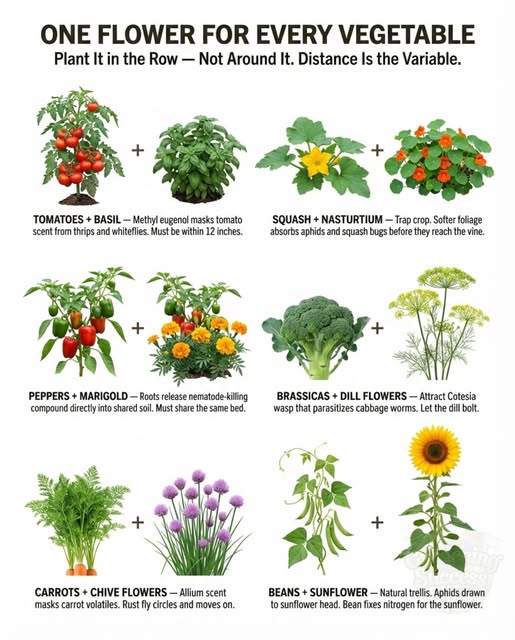
Basil between tomato stems is the clearest example. The aromatic oils that confuse pests looking for tomato foliage work as a scent screen — but only at close range. Basil in a border across the garden is too far. Basil planted within a foot of the tomato stem masks the signal where it matters.
The same principle applies to every pairing that works.
Pairings that work when planted close:
– Nasturtiums at the base of each squash hill — soft foliage that pests prefer over squash leaves. When the nasturtium is loaded with aphids, the vine beside it is clean. Replace heavily infested plants mid-season to reset the trap
– Flowering dill or cilantro in the brassica row — the blooms attract tiny beneficial insects that target cabbage caterpillars. Let one or two plants bolt on purpose. The bolted herb is doing its most important work
– Flowering chives in the carrot row — the scent masks carrot foliage from flies that locate carrots by smell. The chives need to be in the same row, not in a pot nearby
– Sunflowers at the end of a bean row — aphids climb the sunflower stem and cluster at the top, drawing them away from bean foliage below. The bean fixes nitrogen that feeds the sunflower. Both benefit
The distance between the flower and the vegetable is the variable that changes whether companion planting works or doesn’t.