
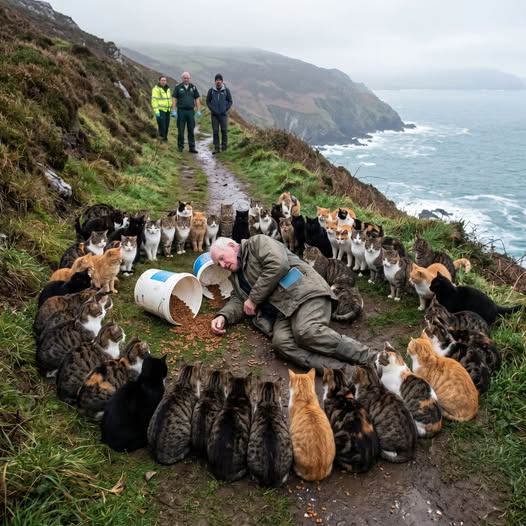
“The old man fed 200 strays every morning for 22 years. When he collapsed on the trail, they formed a circle around him and didn’t let anyone near for 3 hours until the ambulance arrived.”
In a coastal village in the western hills of County Cork, Ireland, there was a man who fed the cats.
Every morning. For twenty-two years.
He started in 2001, the year his wife passed. She had loved cats. They never had children. She used to leave scraps on the back wall for the few ferals that roamed the lane behind their cottage. Three cats, maybe four. A small kindness she never talked about.
After she died, he continued.
Not for three cats. Not for four.
By 2005, he was feeding forty. By 2012, over a hundred. By 2020, the number had stabilized at roughly two hundred — a sprawling colony of feral and semi-feral cats that lived in the hedgerows, stone walls, abandoned outbuildings, and coastal scrub surrounding the village.
Every morning at 5:45 AM, he left his cottage carrying two large plastic buckets — one filled with dry food purchased in bulk, one with water. He walked the same trail along the hillside above the village, approximately 1.4 miles each way. He had eleven feeding stations — rusted baking trays, old ceramic dishes, cut-open plastic containers — placed at intervals along the path.
He filled each one. Every day. In rain, in wind, in frost, in the brutal Atlantic storms that swept through every winter. He never missed a morning. Not once in twenty-two years.
No one helped him.
The village knew about him. Everyone did. Some thought he was eccentric. Some thought he was wasting his money. A few complained about the cats. No one ever walked the trail with him. No one ever carried a bucket.
He paid for the food himself. A local shop owner estimated he spent between €80 and €100 per week — nearly all of his pension. His cottage had no central heating. His furniture hadn’t been replaced in decades. His shoes were repaired with tape. He ate simply — bread, soup, tinned fish.
The cats ate before he did. Every single day.
He never named them. He said it wasn’t his place. But he knew them. He knew which ones were sick. Which ones were new. Which ones had disappeared. He kept a small notebook — a battered blue ledger — where he recorded markings, approximate ages, injuries he’d noticed, and dates. The notebook, when later examined, contained over 3,400 entries spanning two decades.
He brought injured cats to a local veterinarian in a cardboard box on the bus. He paid what he could. When he couldn’t pay, the veterinarian treated them anyway. Over the years, the vet estimated he had brought in over 300 cats. The man never asked for receipts. He never asked for recognition.
The veterinarian said of him: “He came in with a cat in a box every two or three weeks for twenty years. Always polite. Always quiet. Always alone. He never once said ’my cat.’ He always said ’one of the hill cats needs you.’ As if they belonged to the hill and he just worked there.”
On the morning of October 14, 2023, the man — now eighty-six years old — collapsed on the trail.
He had a stroke. A major ischaemic event that dropped him mid-stride between feeding stations six and seven. The buckets fell. The food scattered across the wet grass. He went down on his right side on the muddy path and did not get up.
He was conscious. He could not move his left side. He could not speak. He could not call for help. The nearest house was over half a mile away. The trail was not visible from the road.
No one saw him fall.
But the cats did.
Within minutes, they began arriving. First five or six. Then dozens. Within approximately thirty minutes, by the estimate of the paramedic who eventually reached him, over a hundred cats had gathered on the trail.
They formed a circle around him.
Not a loose gathering. A circle. A dense, tight ring of bodies — pressed flank to flank, facing outward — surrounding the man completely. Some sat. Some stood. A few lay down against his body, pressing into his chest, his back, his legs. The warmth was significant — the morning temperature was 4°C, and the man’s core temperature when paramedics arrived was only mildly hypothermic despite lying motionless on wet ground for over three hours.
The cats kept him warm.
But they also did something else.
A hillwalker who spotted the unusual gathering from a distance and approached to investigate was the one who called emergency services. But when he tried to reach the man, the outer ring of cats blocked his path. They did not attack. They did not hiss. They simply would not move. He described it later as “a wall of cats, shoulder to shoulder, and none of them would let me through. I’ve never seen feral cats do anything like that. They were protecting him.”
The paramedics who arrived had the same experience. The crew lead — who later shared the account through a regional first responder network without identifying the man — said:
“We could see him on the ground. We could see he was breathing. But there were easily a hundred cats around him in a circle and they were not interested in letting us in. We ended up approaching very slowly from one side, and a few of them shifted just enough for us to get through. But they didn’t scatter. They stayed the whole time. While we stabilised him, while we got him on the stretcher, while we carried him out. They followed the stretcher for about two hundred metres down the trail before they stopped. And then they just sat there. In a line. Watching.”
The man survived. The stroke left him with permanent left-side weakness. He could no longer walk the trail. He was moved into assisted living in a nearby town.
He could not feed the cats.
For the first time in twenty-two years, the trail was empty at 5:45 AM.
For three days, the cats waited at their stations.
Then something happened that no one organised, no one announced, and no one took credit for.
Volunteers began walking the trail.
First it was the hillwalker who had found him. Then the veterinarian’s assistant. Then a woman from the village who had never spoken to the man but had watched him pass her window every morning for fifteen years. Then a teenager. Then a retired postman. Then others.
Within two weeks, a rotation of eleven volunteers was covering the trail daily. They used his feeding stations. They carried buckets. They followed his route exactly. A copy of his blue notebook was made and shared among them so they could continue monitoring the cats as he had.
They called themselves nothing. They had no name, no social media page, no fundraiser. They just walked the trail.
The man was told about the volunteers during a visit from the veterinarian. He was sitting in a chair by the window of his care facility. He had not spoken much since the stroke. His speech was halting and effortful.
He listened. He looked out the window for a long time.
Then he said, slowly:
“Tell them… station four… the dish is cracked. Water leaks out by afternoon. Needs replacing.”
He didn’t say thank you. He didn’t cry. He gave a maintenance instruction.
Because that trail was his life’s work. And he wasn’t sentimental about it. He just needed it done right.
As of early 2025, the man is eighty-eight. He is still in assisted care. He cannot walk the trail. His blue notebook has been continued by the volunteers — new entries added weekly in different handwriting, a living document passed between eleven people who never knew each other before an old man fell on a hillside and a hundred cats held the line.
The cats still come to the stations every morning. Some are old — survivors from the early years. Most are new generations born into a colony that has never known a morning without food.
The dish at station four has been replaced.
The veterinarian visits the man once a month. He brings photographs of the trail cats. The man studies each one carefully. He still doesn’t name them. He still calls them “the hill cats.”
He was asked once — just once — by a care worker why he did it. Twenty-two years. Every morning. Alone. In all weather. Nearly all his money. No recognition.
He said:
“My wife left food on the wall for three cats. I just kept going. That’s all. She started it. I just didn’t stop.”
He paused. Then:
“You don’t stop.”