
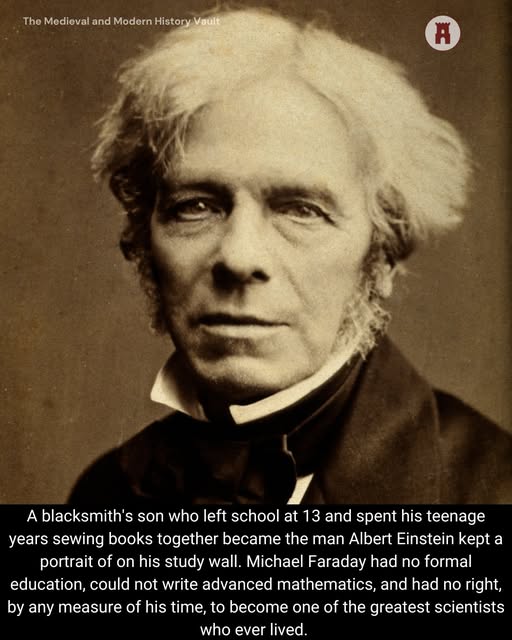
Michael Faraday was born in 1791 in Newington Butts, south London, the son of a blacksmith who was frequently too ill to work. The family was often hungry. His education consisted of learning to read, write, and do basic arithmetic at a church Sunday school, and that was where it ended. At the age of 13 he was running errands for a bookbinder and bookseller. At 14 he was apprenticed to the man, George Riebau of Blandford Street, Marylebone, for a seven-year term. Unlike every other apprentice in that shop, Faraday read every book that came in to be bound.
He read the entry on electricity in the third edition of the Encyclopaedia Britannica and was so captivated that he built himself a crude electrostatic generator out of old bottles and lumber. He read Jane Marcet’s Conversations on Chemistry and began conducting his own chemical experiments. He joined the City Philosophical Society in 1810, a group of young working men who met weekly to hear lectures on science and discuss what they had learned. He was educating himself in the only way available to him, from the inside of a trade he had no intention of staying in.
In 1812, a customer at the bookshop gave the 20-year-old Faraday four tickets to attend lectures at the Royal Institution by Sir Humphry Davy, then the most celebrated chemist in Britain. Faraday attended every one, taking meticulous notes in the careful hand of a man who had taught himself to write properly. He bound those notes into a beautiful 300-page volume and sent them to Davy with a letter asking for any position in science, however small. Davy wrote back kindly but said there was nothing available.
Then, a few months later, Davy’s laboratory assistant was dismissed after getting into a fight. Davy remembered the eager young bookbinder. In March 1813, Faraday was hired as a laboratory assistant at the Royal Institution at 25 shillings a week, two rooms in the attic, and the use of the laboratory. It was, in the judgment of history, one of the most consequential hiring decisions ever made.
Within a year, Davy took Faraday on an 18-month tour of Europe, where he met many of the leading scientists of the age. Back in London, Faraday began his own research. In 1821 he invented the electric motor, demonstrating that electrical current could produce continuous mechanical motion, a concept nobody had achieved before. By 1831 he had made the discovery that would change the world: electromagnetic induction. By passing a magnet through a coil of wire, he generated an electric current. This was the first electrical generator, the foundational principle behind every power station ever built.
He went on to discover the laws of electrolysis, coined the terms electrode, anode, cathode, and ion, discovered benzene, invented the Faraday cage that today lines microwave ovens and MRI scanners, and demonstrated the first known connection between light and magnetism. He had no formal education. He could not write mathematics. He worked entirely through experiment and physical intuition, visualising invisible lines of magnetic force moving through space in ways that mathematical physicists initially dismissed as mystical, and that James Clerk Maxwell later showed to be perfectly correct.
When Faraday was eventually appointed Professor of Chemistry at the Royal Institution, he was offered a knighthood. He turned it down, citing his religious beliefs. Albert Einstein kept a portrait of Faraday on his study wall alongside Isaac Newton and James Clerk Maxwell. Physicist Ernest Rutherford said there was no honour too great to pay to his memory. The man who had spent his teenage years sewing pages together had, without a university, without a degree, and without the language of advanced mathematics, built the intellectual foundations of the electrical age. Every time you switch on a light, start a car engine, or charge a phone, you are using something that traces directly back to a self-educated blacksmith’s son from south London who read every book that passed through his hands.