
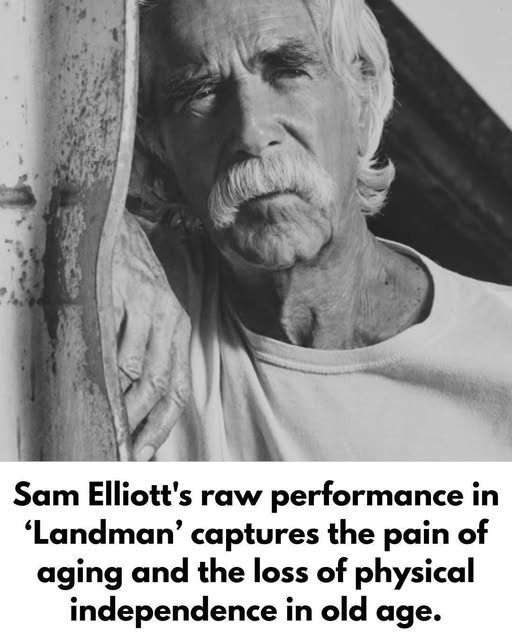
(Tom: This is what I am working diligently to defer for as long as possible with my diet and exercise regime.)
At 81, Sam Elliott struggled to climb out of a swimming pool and what he said next brought millions to tears.
In a recent episode of Landman, the actor delivered one of TV’s most raw reflections on aging. Playing T.L., an 82-year-old former oil worker and distant father, Elliott’s character finds himself stuck in a pool. His knees and hips no longer have the strength to lift him out, and his son, Tommy, played by Billy Bob Thornton, has to help him.
But what followed was more than just a performance. It felt like lived truth.
Sitting by the pool with his son, T.L. talks about another man at the facility, a man who laughs all the time, yet seems unreachable. “It’s a curse that my mind still works,” T.L. says, tears in his eyes. “I sit here fully aware of every way my body is breaking down. I’m fading while my eyes still see it all.”
When Tommy suggests physical therapy, T.L.’s reply is simple and heartbreaking: “You don’t get it. This body is worn through.”
The scene showed something rare on TV. It showed the quiet sorrow of losing physical independence while the mind stays clear enough to witness each decline. Elliott later admitted he was deeply moved during the season, explaining that the emotion had to come honestly with Taylor Sheridan’s writing.
The moment ends with something small but powerful: T.L. and Tommy share their first hug, a simple gesture signaling the start of a long-delayed reconciliation between father and son.
Elliott has played tough characters in films like Tombstone, Road House, and A Star Is Born. But here, he revealed a different kind of strength, the courage to be vulnerable when physical power fades.
The scene resonated because it reflects something universal: watching our bodies slow down, seeing it happen to our parents, or quietly fearing it for ourselves. Elliott wasn’t creating drama for the sake of it. He allowed the truth to emerge naturally from the moment.
For anyone who has helped a parent stand up, watched a loved one struggle with everyday tasks, or felt their own body push back, the scene holds a painful mirror: we are temporary, and our bodies don’t last forever.
Yet it also offers something gentler: connection, understanding, and the grace of being seen as we are. Sometimes, the strongest thing we can do is admit we need help.