
In 1861, the engineers hit a problem that should have ended the project. They dug down into the Parisian soil and found a swamp.
By 1875, that swamp sat beneath the most opulent building in Europe.
It was the height of the Second Empire. Napoleon III had commissioned Baron Haussmann to scrub the grime off medieval Paris and replace it with wide boulevards and monuments to Western civilization. At the center of this new urban jewel was to be a grand opera house.
But the ground refused to cooperate.
The site was waterlogged. For months, steam pumps ran day and night, trying to drain the soil, but the water table was too high. Critics sneered. The Emperor grew impatient. Then came the Franco-Prussian War, the fall of the Empire, and the bloody chaos of the Paris Commune. The project sat unfinished, a skeleton of stone in a broken city.
But a young architect named Charles Garnier refused to let the dream die.
Instead of fighting the water, he decided to tame it. He designed a massive double foundation of concrete and brick, creating a gigantic watertight cistern to relieve the groundwater pressure. He built an artificial lake beneath the opera house to float the massive stone structure safely above the muck.
While the government collapsed and regimes changed, Garnier kept building.
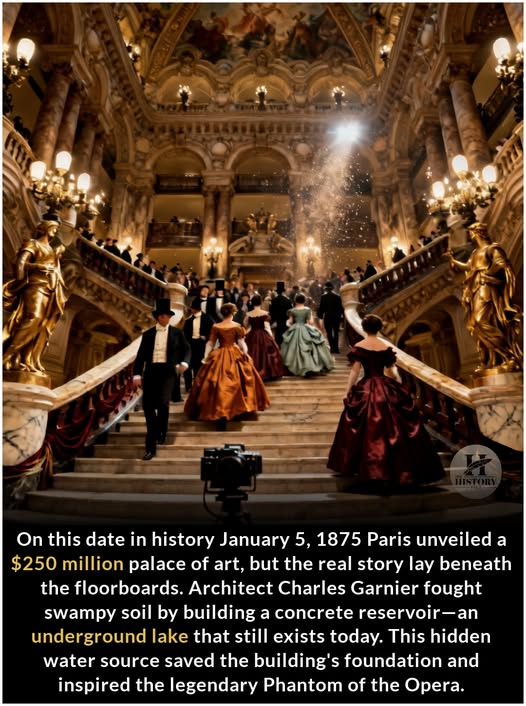
On January 5, 1875, the construction walls finally came down.
The Palais Garnier officially opened its doors to a gala that lasted over 13 hours. It was a spectacle of gold leaf, velvet, and marble that cost roughly 36 million francs—about $250 million in today’s money. The auditorium glittered under the light of a massive gas chandelier, seating nearly 2,000 of the city’s elite.
He built it for art.
He built it for France.
He built it for the ages.
The result was not just a theater, but a declaration that beauty and order could triumph over political chaos. The opulent staircase and the gilded statues proved that culture survives even when governments fall.
We see its legacy today in ways most don’t realize. That hidden underground lake Garnier built isn’t just an engineering trick; it became the setting for Gaston Leroux’s novel, “The Phantom of the Opera.” The spooky, subterranean reservoir is real, and it is still used by Paris firefighters in emergencies.
Even the legends were based on fact. In 1896, a counterweight from the chandelier really did fall, killing a concierge—an event Leroux wove into his ghost story.
Today, the Palais Garnier stands as a UNESCO World Heritage site. It reminds us that true grandeur requires a deep, solid foundation to withstand the shifting sands of time.
Sources: Britannica / History Today