
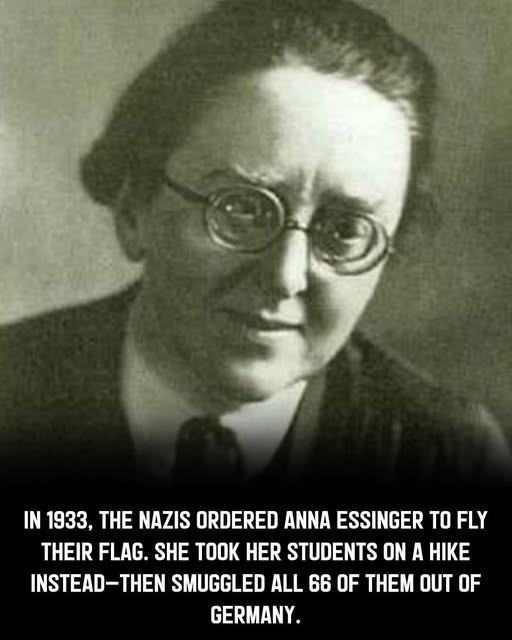
In April 1933, the Nazis ordered every public building in Germany to fly the swastika.
Anna Essinger looked at the flag. Looked at her students. And made a decision.
She organized a hiking trip.
When the children returned, the flag was gone. It had flown, as required by law—but over an empty building.
“Atop an empty building,” Anna said, “the flag can neither convey nor harm as much.”
It was a small act of defiance. But Anna Essinger was already planning something far larger.
She was going to smuggle her entire school out of Nazi Germany.
Anna was born in Ulm in 1879, the oldest of nine children in a secular Jewish family.
At twenty, she did something unusual for a German woman of her time—she moved to America alone, spent ten years educating herself at the University of Wisconsin, and discovered the Quakers. Their values of equality, compassion, and peaceful resistance shaped everything she would become.
She returned to Germany in 1919 on a Quaker relief mission, feeding hungry children in the aftermath of war. In 1926, she and her sisters founded a boarding school in a village called Herrlingen.
It was progressive, coeducational, open to children of any faith. Students called teachers by their first names. Corporal punishment was forbidden. The philosophy was simple: teach children to think, to question, to live without fear.
By 1933, Anna had built something rare—a school where freedom of thought was the foundation of everything.
Then Hitler became chancellor.
Anna had read Mein Kampf.
While her friends hoped the new government would moderate, Anna saw exactly what was coming. Within weeks of Hitler taking power, Jewish children across Germany were being humiliated in classrooms—ordered to stand while teachers pointed out their “biological differences,” forced to eat lunch in toilets because they were “dirty Jews.”
Anna watched as a famous Jewish educator, Kurt Hahn, was arrested. She watched as book burnings lit up Ulm’s cathedral square—the works of Einstein, Freud, Marx reduced to ash.
And she watched as someone inside her own school betrayed her.
Helman Speer, the husband of one of her teachers, wrote to the Nazi Minister of Culture to denounce Anna. Her “airy-fairy humanism,” he complained, was “altogether uncongenial” to National Socialism. He urged that a Nazi spy be installed at the school.
Anna didn’t wait to find out what would happen next.
That spring, while Germany’s democracy collapsed around her, Anna began traveling secretly across Europe—searching for a new home.
Switzerland. The Netherlands. Finally, England, where she found Quaker supporters willing to help her rent a rundown manor house in Kent called Bunce Court.
Then came the dangerous part.
Mass emigration was prohibited. If the Nazis discovered her plan, they could seize the school, impose crippling sanctions, or worse. Everything had to happen in secret.
Anna gathered the parents in small, hidden meetings across Germany. She explained what she intended to do. She asked for their trust—and their children.
Nearly all of them said yes.
That summer, while the children thought they were simply on vacation, Anna’s staff secretly taught them English. Lessons in British history and culture. Preparation for a journey the students didn’t yet know they would take.
On October 5, 1933, Anna Essinger executed one of the most remarkable escapes of the Nazi era.
Her most trusted teachers spread out across Germany in three teams. Parents brought their children to pre-assigned railway stations along three separate routes out of the country.
They had been warned: show no emotion on the platforms. No tears. No long goodbyes. Nothing that might attract attention.
One group traveled along the Rhine from Basel. Another moved through Munich, Stuttgart, and Mannheim. A third crossed northern Germany.
On the trains, everyone was silent as they approached the border.
Sixty-six children. Their teachers. Their headmistress.
All of them made it to England.
Classes began the next day.
Bunce Court was a wreck—an old manor house that had been abandoned for years.
There was no money for repairs, no funds for domestic help. So everyone worked. Students and teachers together, gardening, laying telephone cables, converting stables into dormitories.
British inspectors initially viewed the school with suspicion. But within a few years, they declared themselves amazed “at what could be achieved in teaching with limited facilities.” They concluded it was “the personality, enthusiasm and interest of teachers rather than their teaching apparatus” that made the school work.
And what teachers they were.
As war approached and Britain classified German refugees as “enemy aliens,” many were forbidden from professional work elsewhere—but allowed to remain at Bunce Court. Suddenly, Anna had an astronomer teaching mathematics. A music teacher who had been assistant to the famous wildlife recordist Ludwig Koch. A former senior producer from Berlin’s Deutsches Theater directing school plays.
The children learned not just academics, but music, art, gardening. They performed concerts for local villagers. They stayed with English families on weekends. They found, against all odds, something like home.
One student, Leslie Brent, later called it “a paradise.” After everything he had witnessed in Germany, Bunce Court made the violence seem “like a bad dream.”
Alumni would later describe it as “Shangri-La.” They spoke of “walking on holy ground.”
But Anna’s work was far from finished.
In November 1938, after Kristallnacht, Britain agreed to accept 10,000 Jewish children on what became known as the Kindertransports. Anna was asked to establish a reception camp.
She took in as many as she could—children from Germany, Austria, Poland, Czechoslovakia. Children whose parents she would never meet. Children who would never see their families again.
As Hitler invaded country after country, the refugees kept coming. When the British military requisitioned Bunce Court, Anna found another location and moved the entire school again.
Her eyesight was failing. By the war’s end, she was going blind.
She kept working.
The last children to arrive at Anna’s school were concentration camp survivors.
They had seen things no child should see. They no longer knew what normal life looked like.
One of them was Sidney Finkel, a fourteen-year-old Polish boy who had survived the Piotrkow ghetto, slave labor camps, Buchenwald, and Theresienstadt. He arrived in England in August 1945 with ten other Polish boys, all of them shattered.
Anna and her staff treated them with patience and love. Slowly, carefully, they taught them that the world could be safe again.
Decades later, Sidney wrote about his two years at Bunce Court.
“It turned me back into a human being.”
By the time Anna closed her school in 1948, she had taught and cared for over nine hundred children.
Nine hundred.
She started with sixty-six, smuggled across borders in secret. She ended with concentration camp survivors who had forgotten how to be children.
She stayed at Bunce Court until her death in 1960, corresponding with former students, watching them build lives she had made possible.
They became scientists, artists, professors, doctors. Frank Auerbach became one of Britain’s most celebrated painters. Leslie Brent became a pioneering immunologist. They scattered across the world, carrying with them what Anna had given them—not just survival, but the belief that learning and kindness and freedom were worth fighting for.
In 1933, while others hoped the darkness would pass, one woman saw clearly.
She didn’t wait for permission. She didn’t wait for someone else to act. She organized a hiking trip, smuggled sixty-six children across a border, and spent the next fifteen years saving every child she could reach.
Anna Essinger proved something that remains true today:
One person who refuses to look away can change nine hundred lives.
One school built on freedom can outlast any regime built on fear.
One flag flying over an empty building can be the beginning of the end—not for the children beneath it, but for everything that flag was supposed to represent.