
Discover How to Reduce Your Risk, Restore Your Brain Health, and Reverse the Effects of Alzheimer’s & Dementia with this groundbreaking video series.
Dr Keith Scott-Mumby writes:
My dear colleague recently put together an absolutely incredible video series where they interviewed 10 of the best minds in brain health.
They’ve created this series to bring you the most groundbreaking, life-changing information that science has to offer – straight from the doctors on the frontlines.
These medical professionals are watching healing happen firsthand in their patients.
They know what works and what doesn’t, and they’re here to spill all the secrets in this new video series. I promise you, you do not want to miss this.
The best part is, as a member of my community, YOU are invited to attend an exclusive online broadcast of this groundbreaking series for FREE!
It’s called Brain Health Breakthroughs, and all you have to do is click the link below to register so you can receive the viewing link when the broadcast begins.
Click here to register FREE for the 10-day online broadcast of Brain Health Breakthroughs!
Sugar Poisoning Season

Stacey DaPrato writes about this, a story with which I can relate due to similar, if slightly less dramatic, episodes with my children:
Today I witnessed firsthand something that I often speak out about, and I really feel the need to share.
To preface, we NEVER have candy. We don’t allow it in the house. I hate holidays like Halloween for this very reason. Candy is given out everywhere, all the time. As someone who understands the ramifications of what candy does to children, it is so hard for me to enforce “no candy” when my 6-year-old sees it being handed out like it’s no big deal.
Today we attended an (otherwise super fun!) event where candy was given out. I hesitated to even allow her to collect it – but, given that I am trying to “loosen up” and take a more balanced approach, I allowed her to select a few pieces to bring home. She had one piece at the event, and I told her she could have 2 small pieces after dinner later. The candy was on a pedestal in her mind all day. She kept begging me to have it. She was like a drug addict. After dinner, she had her two pieces.
Within 30 minutes, my child was no longer acting like herself. She was bouncing off the walls. Jittery, couldn’t sit still. Was bouncing in her seat while we tried to play a game with her. She got up and started jumping and running all over the living room. And the anger when it was time to clean up was something I haven’t seen from her in a very long time. Hitting things, grabbing at things. She was feral, and it was insane.
This. This is why I don’t allow it. And THIS is why so many children have behavioral issues. THIS is why so many children are diagnosed with ADHD – yes, I do understand that a small percentage of people do legitimately have this disorder, but the amount it gets diagnosed today is just so far beyond that. Then parents turn around and medicate them with harmful pharmaceuticals.
And here’s the thing – it’s not just the candy! These dyes, artificial flavors, emulsifiers, high fructose corn syrup/refined sugars in general, and so many other chemical additives are is SO MANY of our “foods”. It’s alarming, yet nobody is talking about it.
Here’s the kicker: in addition to the behavioral issues, all of this processed stuff contributes to sickness – yes, it really does. I challenge you to take a close look at the ingredients of the items in your pantry and fridge. Then ask yourself, how often do your kids get sick? I can tell you mine hardly ever do – even during “flu season” – and it’s largely because we severely limit refined sugar, and don’t allow ANY dyes or junky additives in our home.
Where is the outrage???
It is vital you read this, where unvaccinated or vaccinated
Don’t Text And Drive!
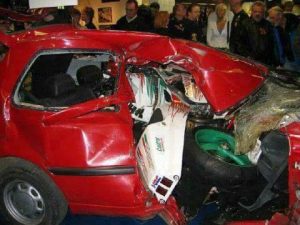
The Honda crotch rocket rider was traveling at approximately 85 mph.
The VW driver was talking on a cell phone when she pulled out from a side street, apparently not seeing the motorcycle. The rider’s reaction time was not sufficient enough to avoid this accident.
The car had two passengers and the bike rider was found INSIDE the car with them.
The Volkswagen actually flipped over from the force of impact and landed 20 feet from where the collision took place.
All three involved (two in the car and the bike rider) were killed instantly. This graphic demonstration was placed at the Motorcycle Fair by the Police and Road Safety Department.
Pass this on to car drivers or soon to be new drivers, or new motorcycle owners and especially everyone you know who has a MOBILE phone!!!
A picture is worth a thousand words.
Save a life. Stop talking on mobile phones and Texting while trying to drive.
The life you save may be your own….. Or mine…
Keep passing this on so everyone will see what can happen by using a mobile PHONE while driving.
Knowledge Makes A Difference
Source of Covid Mutations

Copper Water Bottles

Bragg No Longer Organic?

I thought to check this with them. This was the reply I received this morning:
Hi Tom,
Thanks for contacting Bragg Australia.
We’re happy to confirm none of the apples used to produce the juice for our ACV production are coated with Apeel.
Please don’t hesitate to reach out with any future questions.
Thanks Tom, have a great day!
Uniquely,
Belinda Bloomfield
Commercial Support
FREECALL: 1800 787 904
WEBSITE: braggaustralia.com.au
INSTAGRAM: @bragg_au
Rhombus of Michaelis

It’s a beautiful sight in the birth world to see the Rhombus of Michaelis. As my client labored, I knew when I saw it, she would have a wonderful birth…. and she did.
“The Rhombus of Michaelis?” people ask, “What’s that?” Most women giving birth have never heard of it before and yet it plays a key part in every birth.
Shared with Birthworks International from midwife Jean Sutton in New Zealand. She went back and studied the old midwifery texts where it was described but now has been largely forgotten in our modern day technological society.
So what is the Rhombus of Michaelis and where is it? It was identified in the literature as early as 1932 when a New Zealand obstetrician named Corkill discovered an increased space in the outlet of the pelvis during the second stage of labor.
Later, Michel Odent MD identified a possible link to the Rhombus of Michaelis when he described the fetus ejection reflex. It might also be called the G-spot. If you take your hand and place it vertically over the low sacrum so your fingers are pointing down towards the gluteal crease, then the flat palm of your hand is right over the Rhombus of Michaelis. It is in the shape of a kite and includes the three lower lumbar vertebrae, the sacrum and the long ligament that reaches down from the base of the skull to the sacrum. It is basically a plexus of nerves that serve an important function in labor.
When a pregnant woman is about to give birth, and if her baby is facing towards her spine, the baby’s head will press against the Rhombus of Michaelis nerves causing them to contract and “open her back” slightly, with the result of hiking her left hip and angling her birth canal towards the back where babies are meant to be born.
Here is a description of the Rhombus of Michaelis as given by Jean: This wedge-shaped area of bone moves backwards during the second stage of labor and as it moves back, it pushes the wings of the ilea out, increasing the diameters of the pelvis.
We know it’s happening when the woman’s hands reach upwards (to find something to hold onto), her head goes back and her back arches.
It’s what Shelia Kitzinger was talking about when she recorded Jamaican midwives saying the baby will not be born ‘till the woman opens her back.’ I’m sure that is what they mean by the ‘opening of the back.’
The reason that the woman’s arms go up is to find something to hold onto as her pelvis is going to become destabilized. This happens as part of physiological second stage: it’s an integral part of an active normal birth.
If you’re going to have a normal birth, you need to allow the Rhombus of Michaelis to move backwards to give the baby the maximum amount of space to turn his shoulders in. Although the Rhombus appears high in the pelvis and the lower lumbar spine when it moves backwards, it has the effect of opening the outlet as well. When women are leaning forward, upright, or on their hands and knees, you will see a lump appear on their back, at and below waist level. It’s much higher up than you might think; you don’t look for it near her buttocks, you look for it near her waist. You can also feel it on the woman’s back. It’s a curved area of tissue that moves up into your hand, or you may suddenly see the mother grasp both sides of the back of her pelvis as the ilea are pushed out and she is suddenly aware of those muscles that have never been stretched before.
Normally, the Rhombus is only out for a matter of minutes, it comes out just as second stage starts, and it’s gone back in again by the time that the baby’s feet are born, in fact, sometimes more quickly than that.
Positions that interfere with movement of the sacrum include:
Women lying on their backs with knees pulled up which presses their sacrum down, not allowing it to move.
Women with an epidural have their nerve supply interfered with so that the impulse for it to happen is obstructed.
Jean goes on to tell us what pregnant women need to know:
If they want a short second stage of labor and don’t want to spend a long time pushing, they need to make sure their pelvis will open to make enough space for the baby. This is perfectly safe so long as they have something to hold onto, and that the contraction of the nerve plexus (Rhombus of Michaelis) will relax as soon as their baby is born.
They shouldn’t allow anyone else to move their legs while they are in the second stage of labor because they can feel which way to move their body to give birth. Another person moving their legs may lower the leg in such a way that the pelvis goes back into the “wrong place” – and women in labor who are feeling their contractions will know what this means.
Movement of the sacrum has the effect of opening the diameters of the pelvis. Being upright the pelvis has more space in which the baby can move and a woman births with the help of gravity instead of against it.
Although epidurals are great for pain relief, they get in the way of a spontaneous second stage and vaginal birth. In many cases, the reason they’ve got an epidural is that the baby wasn’t in the best position when it started, and the baby in the less suitable positions needs all the space he can get to turn around in.
The OP (Occiput Posterior) baby needs the Rhombus of Michaelis to move backwards so he has room to turn around so he can come out as an OA (Occiput Anterior)
??Many women fear damage to their pelvic floor but if they can be in an upright position with their weight forwards so the rhombus is free to move, very little damage is done to their internal anatomy.
Jean summarizes the importance of the Rhombus of Michaelis by saying that:
If midwives want to be assisting women to have as many normal births as possible…to be able to promise women that birth is quite manageable…that they don’t need to have the interventions…that it’s simple and it’s safe, as long as it follows the process, then having the back open is just part of that process.
References: Sutton J (2000) Birth without active pushing and a physiological second stage of labour. The Practicing Midwife, Vol 3, No 4. Pp 32-34.