A better metabolic rate means your body will function better systemically, you will have more energy, you will think better, sleep better, and function better overall. A better metabolic rate also makes fat loss a whole lot easier.
Following the Law of Thermodynamics (energy cannot be created or destroyed) — you must be in a caloric deficit to lose weight (calories in < calories out). Yes, there is of course nuance as there are MANY factors that impact the “Calories Out” side of the equation, but we must create an energy deficit which depends on a number of variables. The balance between your energy intake and energy expenditure overtime will determine whether you maintain, lose or gain weight.
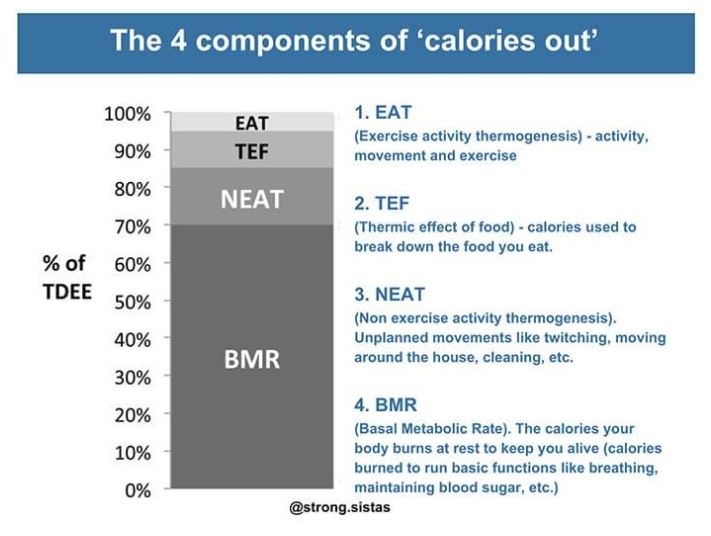
Your energy intake (calories in) equates to all of the calories you consume from food and liquids. Your energy expenditure (your ‘calories out’) is the sum of:
1.Your basal metabolic rate (BMR), which refers to the energy required for your body to maintain basic function. This includes breathing, digesting food, pumping blood throughout the body, maintaining strong hair and nails, the generation of energy, etc.
This accounts for 65% to 70% of your total daily expenditure — making it the largest contribution to the energy expenditure equation. Increasing your metabolic rate is one of the best ways to make weight loss and maintenance more sustainable in the long run. You can increase your BMR and this is advantageous for weight loss!
2.Nonexercise activity thermogenesis — NEAT (body movements outside of planned exercise, like fidgeting, doing laundry, etc.). Calories burned from NEAT will vary A LOT. More active individuals (higher daily step counts) will burn more calories due to higher levels of NEAT. Dr. Levine has shown that NEAT can vary by up to 2,000 calories per day between two individuals of the same size!
3.Exercise, the energy your body uses for planned physical activity, whether that is strength training, playing sports or a cardio session. You actually don’t burn many calories during a strength training session — and the goal isn’t to burn calories. The goal is to elicit a muscular adaptation to then increase the amount of lean mass (muscle) you have, and thus increase your metabolism.
4.Thermic effect of food (TEF) — The amount of calories your body uses to digest the food you consume.
There’s been a lot of debate about the “calories in vs. calories out” model for weight loss, and for good reason. Dr. Fatima Cody Stanford, an obesity specialist and professor at Harvard Medical School, shared this powerful critique:
“This idea of ‘a calorie in and a calorie out’ when it comes to weight loss is not only antiquated, it’s just wrong,” says Dr. Fatima Cody Stanford, an obesity specialist and assistant professor of medicine and pediatrics at Harvard Medical School.
“The truth is that even careful calorie calculations don’t always yield uniform results. How your body burns calories depends on a number of factors, including the type of food you eat, your body’s metabolism, and even the type of organisms living in your gut. You can eat the exact same number of calories as someone else, yet have very different outcomes when it comes to your weight.”
She’s absolutely right — there’s nuance here! Factors like your metabolism, hormones, and even gut health all play a major role in how your body uses energy. The types of foods you eat can even influence how many calories your body burns.
But here’s the key takeaway: While energy balance isn’t as simple as “just eat less, move more,” it still does apply. Extra energy (calories) that your body doesn’t need doesn’t just disappear — it’s stored as fat. This is why understanding your metabolism is so important.
If your metabolism isn’t functioning optimally — due to poor habits, chronic dieting, or hormonal imbalances — your calorie-burning capacity will be significantly lower. And that means weight loss becomes much harder, even if you’re eating “healthy” foods.
So, what’s the solution? You have to meet your metabolism where it’s currently at. Instead of slashing calories or overtraining, focus on gradually improving your metabolic health over time. This patient, intentional approach helps your body adapt and become more efficient at burning energy, setting you up for sustainable success.
Food doesn’t just “poof” into thin air — it’s either used as energy, stored for later, or helps rebuild and repair your body. The key is to optimize how your body processes that energy, so you can feel great and achieve your goals without constant frustration.
Save This Article for Later – Get the PDF Now
Download PDF
Understanding Your Metabolism — A Game-Changing Perspective
Picture this: You’re planning to drive cross-country. Would you start that journey with a car that’s barely running, or would you first make sure your engine is in top condition? When it comes to fat loss, your metabolism is that engine — and its condition makes all the difference. Let me paint you a picture with a real-world scenario:
Meet Anna. She’s maintaining her weight at 1,600 calories daily. To lose weight, she’d need to drop to ~1,200 calories — that’s less than what most children need! It’s like trying to run a marathon on an empty stomach.
Not only is it unsustainable, but it’s also setting yourself up for a cycle of restriction, binge eating, and frustration. Sound familiar? Now, let’s flip the script.
Instead of jumping straight into restriction, Anna decides to invest 3 to 6 months in boosting her metabolism. Through strategic changes in her lifestyle and nutrition (more on these amazing tricks coming up!), she gradually increases her maintenance calories to 2,300 per day. That’s right — she’s now maintaining her weight while eating 700 more calories daily!
Your maintenance calorie intake is not a set number, it is a range of calories. Below the bottom end of that range, you lose weight, above the top end of that range, you gain weight. But again, the cool thing is that you can shift that range up by improving your metabolism!
Here’s where it gets exciting: When Anna decides to start her fat loss journey from this higher maintenance calorie intake, she can eat at a much more reasonable calorie level. No more surviving on lettuce leaves and coffee! She can enjoy satisfying meals while still making progress toward her goals.
Think of it like upgrading your body’s engine. By improving how your metabolism and thyroid system function, you’re essentially turning your body into a more efficient calorie-burning machine. The result? When you do decide to lose fat, you can do it while eating more food, feeling more energized, and actually enjoying the process.
Remember: Your body is incredibly adaptable, but it needs time and patience. The journey from Point A to Point B isn’t a sprint — it’s a strategic process that sets you up for lasting success. Ready to learn how to make this transformation happen? Let’s dive into the exact steps you need to take.
Boosting Your Metabolism — Your Step-by-Step Guide
Now that you understand why improving your metabolism is so crucial, you’re probably wondering: “Okay, but how exactly do I do this?” Let’s break down the process of increasing your BMR (basal metabolic rate) — or in simpler terms, how to rev up your body’s natural calorie-burning engine.
What I’m about to share with you is a proven roadmap that has worked not just for me, but for countless others in our course, Rooted in Resilience.
Here’s the key: Think of these steps as building blocks. Just like you wouldn’t put the roof on a house before laying the foundation, each step builds upon the last. Master one before moving to the next — this isn’t a race, it’s about creating lasting change. Let me walk you through these five game-changing steps:
•Step 1: Break free from the quick-fix trap — Let’s talk about something we’ve all been tempted by — those alluring quick-fix diets that promise dramatic results overnight. You know the ones: “Cut all carbs and watch the pounds melt away!” But here’s what those flashy promises don’t tell you.
Sure, eliminating carbs might show you a lower number on the scale initially. But here’s the reality check: what you’re mostly losing is water weight from dropping stored glycogen, and sometimes even precious muscle mass (definitely not what we’re aiming for!). It’s like cleaning your house by shoving everything into a closet — it looks good temporarily, but you haven’t solved the real problem.
I’ve seen this pattern hundreds of times in our course. The story usually goes something like this: “I tried keto and lost weight quickly … but then I gained it all back, plus some extra pounds.” These aren’t isolated cases.
When you restrict entire food groups, you’re not just affecting your weight — you’re disrupting your hormones, slowing down your metabolism, and worst of all, setting yourself up for an exhausting cycle of restriction and binging.
Here’s a truth that might surprise you: Cutting carbs isn’t some magical key to fat loss. Yes, some people lose weight on low-carb diets, but that’s simply because they’re eating fewer calories overall — not because carbs are the enemy.
Your body is perfectly capable of burning fat while enjoying carbohydrates. In fact, a balanced approach that includes all macronutrients often leads to better, more sustainable results.
Remember this: Your body is smarter than any trending diet. Instead of looking for the next quick fix, let’s focus on what really works — building a stronger metabolism and creating healthy, sustainable habits that stick around long after the latest fad diet has faded away.
•Step 2: Know your numbers — they tell your story — You’ve heard the saying “what gets measured, gets managed,” right? Well, when it comes to improving your metabolism, this couldn’t be more true. Think of it like trying to follow a map without knowing your starting point — pretty tricky, right?
This is why your first crucial step is simple but powerful: Start tracking your weight and food intake. Consider this your metabolic GPS — it tells you exactly where you’re starting from and helps guide your journey forward. Why is this so important? Because without knowing your baseline:
◦You can’t accurately gauge your maintenance calorie needs
◦You won’t know if you’re making real progress or just seeing normal fluctuations
◦You might be eating far less (or more) than you think
◦You’ll miss important patterns in how your body responds to different foods and portions
The easiest way to get started? Download an app like Cronometer and begin logging your meals. Don’t worry about changing anything just yet — simply observe and record. Weigh yourself consistently (ideally first thing in the morning) and track these numbers too.
Remember: This isn’t about judgment or restriction — it’s about gathering information. Think of yourself as a scientist collecting data about your own body. This baseline data will become your roadmap for making informed decisions about your nutrition and metabolism going forward.
•Step 3: Become the chef of your metabolic success — Want to know one of the most powerful ways to boost your metabolism? It’s simpler than you might think: Start cooking your own meals. This isn’t just about saving money or knowing what’s in your food (though those are fantastic bonuses!) — it’s about giving your body the precise fuel it needs to fire on all cylinders.
Think of your metabolism like a high-performance engine. Sure, it might run on regular gasoline, but it performs best with premium fuel. When you cook your own meals, you’re in control of that fuel quality.
Restaurant meals and processed foods often come with a hidden metabolic cost: they’re typically loaded with both carbs and fats (think french fries — high carb and deep fried), rich in inflammatory PUFAs (processed vegetable oils), and surprisingly low in the micronutrients your body craves.
But here’s the good news: You don’t need to become a gourmet chef or never eat out again. Even cooking most of your meals at home (while still enjoying the occasional restaurant meal) can make a huge difference. Why? Because you’re:
◦Avoiding those sneaky preservatives, gums, and fillers that can wreak havoc on your gut health
◦Controlling your ingredients to support energy production
◦Choosing foods that help balance your hormones
◦Building a foundation for a stronger metabolism
Remember, every meal you cook is an investment in your metabolic health. Start simple, focus on whole foods, and watch how your body responds when you fuel it with care. Your metabolism will thank you!
•Step 4: Develop a well-rounded exercise and movement routine — Here’s the thing: you don’t need to go overboard with exercise to improve your metabolism, but staying active is essential. Humans are built to move! Regular activity isn’t just about burning calories — it supports a healthy metabolic response, helping your body function at its best.
Science backs this up. Studies show that people who move consistently throughout the day — not just during a quick workout — maintain better body composition and higher metabolic rates than those who are more sedentary.
In fact, sitting all day after a workout can cancel out some of the health benefits of that workout. Yup, even if you crushed it in the gym, being sedentary the rest of the day means your body isn’t reaping the full rewards, like improved fuel utilization. So, what’s the sweet spot?
◦Strength train 2 to 3 times per week — Why? Muscle is the most metabolically active tissue in your body. Building and maintaining muscle helps boost your metabolism long-term.
◦Aim for 8,000 to 12,000 steps per day — Think light walks, active breaks, or just incorporating more movement into your daily routine.
The goal is to blend intentional workouts with regular movement throughout the day. This balanced approach maximizes the benefits of exercise, promotes fat loss, and supports overall health — without the burnout of overtraining. Let’s keep it simple: Move more. Lift weights. Feel amazing. You’ve got this!
•Step 5: Gradually increase your calorie intake — Now that you’ve spent a few weeks learning how to track and understand your calorie intake, it’s time to take the next step — slowly increasing your calories. Why? Gradual increases help your body adapt, improving your metabolism without unwanted weight gain. Here’s how to do it:
◦Split your calories into 3 balanced meals per day (breakfast, lunch, and dinner), plus a snack if needed.
◦Start small — Increase your daily calories by just 10 to 30 calories per week. For example, if you’re starting at 1,800 calories in week one, aim for 1,820 to 1,830 in week two, and so on.
◦Track bodyweight trends — Weigh yourself 3 to 7 times per week and compare weekly averages. The goal is to increase calories while keeping your weight stable. A small bump at the beginning is normal, but we don’t want to see a continuous upward trend.
Why so slow? This gradual approach gives your body time to utilize the extra energy effectively, boosting your metabolic rate (a.k.a. improving your “calories out”) without storing it as fat. Think of it as training your metabolism to work smarter, not harder. What’s the payoff?
After just 3 months of small weekly increases, you could be eating 240 to 360 more calories per day! That’s extra fuel for your body without sacrificing progress. Many people can continue to increase for several more weeks (since most people have severely downregulated their metabolisms due to years of restrictive diets!)
But remember: You can’t increase calories indefinitely. At some point, you’ll reach the upper end of your maintenance calorie range, where adding more calories leads to weight gain. If that happens, adjust slightly down and stay at that sweet spot. The longer you maintain at the upper end of your calorie window, the better your body will adapt.
This is about more than calories — it’s about building a stronger, more efficient metabolism while giving your body the fuel it needs to thrive.
Summary
And that’s a wrap, folks — five steps to improve your metabolism! Taking time to focus on a maintenance phase can do wonders for your body and mind. Dieting endlessly wears down your metabolism, leads to mental fatigue, and makes it harder to stick with any plan. When you’re constantly bouncing in and out of dieting cycles, it’s easy to lose the belief that you can actually succeed at sustainable fat loss.
Here’s the good news: eating at maintenance can reset your metabolic baseline, restore your mental energy, and build the momentum you need to crush your future fat loss goals. And for some people, these changes alone — better habits and a stronger routine — can even lead to weight loss as their “calories out” increases, creating a natural calorie deficit.
But the benefits don’t stop there. A maintenance phase can also repair your relationship with food. Long-term dieting often damages our hunger cues, makes it harder to trust our instincts, and turns eating into a mental battle. Imagine a life without constant food anxiety, restrictive rules, or fear of eating “too much.”
Instead, picture yourself eating with satisfaction and abundance, free to focus on your passions and goals. Resetting your metabolism isn’t just about physical health — it’s about creating the freedom to live fully, without the weight of dieting holding you back.
Transform Your Health — One Step at a Time
Ashley and her sister Sarah have put together a truly groundbreaking step-by-step course called “Rooted in Resilience.” They have compiled what clearly is the best application of Dr. Ray Peat’s work on Bioenergetic Medicine that I have ever seen.
It is so good that I am using the core of their program to teach the many Health Coaches that I am in the process of training for the new Mercola Health Clinics I am opening this fall. It took these women working nearly full-time on this project for a year to create it.
This has to be one of the absolute best values for health education I have ever seen. If you want to understand why you struggle with health problems and then have a clear program on how to reverse those challenges, then this is the course for you.
It is precisely the type of program I wish I would have had access to when I got out of medical school. I fumbled around for decades before I reached the conclusion they discuss in the course and share with you so you can restore your cellular energy production and recover your health.
Use reverse dieting to increase your calories without gaining weight and tanking your metabolism, all while improving your energy levels
Select and eat the right foods to heal your metabolism and improve glucose utilization
Balance your hormones to help reduce anxiety, weight gain and sleep disturbances
Heal your gut for proper immune function, mood and weight management
Tweak your diet and lifestyle habits to improve your mindset and mental health
Crush your fitness goals with ease and get your life back on track
Master the most essential habits for health with bonus guides, including tons of meal plans to take the stress out of meal time planning and shopping, and so much more!
https://articles.mercola.com/sites/articles/archive/2025/01/14/sustainable-weight-loss.aspx