On Knowing The Rules Of The Game

Saying something isn’t so,
Really doesn’t make it so.

When you call the Universe wrong,
It cuts your chances of living long.

Life obeys set rules and laws,
Best you learn them and make them yours.

A criminal cannot follow orders,
Sane men keep within the borders.

Rice, Brown and White – A Tip

Rice is a dietary staple for a large percentage of the world’s population and has been for centuries.

While people ate brown rice the nutrition provided was good. When the preference switched to the more palatable and more easily chewable white rice, nutritional deficiencies resulted.

White rice is produced by removing the bran and germ of the rice grain, leaving only the starchy endosperm. While this process extends shelf life and provides a quicker cooking time, it also removes critical nutrients, most notably thiamine (vitamin B1). Thiamine deficiency is the leading cause of beriberi.

Also, refined carbohydrates like white rice have been linked to a host of modern health issues, including obesity, diabetes, and metabolic syndrome. For this reason what little rice I consume is brown rice.

For those who prefer white rice over brown there is a process by which the negative impacts of white rice can be reduced. Obviously you cannot replace the lost nutrients by other than supplementing but you can decrease the inflammatory effects of white rice with this tip.

Resistant starch is a type of starch that resists digestion in the small intestine and ferments in the large intestine, feeding the beneficial bacteria in the gut. This not only improves digestive health but also increases feelings of fullness, reduces inflammation, and improves insulin sensitivity.

Here’s the hack: cook your rice with a teaspoon of coconut oil, then cool it for 12 hours before reheating. This simple process can increase the resistant starch content of rice by up to 10 times! The coconut oil interacts with the starch molecules, making them more resistant to digestion, while the cooling process further crystallizes the starch. The result is a healthier, more satisfying rice that won’t send your blood sugar on a roller coaster.

https://nexusnewsfeed.com/article/food-cooking/the-shocking-truth-about-white-rice-and-how-to-make-it-healthy-again/

How Dairy Can Boost Fat Loss

In the ever-evolving world of nutrition and weight loss, few food groups have been as controversial as dairy. Once hailed as a cornerstone of a healthy diet, then vilified as a contributor to weight gain, dairy products have experienced a rollercoaster of public opinion. However, recent scientific research is shedding new light on the potential benefits of dairy in weight management, revealing some surprising findings that may change how we view these nutrient-dense foods.

Dairy products have been a part of human diets for over 7,000 years, valued not just for their taste but also for their nutritional density. Throughout history, milk, cheese, and yogurt have been staples in many cultures, providing essential nutrients like calcium, protein, and various vitamins. However, as obesity rates began to rise in the late 20th century, dairy products — particularly those high in saturated fat — came under scrutiny when the anti-saturated fat campaign began.

Recent studies have begun to challenge the notion that dairy products are a causal factor for weight gain.1 In fact, emerging evidence suggests that dairy might play a beneficial role in fat loss and body composition. Let’s dive into some of the intriguing findings.

https://articles.mercola.com/sites/articles/archive/2024/09/17/dairy-fat-loss.aspx

On Boron, Castor Oil and Seizures

One of my clients was kind enough to send the following after my previous post on Boron.

Hi Tom

It’s interesting that you had such a positive story to tell about Boron AKA Borax.

My husband would have extreme back pain just before it rained. It was good for me because I knew when to take out my umbrella but very debilitating for him.

He took the Boron (I got the recipe from Bitchute.com) and he is no longer my weather reporter. He is pain free.

I wanted to let you know about another one of the supposed “wives tales” that just happen to work.

My husband was experiencing seizures and they were increasing in both quantity and severity. We didn’t go to the doctor because the Big Pharma cures have side effects that are worse than the disease. The last seizure he had was terrible and at the end of the seizure he said he’d had an NDE (near-death experience).

After this shock I felt an urgent need for a cure. I happened to Google a snippet from a woman who had a daughter with severe epilepsy and she said since taking a teaspoon of Castor Oil occasionally there had been no more seizures.

I remember some of my friends complaining that their mother would line them up for a weekly dose of Castor Oil so I though “What the heck…we have nothing to lose” so I dosed my husband and “Viola” no more seizures.

I think one of the side effects of the jab is seizures so this may be of help for some other people.

Have a wonderful day!

M

Flu Vaccination Increases Risk of Medium- and Long-Term COVID-19 Symptoms: ‘Journal of Clinical Medicine’

Yet more evidence that vaccines compromise the immune system and thus increase the risk of harm from other pathogens.

study published earlier this month in the peer-reviewed Journal of Clinical Medicine confirms influenza (flu) vaccination increases the risk of medium-term and long-term COVID-19 symptoms.

https://jonfleetwood.substack.com/p/flu-vaccination-increases-risk-of

BREAKTHROUGH: How The Spike Protein Leads to Multiple Pathologies

Free Radical Schematic

Ribeiro, et al. demonstrate how the Spike Protein may induce a state of systemic, chronic elevated ROS production which satisfactorily explains post-Covid/Spike Protein exposure pathology.

It was one of those moments when the clouds lift, and you can suddenly see for miles and miles with complete clarity. I have been studying a new paper by Ribeiro et al. The title belies the staggering importance of the paper.

Inhibition of HIF-2α Pathway as a Potential Therapeutic Strategy for Endothelial Dysfunction in Post-COVID Syndrome

The headline, indeed, does not tell us what the most important finding in the paper is. This finding completely explains all the aging/pathological implications of what I predicted the Spike Protein would do to the body: Excessive ROS Production.

I had seen this over three years ago, in 2021.

IS THE SPIKE PROTEIN OF SARS-CoV-2 A MITOCHONDRIAL “TORPEDO?”
https://wmcresearch.org/is-the-spike-protein-of-sars-cov-2-a-mitochondrial-torpedo/

Ribeiro, et al. Showed that the S1 unit of the Spike Protein does, indeed, significantly increase ROS production in cells and in the mitochondria.

Next we tested whether S1 exposure affects ROS and NO production in HREC. ROS significantly increased in a time-dependent manner (3 hours, p=0.014; 4 hours, p= 0.008; 5 hours, p=0.010; 6 hours, p=0.025) upon S1 treatment (Figure 5A). Additionally, mitochondrial ROS production also rose in cells treated with S1 (Figure 5B). 

What is even more concerning is that, as I have also predicted, the plasma of those with Long COVID performs precisely the same function.

Our findings revealed a time-dependent rise in cellular ROS (1 hour, p=0.0086; 2 hours, p=0.0064; 3 hours, p=0.0.0083; 4 hours, p= 0.012; 5 hours, p=0.0321; 6 hours, p=0.0298) following treatment with PCS-plasma (Figure 6A). Additionally, mitochondrial ROS significantly increased 4 hours post-treatment (Figure 6B). 

Inhibition of HIF-2α Pathway as a Potential Therapeutic Strategy for Endothelial Dysfunction in Post-COVID Syndrome
https://www.medrxiv.org/content/10.1101/2024.09.10.24313403v1.full-text

What does this mean?

This was the moment the clouds lifted. The moment of clarity. Though we need more studies to provide proof, what I am almost certain is occurring is that the Spike Protein damages the Endothelium, inducing what I have termed Spike Protein Endothelial Disease (SPED). SPED causes the barrier of the Endothelium to lose integrity. This then allows the S1 unit to penetrate organs and induce excessive ROS production, leading to the plethora of disease states we are universally observing.

It is like a lethal can opener.

Also, we need randomly sample the blood supply to determine if Spike-exposed plasma is inducing the same effects.

Without question. The Spike Protein of SARS-CoV-2 must be avoided at all costs. A state of chronic ROS production cannot be endured by the body. This is certainly how it is aging us. Fortunately, we can avoid massive doses of Spike and reduce duration/severity of infection. We can also heal the damage done and prevent future damage.

I will be working on researching the state of Spike reverse transcription. That is a separate, yet equally important factor which we must determine.

https://wmcresearch.substack.com/p/breakthrough-the-spike-protein-via

Carbohydrates: The Unexpected Ally in Your Fat Loss Journey

A Dr Joseph Mercola article includes this gem, Let’s start with a myth: carbohydrates are inherently fattening and should be removed from your diet if you want to lose weight. This is not true! Carbohydrates can and should be included in a healthy fat loss phase. So in this article let’s talk about why including carbs in your diet is BENEFICIAL for fat loss.”

The article is worth reading:

https://articles.mercola.com/sites/articles/archive/2024/09/10/carbohydrates-fat-loss.aspx

Best And Worst Produce For Toxic Load

Environmental Working Group’s Dirty Dozen:

Strawberries
Spinach
Kale, collard and mustard greens
Grapes
Peaches
Pears
Nectarines
Apples
Bell and hot peppers
Cherries
Blueberries
Green beans

EWG’s Clean Fifteen:
Avocados
Sweet corn
Pineapple
Onions
Papaya
Sweet peas (frozen)
Asparagus
Honeydew melon
Kiwi
Cabbage
Watermelon
Mushrooms
Mangoes
Sweet potatoes
Carrots

Finish reading: https://www.ewg.org/foodnews/summary.php#clean-fifteen

The ultimate guide to Fermented Foods

Fermented Foods

Fermented foods and beverages have been part of the human diet for centuries. Although history is a little vague as to how the fermentation process was developed and by whom, archaeological findings suggest that the practice has been around since 13,000 B.C. [1]

In fact, archaeologists uncovered evidence of the earliest form of fermentation – specifically beer brewing from cereal grains – when they analyzed stone mortars found in Natufian burial sites. The Natufians were a semi-sedentary, foraging group of people that occupied the Levant region (modern-day Israel, Jordan, Lebanon and Syria) some 15,000 years ago. [2]

The Natufians were not the only ones who enjoyed using fermented products. Historical records show that fermented bread and beer were also diet staples in ancient Egypt. Vinegar, which is made via a two-step fermentation process and whose origins can be traced back to 5,000 B.C. in ancient Babylon, has also been found in ancient Egyptian urns. [3]

In ancient Greece and Italy, freshly harvested grapes were pressed underfoot in large pottery vessels or stone vats and fermented in terracotta jars to make red and white wine. Because the ancient Greeks and Romans were avid drinkers of this fermented beverage, wine became a common everyday drink that was consumed on its own or while having a meal. [4]

Yogurt is another fermented food that was widely consumed in ancient Rome and Greece. But because it was considered by the Greeks as “poor man’s food,” yogurt was only consumed by the peasants, who liked adding a bit of honey to make the sour fermented product more palatable. [5]

The ancient Mesopotamians and nomadic Turks were also great consumers of yogurt. In fact, it is widely believed that the first ever yogurt was created by accident when milk turned sour in the warm temperatures of the desert somewhere in the Middle East.

According to some historians, the earliest known appearance of yogurt was in Mesopotamia (modern-day Iraq) more than 7,000 years ago (around 5,000 B.C.). In Turkish literature, the consumption of yogurt was first mentioned in texts dating back to the 11th century (1100 B.C.). It is also believed that “yogurt” came from the Turkish word “yoğurmak,” which means to thicken, coagulate or curdle.

Two Turkic ethnic groups, namely, the Karachays and the Balkars, who lived in the North Caucasus region, are also credited with developing kefir, a fermented drink whose consistency and flavor are similar to yogurt. Kefir is produced by fermenting milk using kefir grains, a symbiotic culture obtained by fermenting milk in animal skins over a long period of time. [6]

The consumption of fermented foods and beverages was not only widespread in ancient Europe and the Middle East but also in Asia. In countries like Mongolia, India and China in particular, yogurt was considered a medicinal food and consumed for its health-supporting properties.

Genghis Khan, the founder of the first Mongolian Empire, was said to have encouraged his army to drink a type of yogurt made from fermented horse milk called “kumis.” He believed that consuming kumis made his soldiers stronger and braver. [7]

In ancient India, yogurt found a place in the kitchens of Emperor Akbar I, who ruled the Mughal Empire from 1556 to 1605. But even before his reign, Ayurvedic scripts dating from about 6,000 B.C. had been heralding the health benefits of consuming fermented dairy products like yogurt. [8]

Researchers also discovered that around the same time (or even earlier), the ancient Chinese had been fermenting a mixture of rice or millet, honey and fruit to make alcoholic beverages. Records state that in the palace of the Shang emperor, fermented drinks, along with various fermented foods, were stored in bronze vessels and offered as sacrifices to royal ancestors. [9]

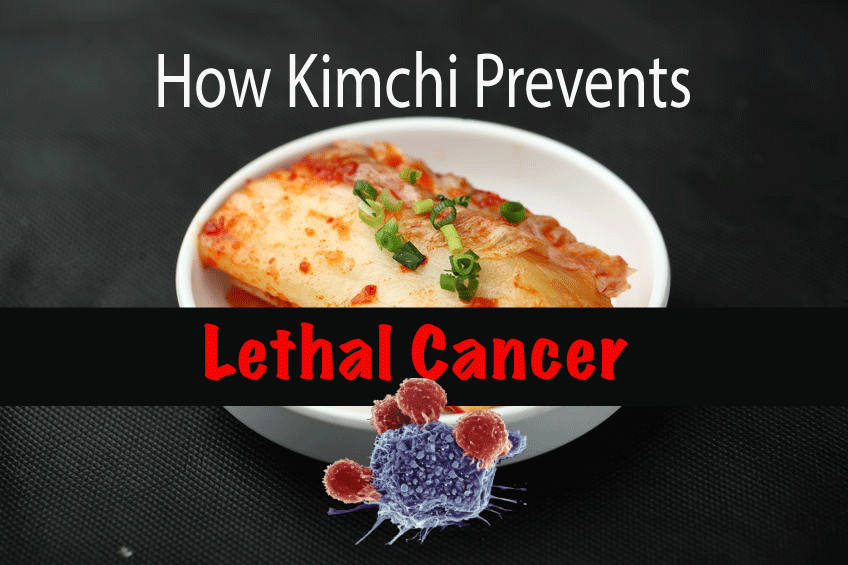
China and neighboring countries like Japan and Korea, as well as Indonesia in the south, eventually came up with more fermented food products – such as soy sauce, natto, kimchi, nai lao (Beijing yogurt), miso and tempeh – that are now commonly consumed on their own or used in kitchens worldwide.

Fermented foods from the West like sauerkraut, pickles, cottage cheese and buttermilk have also spread in other parts of the world and are now widely appreciated not only for their unique flavors and versatility, but most especially for their wonderful health benefits.

Fermentation and the benefits of fermenting foods

The first people to make use of fermentation primarily employed the technique for food preservation. But as fermented foods gradually became a part of their diet, the early humans realized that consuming such foods provided many health benefits. In fact, some cultures used fermented foods as a natural remedy.

Yogurt, for instance, was introduced by King Francis I of France to Western Europe in 1542 as a medicinal food. [10] But it wasn’t until the early 20th century that people began to understand what gave yogurt – and fermented foods in general – its health-supporting properties.

In 1905, a Bulgarian microbiologist named Stamen Grigorov discovered the lactic acid bacterium Bacillus bulgaricus (now Lactobacillus bulgaricus), which is still used today to turn milk into yogurt. At the time, yogurt was consumed in large quantities in his home country particularly by peasants, who went on to live very long lives.

This piqued the interest of Russian-born scientist Ilya Ilyich Mechnikov, who was awarded the Nobel Prize in 1908 for his discovery of phagocytes (a type of immune cell that engulfs microbes) and phagocytosis in 1883. [11] Mechnikov theorized that B. bulgaricus in yogurt was responsible for support the health of Bulgarian peasants.

In 1965, researchers D.M. Lilley and R.H. Stillwell first coined the term “probiotics” to refer to “factors” or substances produced by microorganisms that enhanced the growth of others. But its definition was replaced in1974 by R.B. Parker, who referred to probiotics as “organisms and substances which contribute to intestinal microbial balance.” [12]

As researchers began to explore the importance of intestinal microflora in the maintenance of good overall health, it became clear how probiotics, the main components of fermented foods, can offer health benefits.

Numerous studies have found that gut microbial imbalance, which stems from harmful microbes outgrowing beneficial ones, leads to many health issues. [13] Thankfully, these issues can be relieved with the introduction of probiotics, or “good microbes,” from fermented foods.

According to a study published in the journal Molecules, probiotics can help keep bad gut microbes in check by inhibiting their ability to colonize other parts of the intestine. [14] This is why researchers recommend the consumption of fermented foods as a means of maintaining homeostasis in the gut.

Another good reason to include fermented foods, which are high in fiber, in your diet is that some intestinal microbes produce beneficial chemicals called short-chain fatty acids (SCFAs) while fermenting dietary fiber. [15] Aside from having health-supporting activities, some SCFAs like butyrate serve as an energy source for the cells that line the inside your colon. [16]

The health benefits of fermented foods don’t just come from their impact on your gut microflora. The fermentation process itself also contributes to the overall goodness of fermented foods, specifically in terms of stability, taste and nutrition.

Two types of fermentation are used to produce fermented foods. Lactic acid fermentation, considered to be one of the oldest food preservation methods in existence, is facilitated by lactic acid bacteria like L. bulgaricus, which use the lactose in foods to obtain energy.

In return, these bacteria produce a chemical called lactic acid, which inhibits the growth of microorganisms that cause food spoilage. Lactic acid is also responsible for the sourness of fermented foods. [17]

In addition to lactic acid, Lactobacilli are known to produce hydrogen peroxide, another compound that can stop the growth of food-spoiling microbes. Fermented foods that are produced using lactic acid fermentation include sauerkraut, kimchi, pickles, yogurt, miso, salami and sourdough bread. [18]

Alcoholic or ethanol fermentation occurs with the active participation of yeasts, fungi or some select bacteria. Instead of lactose, these microorganisms convert natural sugars like fructose and glucose to alcohol (ethanol), carbon dioxide and heat. The compounds generated by this process, including carbon dioxide, can protect foods from mold and other microbes that cause spoilage. [19][20]

During ethanol fermentation, certain enzymes in yeast help increase the levels of beneficial phytonutrients in the fermented products. One example of this is caffeic acid, a powerful antioxidant found in fruits, vegetables, edible herbs and spices. [21]

Caffeic acid is said to be released during fermentation from caftaric acid, a phenolic compound naturally present in grape juice. Red and white wine contain high levels of caffeic acid because of this. [22]

In addition to preventing food spoilage and increasing the phytonutrient content of foods, fermentation also helps destroy non-nutritive food components that can disrupt the activity of digestive enzymes. [23][24]

But what truly makes fermented foods such great foods for supporting good overall health is the fact that fermentation increases the bioavailability of their nutrient content. [25] According to research, the organic acids produced by fermentative microbes can bind to plant-based proteins and minerals to form soluble, easy-to-absorb products.

A study published in the journal Fermentation also reports that during fermentation, an enzyme capable of degrading the anti-nutrient, phytic acid, is formed. [26] This enzyme further helps you enjoy the nutritional benefits of fermented foods by preventing the binding of phytic acid to minerals. Phytic acid greatly reduces the bioavailability of nutrients in your gastrointestinal tract. [27]

Another great thing about fermentation is that, according to studies, fermentative microbes like lactic acid bacteria can synthesize some essential vitamins as well as bioactive compounds with beneficial activities. [28]

Research has found that some probiotic bacteria can produce vitamin K as well as water-soluble B-vitamins, such as biotin (B7), cobalamin (B12), folate (B9), niacin (B3), pantothenic acid (B5), pyridoxine (B6), riboflavin (B2) and thiamine (B1). [29]

Probiotic bacteria can also produce conjugated linoleic acid (CLA) and conjugated linolenic acid (CLNA), isomers of the healthy fats, linoleic acid and linolenic acid, respectively. [30] Found only in animal-based foods, CLA and CLNA are linked to significant health benefits.

To recap, here are the 7 benefits of Fermenting Foods:*

  • Increases the nutrient content of food
  • Improves the bioavailability of nutrients
  • Prolongs the shelf life of easy-to-spoil foods
  • Transforms the taste of food
  • Provides plenty of probiotics
  • Increases the levels of beneficial phytonutrients
  • Helps destroy non-nutritive food components (toxins and antinutrients)

https://www.healthrangerstore.com/blogs/natural-health/7-benefits-of-fermenting-food