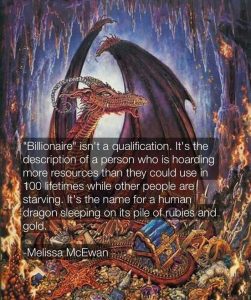
I love the example set by J.K. Rowlings. She lost her billionaire status because she gifted so much.
Or the European billionaire who purchased a swathe of Brazilian rainforest to prevent its destruction.

Tom's Blog on Life and Livingness
I love the example set by J.K. Rowlings. She lost her billionaire status because she gifted so much.
Or the European billionaire who purchased a swathe of Brazilian rainforest to prevent its destruction.


The convergence of multiple red-alert warnings is staring us in the face, all pointing to a major “event” of some type in the upcoming weeks or months.
Whatever it is, this new catastrophe will hasten the collapse of the old world system, a collapse of economies and political structures that is already underway, paving the way for the Great Reset or, as some call it, the New World Order. I call it the beast system.
Predicting the timing of such an event is impossible but I do believe we are looking at a major shock event happening roughly within the next three to nine months, a year at most.
The reason is simple. The billionaire globalist oligarchs desire to bring about a situation which involves digitization (of money and human beings), dehumanization (humans replaced by transhuman hybrids), destruction (of all cultural norms, male/female genders, the ability to reproduce without technology, etc.) and depopulation (of those deemed “useless eaters”). These are the “Four Ds” needed to bring about the total control that globalist technocrats seek to extend over all human behavior in a restructured world run by artificial intelligence and based on the elimination of all fossil fuel usage by the common man (non-oligarchs). If only the oligarchs have access to fossil fuels and only the oligarchs are allowed to reproduce and enjoy freedom of speech, what you end up with is a one-world slave state. And that’s exactly the goal.
So the Four Ds are used to get to the fifth and final D, which is dystopia. In the eyes of the globalist predator class, they’re reaching for their utopia, but for the rest of us, it will be a living hell, a dystopia.
https://lionessofjudah.substack.com/p/globalists-have-another-shock-event

Funny how the power elite all know what’s around the corner.

(Tom: I got to 43 but this guy listed 50!)
When it was confirmed that governments around the world released covid-19 “vaccines” which were made in a different way to clinical trial “vaccines” and that the commercial batches were contaminated with toxic DNA and endotoxins, Dr. Phillip Altman added it to his growing list of misinformation, disinformation and lies the public have been told.

Nearly half of the baby food we give children contains toxic pesticides which can harm their development, a study shows. This is “concerning” for babies who are “particularly vulnerable”, says the author.
https://www.mirror.co.uk/news/us-news/baby-food-bombshell-nearly-40-31512983
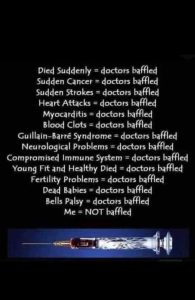
A friend posted these links on MeWe.com. I have not yet looked at them and with 70 tabs open in my browser, 114 saved images yet to be posted and put in my newsletters let alone the tens of thousands of as yet unread emails (what was that about information overload?) chances are I will not be getting to them any time soon. I am putting them here for you so if you are more organised and up to date than I you are not deprived of the data.
This five part “Viral Delusion” series is the quickest way to get up to speed. They can just be listened to while you are doing other things.
There was no “lab leak.”
Patents and money trails are not proof of existence.
The Viral Delusion, Episode One: “The Tragic Pseudoscience of SARS-C0V-2 (Behind the Pandemic Curtain)
https://rumble.com/v1709eh-the-viral-delusion-episode-1-the-tragic-pseudoscience-of-sars-cov-2.html
The Viral Delusion, Ep. 2:
“Monkey Business: Polio, Measles, and How it All Began.”
The Viral Delusion Part 3: The Mask of Death, The Plague, Smallpox and The Spanish Flu
The Viral Delusion Ep. 4:
AIDS: The deadly Deseption
The Viral Delusion, Ep. 5:
Sequencing the Virus: … without the v!rus.
Link to full Viral Delusion series, 1 – 5:
For 11.99, you may get better quality and support the creators at:
https://paradigmshift.uscreen.io
Doctor Samantha Bailey, Bioweapon B.S.:
https://www.bitchute.com/video/IYElbp12lKh0/
A Farewell to Virology, text:
https://drsambailey.com/wp-content/uploads/2023/09/A-FAREWELL-TO-VIROLOGY-Expert-Edition-English.pdf
A Farewell to Virology, part one – video commentary series with Steve Falconer
For further information, read Virus Mania, Fauci’s First Fraud, and AIDS, Opium, Diamonds, and Empire
Watch House of Numbers and Fauci’s First Fraud, on Rumble:
House of Numbers:
Bioweapon BS, Doctor Samantha Bailey
The End of COVID documentary series:
The Yin & Yang of HIV, Part One:
https://drsambailey.com/resources/videos/viruses-unplugged/the-yin-yang-of-hiv-part-one/
The Yin & Yang of HIV, Part Two:
The Yin & Yang of HIV, Part Three:
For more good resources:
“HIV, A Virus Like No Other:”
The legal challenges are rolling.