A good resource regarding Vitamin C.
Finish reading: http://www.doctoryourself.com/Levy%20Vitamin%20C%20Therapy%20Manila%202017.pdf

Tom's Blog on Life and Livingness
A good resource regarding Vitamin C.
Finish reading: http://www.doctoryourself.com/Levy%20Vitamin%20C%20Therapy%20Manila%202017.pdf
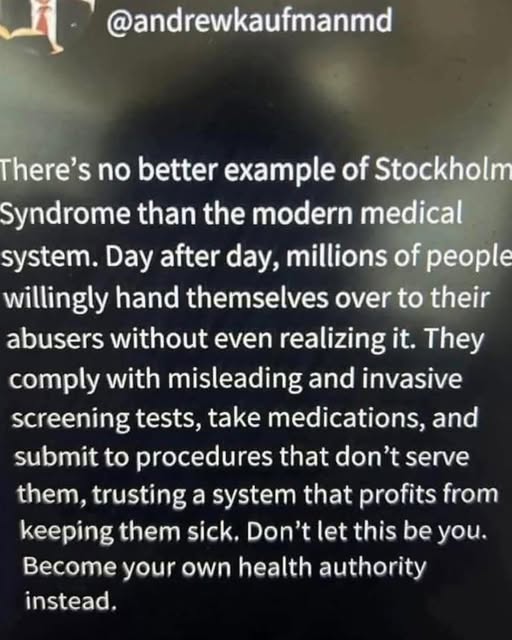
(Stockholm syndrome is a psychological response to being held captive or abused. People with Stockholm syndrome form a bond with their captors or abusers and sympathize with them.)

I know the exact pressure it takes to crack a rib during CPR. But last Tuesday, I learned a patient’s silence can break a doctor’s soul.
His name was David Chen, but on my screen, he was “Male, 82, Congestive Heart Failure, Room 402.” I spent seven minutes with him that morning. Seven minutes to check his vitals, listen to the fluid in his lungs, adjust his diuretics, and type 24 required data points into his Electronic Health Record. He tried to tell me something, gesturing toward a faded photo on his nightstand. I nodded, said “we’ll talk later,” and moved on. There was no billing code for “talk later.”
Mr. Chen died that afternoon. As a nurse quietly cleared his belongings, she handed me the photo. It was him as a young man, beaming, his arm around a woman, standing before a small grocery store with “CHEN’S MARKET” painted on the window.
The realization hit me like a physical blow. I knew his ejection fraction and his creatinine levels. I knew his insurance provider and his allergy to penicillin. But I didn’t know his wife’s name or that he had built a life from nothing with his own two hands. I hadn’t treated David Chen. I had managed the decline of a failing organ system. And in the sterile efficiency of it all, I had lost a piece of myself.
The next day, I bought a small, black Moleskine notebook. It felt like an act of rebellion.
My first patient was Eleanor Gable, a frail woman lost in a sea of white bedsheets, diagnosed with pneumonia. I did my exam, updated her chart, and just as I was about to leave, I paused. I turned back from the door.
“Mrs. Gable,” I said, my voice feeling strange. “Tell me one thing about yourself that’s not in this file.”
Her tired eyes widened in surprise. A faint smile touched her lips. “I was a second-grade teacher,” she whispered. “The best sound in the world… is the silence that comes just after a child finally reads a sentence on their own.”
I wrote it down in my notebook. Eleanor Gable: Taught children how to read.
I kept doing it. My little black book began to fill with ghosts of lives lived.
Frank Miller: Drove a yellow cab in New York for 40 years.
Maria Flores: Her mole recipe won the state fair in Texas, three years running.
Sam Jones: Proposed to his wife on the Kiss Cam at a Dodgers game.
Something began to change. The burnout, that heavy, gray cloak I’d been wearing for years, started to feel a little lighter. Before entering a room, I’d glance at my notebook. I wasn’t walking in to see the “acute pancreatitis in 207.” I was walking in to see Frank, who probably had a million stories about the city. My patients felt it too. They’d sit up a little straighter. A light would flicker back in their eyes. They felt seen.
The real test came with Leo. He was 22, angry, and refusing dialysis for a condition he’d brought on himself. He was a “difficult patient,” a label that in hospital-speak means “we’ve given up.” The team was frustrated.
I walked into his room and sat down, leaving my tablet outside. We sat in silence for a full minute. I didn’t look at his monitors. I looked at the intricate drawings covering his arms.
“Who’s your artist?” I asked.
He scoffed. “Did ’em myself.”
“They’re good,” I said. “This one… it looks like a blueprint.”
For the first time, his gaze lost its hard edge. “Wanted to be an architect,” he muttered, “before… all this.”
We talked for twenty minutes about buildings, about lines, about creating something permanent. We didn’t mention his kidneys once. When I stood up to leave, he said, so quietly I almost missed it, “Okay. We can try the dialysis tomorrow.”
Later that night, I opened my Moleskine. I wrote: Leo Vance: Designs cities on paper.
The system I work in is designed to document disease with thousands of data points. It logs every cough, every pill, every lab value. It tells the story of how a body breaks down.
My little black book tells a different story. It tells the story of why a life mattered.
We are taught to practice medicine with data, but we heal with humanity. And in a world drowning in information, a single sentence that says, “I see you,” isn’t just a kind gesture.
It’s the most powerful medicine we have.

Saw this bait post on X. Instantly thought, ‘Another one Bites The Dust’ by Queen.

Brazil shows people-first food access policies can conquer hunger, after lifting over 40 million people out of food insecurity in just two years, the UN confirms. Brazil now sends a timely signal to world leaders that tackling hunger, inequality and climate crisis together is achievable and replicable – if they make the political choice to do so.
“Brazil didn’t beat hunger by chance – this took concerted political action. We did it by putting people, family farmers, Indigenous and traditional communities, and access to good local food at the center – and by including those most affected,” says Elisabetta Recine, IPES-Food panel expert, and President of the Brazilian National Food and Nutrition Security Council (Consea).
With global food insecurity high and UN hunger goals dangerously off track – amid conflict, climate shocks and a spiraling cost of living – the success of Brazil Sem Fome offers both a wake-up call and a roadmap. It was achieved not through techno-fixes or increases to yields, but people-first policies to guarantee food access. Read more here to learn how they did it without GMOs.
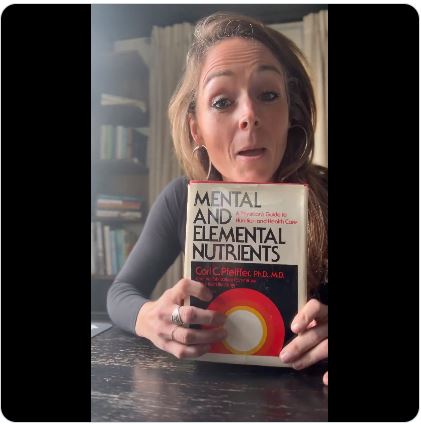
Kristina Cook writes: “I sound mad, because I am.
For 6 years, my daughter needlessly suffered from treatment resistant “severe mental illness” that I now know was metabolic and mitochondrial dysfunction that I could have fixed from day one on my own at home and in my kitchen. It was never Bipolar Disorder (and hallucinations during manic episodes), never OCD, never anxiety, not depression, not ADHD. It was her body screaming out for help.
This book was published in 1975. 50 years ago!!
In August of 2024, I found metabolic therapies. I changed our diet. I threw out ALL of my groceries and went to the farm. 7 days later, she was off her afternoon meds. 3 weeks after that, we found Brain Energy and added the ketogenic diet to our metabolic therapies. 3 days after that, she woke up an entirely new child. She was off all medication within the next 2 weeks and in remission ever since. From treatment resistant to living her best life in 6 weeks.
We are built from food. Not pharmaceuticals.
Get curious. Your child’s life might just depend on it.”
Click to view the video: https://x.com/KristinaCo9561/status/1971633310058135686