
“If you realized how powerful your thoughts are, you would never think a negative thought.”
Peace Pilgrim – Activist (1908 – 1981)
Pregnancy and Immune Modulation: Separating Nuance from Oversimplification
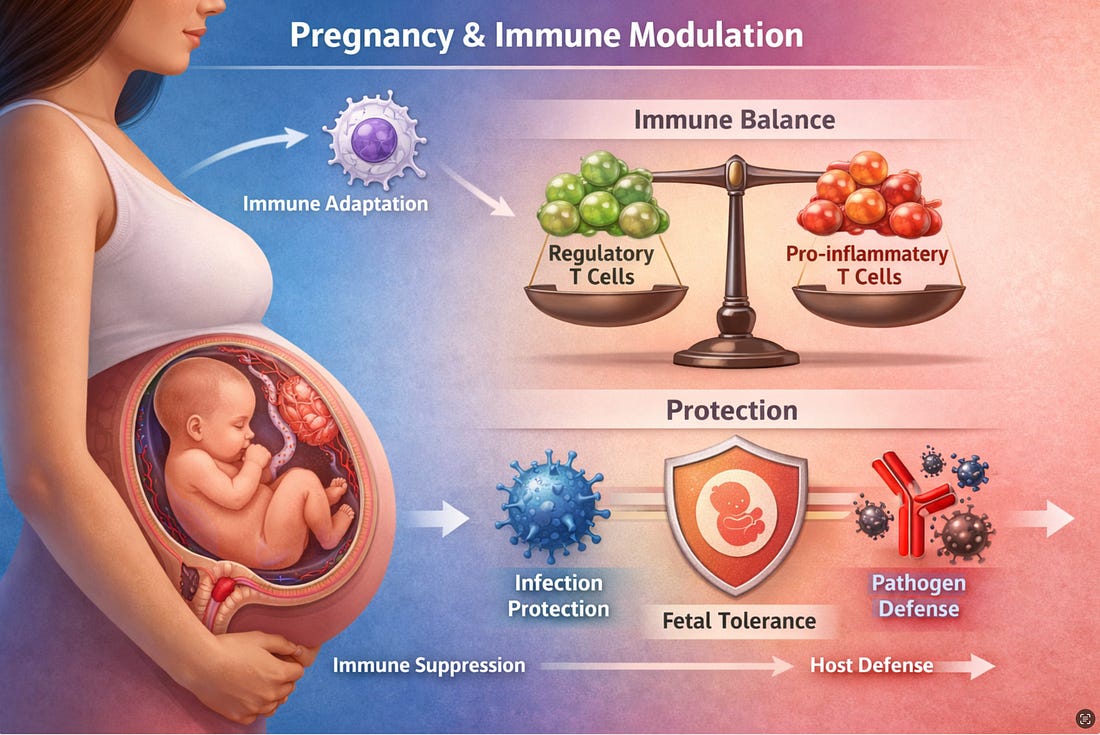
I had been told that a woman’s immune system “shuts down during pregnancy”. That is an incorrect oversimplification. The immune system does not shut down or reduce, it modulates its responses!
The claim that pregnancy “suppresses” the immune system has long served as a convenient shorthand for clinicians and public communicators alike. The reality documented in the scientific literature is considerably more sophisticated. Pregnancy does not weaken immunity in any straightforward sense; it recalibrates the immune system in ways that are both systemic and purposeful, with implications that extend well beyond the placental interface into how the pregnant body responds to pathogens and vaccines, and how the newborn is protected after birth.
Modulation, Not Suppression
The distinction between immune suppression and immune modulation is more than semantic. Multiple independent reviews have concluded that pregnancy reshapes the immune response rather than simply reducing it. As one widely cited synthesis states, the immune system during pregnancy is “not suppressed, but instead modulated to facilitate a pregnancy,” accounting for the differential susceptibility to different classes of pathogens observed across gestation.
This position is supported by large-scale longitudinal data. While there is little evidence for global immunosuppression during pregnancy, increased risks associated with certain viral infections reflect specific qualitative immunological changes rather than a general failure of host defense. The elevated severity seen with influenza, COVID-19, and hepatitis during pregnancy is attributable to targeted shifts in cellular immunity, not a wholesale reduction in immune function.
Those shifts are hormone-driven and body-wide. Estrogen, progesterone, human chorionic gonadotropin (hCG), and cortisol each modulate specific immune components — cytokine profiles, NK cell behavior, regulatory T cell populations, and neutrophil activity — in ways that propagate systemically far beyond the uterus. A 2025 study from the Icahn School of Medicine at Mount Sinai examining immunological transitions in uncomplicated pregnancies described dramatic changes in inflammatory mechanisms and immune cell dynamics when individuals transitioned from non-pregnant to pregnant states, with pre-pregnancy obesity further amplifying these inflammatory shifts.
Neutrophils illustrate the paradox well: they increase in number during pregnancy, but their reactive oxygen burst and cytokine responses post-stimulation are dampened — a state of being “primed but restrained.” Complement proteins such as C3a, C4a, and CH50 rise markedly, indicating that systemic inflammation is regulated rather than suppressed. These changes reflect a purposeful reconfiguration designed to sustain both maternal defense and fetal tolerance simultaneously.
The Placental-Systemic Feedback Loop
The local and systemic immune changes of pregnancy are not independent. The maternal-fetal interface is a unique immunological environment that balances fetal tolerance with pathogen defense, protecting both mother and fetus while preventing immune rejection of the genetically distinct fetus. Specialized local mechanisms — Hofbauer macrophages, decidual NK cells, and regulatory T cells accumulating in the decidua — create a tolerance-permissive microenvironment sustained by IL-10 and TGF-β secretion.
Critically, the hormonal signals driving these local adaptations propagate throughout the maternal circulation. This feedback loop between the placental microenvironment and the systemic compartment is why the immune changes of pregnancy cannot be understood in purely local terms. The pregnant woman’s response to a respiratory virus or to an intramuscular vaccine reflects ongoing immunological work to maintain the placenta, not merely a localized uterine adaptation.
Vaccine-Induced Immunity During Pregnancy: Functional Differences Exist
The modulated immune environment of pregnancy has measurable consequences for vaccine responses. A 2025 study published in npj Vaccines — part of the Nature Portfolio — examined serological and cellular responses to COVID-19 mRNA booster vaccines in pregnant and non-pregnant women and identified meaningful qualitative differences. Antibodies from pregnant women were less cross-reactive to non-vaccine antigens, including the XBB.1.5 and JN.1 variants. Non-pregnant women showed greater IgG1:IgG3 ratios and higher neutralization against all variants tested.
In contrast, pregnant women showed lower IgG1:IgG3 ratios and reduced neutralization breadth but demonstrated increased antibody-dependent NK cell cytokine production and neutrophil phagocytosis, especially against novel variants. The study also found that pregnancy increased memory CD4+ T cells, IFNγ production, and monofunctional dominance, and elevated fatty acid oxidation. This metabolic shift constrains B-cell and T-cell expansion and functional intensity, providing a plausible mechanistic basis for the observed differences in antibody quality.
This is not a picture of failed immunity. It is a picture of redirected immunity. The pregnant immune system compensates for narrowed antibody cross-reactivity by leaning more heavily on innate effector mechanisms. But from the perspective of protection against fast-mutating viruses, reduced cross-variant neutralization is a clinically meaningful limitation — one that routine titer comparisons in large immunogenicity studies may not capture. A 2025 systematic review in the Pediatric Infectious Disease Journal, comparing the immunogenicity of COVID-19 vaccines in pregnant versus non-pregnant persons, similarly confirmed detectable and generally protective titers in pregnancy while noting the need for more mechanistic data on functional antibody quality.
These findings raise an open question in the literature: should vaccine formulations or dosing intervals be modified to account for the pregnancy-specific immune state? The available data do not settle this question, but they make a strong case for transparent, independent investigation.
Breast Milk: A Second Immune Transfer System
After birth, the infant faces its greatest pathogen exposure risk at mucosal surfaces — the respiratory and gastrointestinal tracts — at a time when its own immune system is immature. Placental IgG transfer provides systemic coverage during the final trimester, but mucosal defense requires a different class of antibody. Breast milk addresses this gap, and the primary mechanism is secretory IgA (sIgA).
sIgA constitutes over 90% of immunoglobulins in mature human milk.8 When breast milk coats the infant’s oral mucosa, nasal cavity, Eustachian tubes, and gastrointestinal tract, sIgA binds pathogens at the surface before they can invade, keeping them immobilized for digestion and excretion rather than systemic entry. Critically, sIgA is stabilized by a secretory component that renders it highly resistant to digestive enzymes — a structural feature that IgG lacks — allowing it to remain functional throughout the infant’s gastrointestinal tract.
The sIgA content of breast milk is not generic. According to Brandtzaeg’s foundational work, the content of milk sIgA reflects the antigenic stimulation of the mother’s mucosal immune system by the intestinal and respiratory pathogens she has encountered.
Because mother and infant typically share an environment, this creates a personalized antibody repertoire calibrated to the specific pathogens the infant is most likely to face — a feature that formula cannot replicate.
Beyond immediate pathogen exclusion, breast milk sIgA plays a formative role in shaping the infant gut microbiome and regulating immune development. Experimental work in mice has shown that, in the absence of milk immunoglobulins, offspring develop natural IgA responses more rapidly, with premature germinal center reactions, suggesting that maternal sIgA actively modulates the pace and character of the infant’s immune maturation rather than simply substituting for it.
Natural Infection vs. Vaccination: A Difference in Milk Antibody Profile
A consistent finding across multiple studies is that the route of maternal antigen exposure determines the class of antibody predominating in breast milk. Natural infection — which stimulates mucosal immune tissues directly — generates an IgA-dominant milk antibody profile. Intramuscular vaccination, which acts primarily on systemic compartments, generates an IgG-dominant profile in milk.
This was documented explicitly in the context of COVID-19: mothers who recovered from SARS-CoV-2 infection had IgA-dominant antigen-specific antibodies in their breast milk, whereas mothers who received mRNA vaccines produced IgG-dominant responses in their milk.12 Whether breast milk IgG or sIgA provides more meaningful protection for the infant mucosal surface remains an active area of investigation.12 However, given that sIgA is structurally optimized for mucosal defense and enzymatic resistance, and given that influenza and pertussis vaccines administered during pregnancy have been shown to induce pathogen-specific sIgA and IgG in milk that protect breastfed infants from those respiratory illnesses,13 the route-of-exposure difference warrants continued study.
Conclusion
The scientific literature consistently supports one overarching conclusion: pregnancy represents a state of systemic immune recalibration, not suppression. The immune balance shifts from Th1-type proinflammatory activity toward Th2-type tolerance mechanisms; neutralizing antibody responses to novel antigens narrow, while innate effector pathways expand; and after delivery, breast milk provides a mucosal immune layer that is both personalized and only partially replicated by systemic vaccination.
Vaccines during pregnancy remain protective and are recommended — but the biological reality is more textured than institutional messaging typically conveys. Pregnant women generate detectable, functional immune responses to vaccines, while simultaneously operating under an immunological framework that prioritizes fetal tolerance, narrows cross-variant antibody breadth, and shapes infant mucosal immunity through a mechanism that intramuscular vaccines engage only incompletely. Understanding these distinctions is the reason to study it more rigorously, and to ensure that vaccine policy reflects the full complexity of the pregnant immune state rather than a simplified equivalence narrative.
Finish reading: https://open.substack.com/pub/rwmalonemd/p/pregnancy-and-immune-modulation
The Highest Level of Statesmanship
With all that is going on it pays to remind ourselves of the words of Lord Acton:
“The idea that the object of constitutions is not to confirm the predominance of any interest, but to prevent it; to preserve with equal care the independence of labour and the security of property; to make the rich safe against envy, and the poor against oppression, marks the highest level attained by the statesmanship of Greece.” – Lord Acton
Sweet potatoes: the superfood that balances blood sugar and boosts immunity

Rich in bioavailable vitamins A, C, B6, potassium and fiber, supporting immunity, brain function and blood sugar stability naturally.
Contains beta-carotene, cyanidin (in purple varieties) and other compounds that combat oxidative stress and chronic inflammation.
Supports detoxification and microbiome health, countering damage from GMOs, pesticides and processed foods.
High fiber content slows digestion, preventing insulin spikes—unlike refined carbs pushed by Big Food.
A whole-food alternative to synthetic supplements and medications, undermining big pharma’s profit-driven sickness model.
Sweet potatoes are far more than just a delicious side dish—they are a nutritional powerhouse packed with essential vitamins, minerals and fiber that play a crucial role in preventing deficiencies, supporting immune function and stabilizing blood sugar levels. Unlike processed foods laden with toxic additives, sweet potatoes offer a natural, nutrient-dense alternative that aligns with holistic health principles. Their rich antioxidant content, combined with anti-inflammatory properties, makes them an ideal food for detoxification and overall wellness.
Finish reading: https://nexusnewsfeed.com/article/food-cooking/sweet-potatoes-the-superfood-that-balances-blood-sugar-and-boosts-immunity/
Quote of the Day
“Happiness is an inside job.”
William Arthur Ward – Writer (1921 – 1994)
The coming changes in the International Monetary System: dedollarization, massive public and private debt levels

What was the Bretton Woods Monetary System?
Why the international monetary system based on a fiat U.S. dollar has provided the United States with some exorbitant economic privileges.
Many central banks have been gradually reducing their stocks of dollar-denominated Treasury bills and bonds in their official reserves relative to gold.
In the United States and in other economies, lax fiscal and monetary policies could trigger financial crises and an important economic downturn.
“That’s AI!”
Sebastian Lopez’s viral short film asks the uncomfortable question: when everything could be AI, can we still trust what we see?
Click to view the video: https://www.flixxy.com/thats-ai-2026-hilarious-short-film.htm
“Zero-knowledge encryption” promise breaks down with malicious server attacks.

Researchers at the Swiss Federal Institute of Technology (ETH Zürich) have discovered serious vulnerabilities in popular, cloud-based password managers that allowed them to view and modify stored passphrases.
Finish reading: https://www.itnews.com.au/news/researchers-find-critical-vulnerabilities-in-cloud-based-password-managers-623661
Carol Kaye

Some people change the world so quietly that the world doesn’t notice until decades later.
Los Angeles, 1963. A bass player didn’t show up for a recording session. The studio needed someone immediately. They looked around the room.
“Carol, can you play bass?”
Carol Kaye had never really touched a bass guitar before. But she didn’t say no to challenges. She picked up the instrument, figured out the part, and played the session.
That moment—born from someone else’s absence, from pure chance—changed the sound of popular music forever.
Carol Kaye became one of the most recorded bass guitarists in history. She played on an estimated 10,000 recordings. She created bass lines that became part of your DNA even if you never knew who played them.
And for decades, almost nobody outside the music industry knew her name.
But the musicians knew. When you needed a bass line that was clean, creative, and absolutely perfect, you called Carol Kaye.
Born in 1935 in Everett, Washington, Carol grew up during the Depression in a family that struggled. Music became her escape and eventually her survival.
She taught herself guitar as a teenager, learning bebop jazz by listening to records and figuring out the changes by ear. By her early twenties, she was skilled enough to play clubs alongside jazz legends in Los Angeles.
Throughout the 1950s, Carol worked the LA jazz scene. Bebop clubs on Central Avenue. Backing touring musicians. Making a living doing what she loved.
She was professional, talented, and respected in a world that didn’t often respect women musicians.
Then came the early 1960s and The Wrecking Crew. The loose collective of Los Angeles session musicians who played on countless hit records.
These weren’t the artists whose faces appeared on album covers. They were the anonymous professionals who actually played the instruments while the “bands” often just sang.
And Carol Kaye became one of their most indispensable members. And the only regular female member of the crew.
After that first bass session in 1963, Carol realized something. She was good at this. Really good.
The bass let her be melodic and rhythmic simultaneously. It let her create foundations that were simple enough to support a song but interesting enough to make it unforgettable.
Producers started requesting her specifically. Word spread. Carol Kaye could play anything. She was fast. Creative. Professional.
And she brought something special. A melodic sensibility from her jazz background combined with the pocket and precision that pop music demanded.
In 1966, Brian Wilson created Pet Sounds, the Beach Boys album that would redefine pop music. Carol played bass on “Good Vibrations.”
Her lines weren’t just accompaniment. They were architectural. They gave the songs movement, color, emotional depth.
She played on Phil Spector’s “Wall of Sound” productions. She played on Motown hits when Detroit labels brought their artists to LA. The Supremes. The Temptations.
Those iconic bass lines that made you want to dance? Many were Carol.
She played on Monkees hits. Barbra Streisand recordings. Frank Sinatra’s. The Righteous Brothers’ “You’ve Lost That Lovin’ Feelin’”—one of the most-played songs in radio history.
That’s Carol on bass.
And the MASH theme—“Suicide Is Painless.” That iconic, melancholy bass line? Carol Kaye.
She wasn’t just playing notes written on a chart. She was often creating the parts herself. Writing bass lines on the spot that became essential to the songs’ identities.
She was a composer without credit. An architect without recognition.
And here’s what makes Carol’s story both remarkable and infuriating. She was rarely credited.
Session musicians in that era typically weren’t. No royalties. No album credits. No acknowledgment.
For a woman in that environment, it was even harder. Carol had to be twice as good to get the same respect. She had to prove herself constantly in a world that assumed men were better musicians simply by virtue of being men.
She had to be perfect every time.
And she was.
Paul McCartney has called her one of the great bass players. Geddy Lee of Rush has praised her technique. Sting has acknowledged her influence.
These bass legends—men who became famous for their instrument—recognize Carol as a pioneer and master.
In 1976, Carol’s life changed suddenly. A car accident severely injured her hands and arms.
For a bassist, this is catastrophic. Her career as a session player effectively ended.
She could have disappeared. Many musicians do.
Carol chose differently.
After surgery and extensive recovery, she returned to music as a teacher. She began sharing everything she’d learned in those thousands of sessions.
She wrote instruction books. She mentored young musicians. She insisted, gently but firmly, that her contributions be acknowledged.
And slowly, the world started listening.
Today, at ninety years old, Carol Kaye is still teaching. Still inspiring new generations of bassists who are just discovering that the sounds they’ve been listening to their entire lives were shaped by this remarkable woman.
She doesn’t do it for fame. She never did.
She does it because music is what she loves, what she knows, what she has to give.
Carol Kaye’s story teaches us something crucial about greatness. It doesn’t always announce itself.
Sometimes, real greatness shows up, does extraordinary work, and moves on to the next job without needing applause.
But history remembers.
Carol Kaye was one of the architects of modern popular music. She created sounds that became part of global culture.
She proved that women belonged in recording studios not as novelties but as equals. As masters of their craft who could outplay almost anyone.
The next time you hear “Good Vibrations,” or the MASH theme, or any of dozens of classic songs from the 1960s and 70s, listen for the bass.
Really listen.
That’s Carol Kaye. That’s the sound of greatness that didn’t need to shout—because it knew how to create the rhythm that makes songs last forever.
She didn’t demand her place in history.
She earned it. One bass line at a time.
For decades, the world danced to her rhythms without knowing her name. Radio stations played her work thousands of times a day. Musicians built careers on songs she’d helped create.
And she just kept working. Session after session. Song after song. Creating the invisible architecture that held popular music together.
No ego. No demands for recognition. Just excellence repeated ten thousand times.
That’s a different kind of power. The kind that doesn’t need credit to matter. The kind that shapes culture from the inside out.
Carol Kaye changed what bass guitar could be. She brought jazz sophistication to pop simplicity. She made the instrument melodic when everyone else treated it as just rhythm.
She did it while being the only woman in rooms full of men who didn’t always want her there. She did it while raising children. She did it while fighting for fair pay and basic respect.
And she did it so well that her work became timeless.
Ninety years old and still teaching. Still sharing. Still making sure the next generation understands that greatness doesn’t require fame.
It just requires showing up, doing the work, and doing it better than almost anyone else can.
For those who’ve ever done excellent work that nobody noticed—what kept you going when the recognition never came but you knew the work mattered anyway?
Colonel David Hackworth
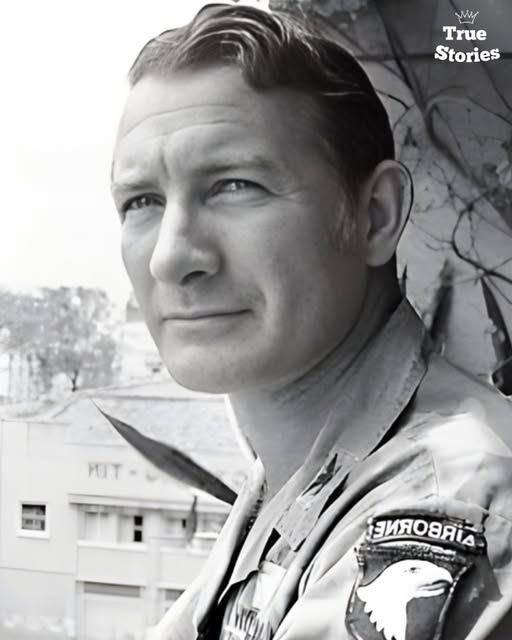
Colonel David Hackworth went on national television in 1971 and accused the U.S. Army of failing its own soldiers during the Vietnam War, knowing the interview would likely end his career.
At the time, David Hackworth was one of the most decorated officers in the military. He had earned eight Purple Hearts, two Distinguished Service Crosses, and more than 90 medals across Korea and Vietnam. Inside the Army, he was considered a combat legend. On May 27, 1971, sitting under studio lights on ABC’s Issues and Answers, he became something else.
A whistleblower in uniform.
Hackworth did not speak in generalities. He described drug use spreading through combat units, officers chasing body count statistics instead of protecting troops, and leadership decisions that he said were getting soldiers killed. He called the situation “a crisis in leadership” and warned that the Army was breaking down from the inside.
The reaction was immediate.
Pentagon officials were furious. Senior commanders accused him of disloyalty and exaggeration. Investigations into his conduct began within weeks. Hackworth later said he understood the risk before he spoke. “I knew when I did that interview, my career was over.”
The scrutiny intensified.
Military auditors examined his finances, his awards, and his command decisions. Hackworth denied wrongdoing, but the pressure mounted. Facing potential court martial and the collapse of his position, he resigned from the Army in 1971 after 26 years of service.
The consequences followed him into civilian life.
Some veterans saw him as a truth teller who spoke for enlisted soldiers. Others viewed him as a traitor who publicly attacked the military during wartime. The division never fully disappeared.
But Hackworth did not retreat.
In 1989, he published About Face, a 700 page memoir that detailed corruption, poor leadership, and systemic failures inside the Army. The book became a bestseller and is still used in military leadership courses. Later, as a military analyst for Newsweek and television networks, he continued criticizing Pentagon decisions, including readiness problems in the 1990s.
The irony defined his career.
David Hackworth had built his reputation by fighting wars aggressively and leading from the front. In Vietnam, he had created “Tiger Force” style units designed for mobility and survival, pushing commanders to reduce casualties rather than chase statistics.
His most controversial battle was not against an enemy.
It was against his own institution.
Colonel David Hackworth did not destroy his career because he opposed the military.
He risked it because he believed loyalty to soldiers mattered more than loyalty to the system that was failing them.