
The Strongest Warming Was BEFORE CO2 Rose
The Strongest Warming Was BEFORE CO2 Rose
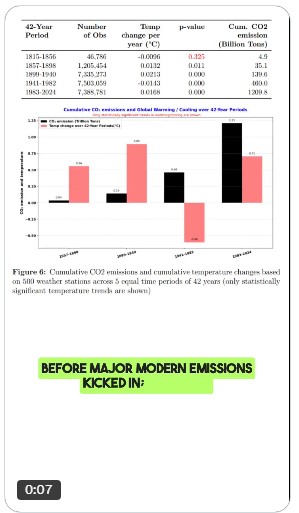
A new study analyzed daily temperatures from 992 long-running weather stations across 29 countries covering the years 1899 to 2024.
Then it compared those temperatures to cumulative human CO2 emissions.
They don’t match.
From 1899 to 1940, the planet warmed at a rate of 0.022 C per year, even though emissions were low.
Then from 1941 to 1982, temperatures cooled, despite CO2 emissions more than tripling.
From 1983 to 2024, warming returned, but slower than before, at a rate of 0.017 C per year, even as emissions rose 8.6 times higher than during the earlier warming phase.
As the author concludes, “These findings challenge the conventional assumption that human-induced CO2 is the primary driver of global warming.”
Click to view the video: https://x.com/Electroversenet/status/2055800464617382287?s=20
The Activist and the Farmer
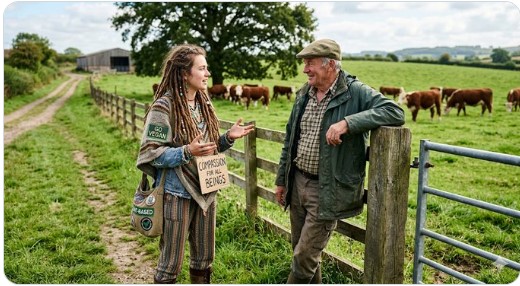
Activist: “Your cows are putting carbon into the atmosphere.”
Farmer: “Where did they get it?”
Activist: “What?”
Farmer: “The carbon. Where did the cow get it before it put it anywhere.”
Activist: “From… eating?”
Farmer: “From eating grass. And where did the grass get it.”
Activist: “The soil?”
Farmer: “The air. The grass pulled it out of the air last spring. The cow ate the grass. The cow breathed some of it back out. It went back into the air it came from.”
Activist: “But it’s still going into the atmosphere.”
Farmer: “It’s going back. There’s a difference between a thing going somewhere and a thing going back. You’ve described a circle and you’re frightened of it.”
Activist: “Then just don’t have the cow.”
Farmer: “The grass still dies in autumn. It rots where it falls. The carbon goes back into the air either way, just without anyone getting fed in the middle.”
Activist: “It’s not that simple.”
Farmer: “It’s grass, cow, breath, grass. Or it’s grass, rot, air, grass. Same circle, fewer dinners. If that’s complicated for you I’d stay away from the water cycle. That one’s got clouds in it.”
Scientist Gregg Braden on Net Zero

Scientist Gregg Braden warns that efforts to dramatically reduce atmospheric CO₂ could take us dangerously close to the extinction threshold, endangering all life on Earth. “If we were to meet the [the UN’s climate] goals… we would see a CO₂ level right around 220 or so parts per million.” “Extinction level CO₂ on this planet—when the CO₂ drops below a certain level, forests die and life does no longer thrive—that is 180 parts per million.” “It’s not good for us. Those proposals are not good for humans.”
https://x.com/wideawake_media/status/2046174797294403770?s=20
Climate Alarmism Unravels Over Time
In 1954, scientists told Congress the Arctic would melt within 25 to 50 years. Then 20 years later, in 1974, Time magazine warned we were heading for another ice age.
By the 1990s, when that didn’t happen, warming was the returning scare, with Norway’s top experts saying the Arctic would be ice-free by 2007.
The Centre for Biological Diversity said it would be ice-free by 2012.
The BBC said by 2013.
Needless to say, they were all wrong.
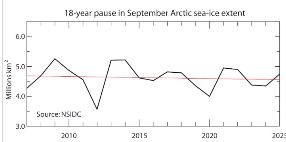
The Arctic sea ice minimum has actually been stable for the past 18 years now.
In 2008, NASA’s James Hansen predicted Lower Manhattan would be underwater by 2018 due to the burning of fossil fuels.
Back in 1923, scientists claimed Glacier National Park would melt by 1950. Then in 2006, Al Gore said it would be gone by 2020. Yet today, the glaciers are still there about the same size they were 35 years ago.
Decade after decade, the doomsday dates change, but the climate alarmist script persists.
Video: https://x.com/Electroversenet/status/2044928832180814264?s=20
Wind Turbine Farm
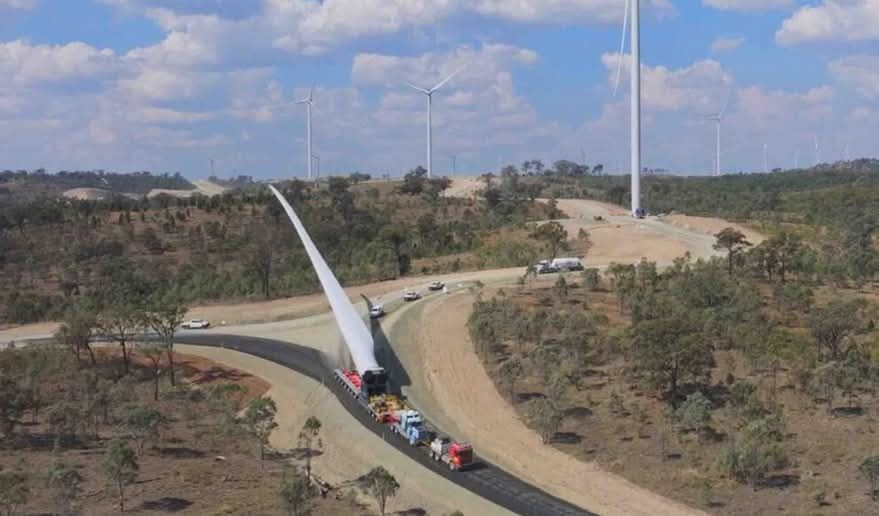
Australia currently has 13.3 gigawatts of installed wind energy capacity across roughly 90 operating wind farms. To meet the federal government’s renewable energy targets Energy Minister Chris Bowen admitted Australia needs to build 40 wind turbines every month until 2030. That is approximately 3840 new turbines on top of what already exists.
Let that number sit for a moment. 3840 wind turbines. In eight years. Across regional Australia.
Now let us look at what each one actually involves before a single blade turns.
A modern wind turbine stands between 140 and 200 metres tall. That is taller than a 50 storey building. Before the tower goes up the foundation has to go in. A typical foundation for a modern turbine requires between 550 and 850 cubic metres of concrete. At the MacIntyre wind farm in Queensland each foundation required nearly 2000 tonnes of concrete.
The reinforcing steel in each foundation runs to between 60 and 110 tonnes of reo bar. That steel reinforced concrete base is buried permanently in the ground. When the turbine reaches the end of its life in 25 to 30 years that foundation stays there forever. It is effectively impossible to remove without destroying the surrounding land.
The civil work and foundation for each turbine costs between 300000 and 600000 dollars. The tower itself between 500000 and 1.2 million dollars. Transport crane hire and installation another 500000 to one million dollars. Electrical connections and cabling another 300000 to 800000 dollars.
That is between 1.6 million and 3.6 million dollars per turbine before you count the cost of the turbine itself.
Multiply that by 3840 turbines and the civil and infrastructure cost alone runs to between 6 billion and 14 billion dollars. Just for the holes in the ground the concrete the steel and the cranes.
Then there are the roads.
Wind turbine blades on modern turbines run between 60 and 85 metres long. Each blade is transported separately on a special oversize load vehicle. Each movement requires pilot vehicles front and rear. Special permits. Road assessments. Road widening in many cases. Bridge strengthening. Removal of roadside trees and overhead infrastructure along the route.
A wind farm with 100 turbines requires 300 blade movements plus movements for towers foundations and nacelles. Across roads in regional Australia that were never designed for this traffic.
The cost of that road damage and infrastructure upgrades falls on local councils and state governments. Which means it falls on ratepayers and taxpayers. No wind energy company is picking up the bill for the regional roads their supply chains destroy.
And here is something nobody mentions. More than 3000 existing wind turbines across Australia will reach the end of their operational life by 2045. Those turbines need to be decommissioned. The fibreglass blades cannot be recycled. They are being buried in landfill. The concrete foundations stay in the ground permanently. And who pays for decommissioning is largely unresolved in most lease agreements across the country.
Then there are the transmission lines to carry all this electricity from where it is generated to where people actually live.
The Central West Orana renewable energy zone transmission project near Dubbo. Original estimate 650 million dollars. Current confirmed cost 5.5 billion dollars. Eight times the original estimate.
VNI West connecting Victoria and NSW. Started at 3.9 billion dollars. Now heading towards 11 billion dollars.
Project EnergyConnect connecting South Australia and NSW. Started at 1.53 billion dollars. Now over 4 billion with another 1.1 billion being sought from consumers on top of that.
HumeLink in southern NSW. Originally 1.3 billion dollars. Now 4.88 billion dollars. And its carrying capacity was reduced at the same time. More expensive and less capable.
Every dollar of every blowout goes onto your electricity bill for the next 30 to 50 years.
Then there is Snowy 2.0. The pumped hydro project that is supposed to store energy when the sun shines and the wind blows and release it when they do not.
Original cost 2 billion dollars. Current cost past 12 billion and still climbing. The 12 billion figure has been declared unachievable by Snowy Hydro’s own chief executive. The tunnelling machine was stuck underground for 19 months. Independent critics say the real total including transmission will exceed 20 billion dollars.
Then there are the batteries.
The government tells us that when the sun stops shining and the wind stops blowing the big batteries will keep the lights on. Here is what they can actually do.
The Waratah Super Battery in NSW is one of the largest in the country. It can power 970000 homes for one hour. Or 80000 homes for a full day. Australia has 11 million households.
The standard grid scale battery in Australia currently stores between two and four hours of electricity. Four hours is what the industry calls long duration storage. When the sun goes down on a hot summer night and the wind drops the batteries have two to four hours before they are empty. Then what.
The Australian Energy Market Operator says Australia needs 22 gigawatts of battery storage by 2030 and 49 gigawatts by 2050. We currently have about 3 gigawatts. That means increasing battery capacity by more than 700 percent in five years and over 1600 percent by 2050.
And here is what nobody is telling you. The batteries being installed right now through the 2020s will need to be replaced in the 2040s. You pay for them once and then you pay for them again. Just in time for the 2050 net zero deadline.
So what does all of this actually cost.
The federal government has already paid more than 29 billion dollars in subsidies to the renewable energy industry over the past ten years. The 2024 federal budget committed another 22 billion on top of that. The home battery subsidy program has been expanded to 7.2 billion dollars over four years. Grid scale battery investment hit 2.4 billion dollars in a single quarter in early 2025 alone.
Wood Mackenzie analysis shows the battery pipeline in Australia alone represents more than 80 billion dollars of potential investment.
And the Australian Energy Market Operator’s own modelling puts the total annualised capital cost through 2050 for grid scale generation storage transmission and distribution at 128 billion dollars. That is not a figure from critics. That is the government’s own energy market operator using their own least cost optimal pathway numbers.
128 billion dollars. For a system where the standard battery lasts two to four hours. Where the biggest battery in NSW can power 80000 homes for one day.
Where 3840 new wind turbines need to be built in eight years across regional roads that cannot handle the transport. Where transmission lines blow out to eight times their original cost estimates before the first pole is in the ground.
And every single dollar of it comes from one of three places.
Your taxes. Through direct government spending and through the Clean Energy Finance Corporation which has been given 32.5 billion dollars of taxpayer capital to lend cheaply to private energy companies.
Your electricity bill. Through network charges that recover the cost of transmission lines over the next 30 to 50 years added to every power bill in the country.
Or both at once. Through government underwriting schemes that guarantee private investors a minimum return. Meaning if the projects lose money the taxpayer makes up the difference. Private companies build the wind farms and solar farms. They take the profits. When the returns fall short you cover the losses.
Some people will say that is federal money not state money or that is state money not federal money. It makes no difference to the person paying the bill.
Federal spending comes from federal taxes. State spending comes from state taxes. Transmission blowouts come from your electricity bill. When all levels of government are spending money on the same program the taxpayer pays all of it regardless of which parliament wrote the cheque.
The federal government alone has committed over 100 billion dollars in direct spending loan guarantees and investment underwriting to this program. The states are spending billions more on top of that. The total is what matters. And the total comes out of your pocket one way or another.
There has been considerable public debate about whether the Future Fund which holds the retirement savings of Australian public servants should be used to help rebuild Australia’s oil refining capacity and protect our fuel security.
The government ruled that out. Yet that same government found 128 billion dollars worth of ways to fund a renewable energy system that stores electricity for two to four hours at a time and still cannot guarantee power on a calm cloudy night.
Nobody in government will say the full number out loud in a single sentence. Ask your local member to do it. See what happens.
Cooking the Climate Data
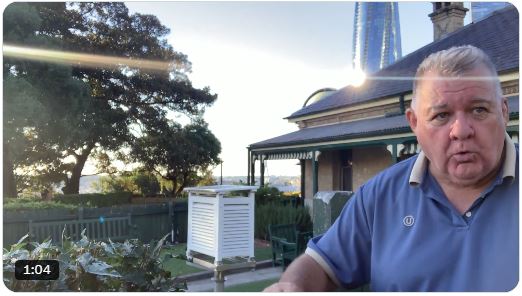
See that white louvered box? Since November 2017, Sydney’s official temperatures have been recorded inside it at Observatory Hill. The screen is sited in what is the hottest available location at Observatory Hill, with heat reflecting from the adjacent old stone building and its tin roof only a few metres away directly to the south. BOM’s own parallel data shows that this new site records temperatures up to 3°C warmer than the previous location.
This has cooked Sydney’s temperature record – yet this cooked data is used in a study claiming Sydney’s summers are becoming longer.
https://x.com/craigkellyAFEE/status/2044312732984586638?s=20
Wind Turbine Construction
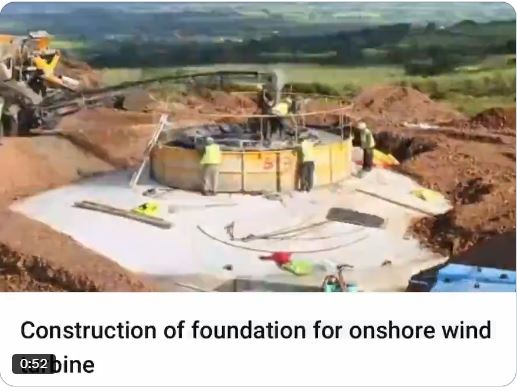
Ever seen the insane effort it takes to “build green”? Just watch how they pour a SINGLE wind turbine foundation: 600–1,000 TONS of concrete, massive excavation, endless rebar, and heavy machinery tearing up the land for days.
And that’s only the base. The blades? Made with balsa wood stripped from the Amazon rainforest, straight-up deforestation in the name of “saving the planet”.
Then add: • Concrete • Carbon fiber • Steel • Cast iron • Copper • Aluminum • Plus boron, chromium, cobalt, manganese, molybdenum, nickel & rare earth elements All mined, refined, and shipped with massive energy & pollution.
These things last 25 years max. By 2050 the world will be drowning in 43 million tons of worn-out blades, that’s the weight of 215,000 locomotives headed for landfills (most can’t even be recycled). Oh, and here’s the rest of the ridiculous list:
– They slaughter hundreds of thousands of birds & bats every year
– They only spin when the wind feels like it (so we still need gas/coal plants on standby)
– They chew up huge chunks of land and ruin views for miles
– They’re noisy, expensive to maintain, and require giant subsidies to even exist
– They slaughter hundreds of thousands of birds & bats every year
– They only spin when the wind feels like it (so we still need gas/coal plants on standby)
– They chew up huge chunks of land and ruin views for miles
– They’re noisy, expensive to maintain, and require giant subsidies to even exist
This is “green” energy? We’re destroying rainforests, mining toxic rare earths, pouring planet-warming concrete, and creating mountains of non-recyclable waste… to fight climate change?
It’s completely ridiculous. A multi-trillion-dollar environmental own-goal sold as virtue.
Egg Shells

It’s a myth that ground eggshells prevent blossom end rot. Egg shells decompose too slowly to be effective as a calcium fertilizer but they are still a welcome addition to compost as organic matter.
If you want a calcium boost faster than slowly decomposing eggs shells, first crush them into a fine powder. I use the blender, you can also use a pestle and mortar.
Then squeeze a lemon onto the crushed egg shells. This makes calcium citrate. Mix it one part to ten parts of water then water it onto the soil near the base of the plant.
New study confirms the Medieval Warm Period warmer than today
Researchers found leafy moss buried 36 feet deep in Antarctica’s Boulder Clay Glacier, dated to around 1,000 years ago, right in the middle of the Medieval Warm Period.
During this time, parts of Antarctica were warm enough for meltwater to carve a 4 km long channel through what is now a permanently frozen glacier.
Ice that never melts today once hosted moss and flowing streams.
The medieval warm period wasn’t a myth, as some climate activists have tried to claim.
The physical proof is there.
Moss, melt channels and layered sediments all tell the same story, as do proxy records from around the world.
The planet was warmer just 1,000 years ago.
https://x.com/Electroversenet/status/2041304951708954748?s=20