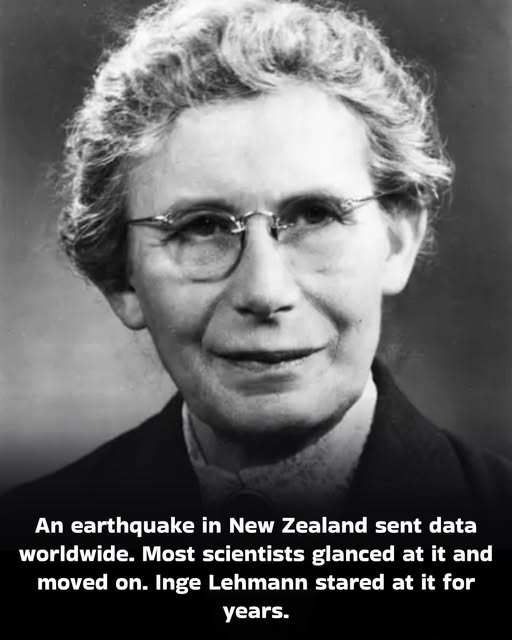
An earthquake in New Zealand sent data worldwide. Most scientists glanced at it and moved on. Inge Lehmann stared at it for years.
Then she discovered the center of the Earth.
In 1929, an earthquake struck near Murchison, New Zealand. The seismic waves it sent rippling through the Earth traveled thousands of miles, passed through every layer of the planet, and were recorded by instruments on the other side of the world.
Most scientists glanced at the data and moved on.
Inge Lehmann stared at it for years.
She was Denmark’s only seismologist—a quiet, meticulous woman who spent her days maintaining seismograph stations alone, without an assistant, despite requesting one repeatedly.
Her official duties were unglamorous: instrument upkeep, data logging, routine reports. The kind of work that kept institutions running but rarely produced breakthroughs.
But Lehmann had noticed something in the Murchison data that didn’t fit.
Certain seismic waves—P-waves—were appearing in locations where, according to every accepted theory, they simply should not be.
The prevailing scientific consensus held that Earth’s core was entirely molten liquid. If that were true, these waves would have behaved very differently.
They weren’t behaving that way.
Something was down there. Something the textbooks hadn’t accounted for. Some kind of boundary, deep inside a molten core, that was deflecting waves in ways no one had predicted or even imagined.
Lehmann had no supercomputer. No advanced imaging. No institutional support and no research budget to speak of.
She had cardboard oatmeal boxes and index cards.
Working in her spare time—the hours left over after her official duties were done—she built a filing system inside those boxes, tracking earthquake data collected from seismograph stations around the world.
Every wave. Every anomaly. Every reading that didn’t quite make sense.
She recorded them by hand. She calculated by hand. She cross-referenced by hand.
Her nephew would later describe visiting her: Inge outside on the lawn, a large table covered in cardboard boxes, working through the mathematics of the Earth’s interior with the focused patience of someone who had simply decided to find the answer.
In 1936, she published her conclusion.
The paper was titled “P’”—P-prime.
One of the most understated titles in the history of science, for one of the most significant discoveries the field had ever produced.
Lehmann’s mathematical proof showed that Earth’s core was not one thing but two: a solid metal inner core, dense and ancient, surrounded by a molten outer core.
Two distinct layers, separated by a sharp boundary thousands of miles beneath our feet—a boundary that no one had known existed, which no instrument had ever directly reached, which she had found using nothing but seismograph readings and the mathematics she’d worked through on her lawn.
The scientific community didn’t immediately celebrate.
It took years.
Serious geologists reviewed her work, ran their own analyses, looked for the error that would make the conventional wisdom safe again.
But the data kept confirming what Lehmann had found.
One by one, the field’s leading figures—Beno Gutenberg, Charles Richter, Harold Jeffreys—accepted her interpretation.
The inner core was real.
She had been right.
When computer modeling finally caught up to her calculations in the 1970s, it confirmed what Lehmann had established with cardboard and pencil decades earlier.
She didn’t slow down.
After retiring from the Danish Geodetic Institute at sixty-five, she moved to the United States and kept working—for three more decades.
In the 1950s, collaborating with American seismologists, she identified another anomaly: an abrupt change in seismic wave velocities approximately 220 kilometers below Earth’s surface.
A second hidden boundary. Subtle and strange. Its nature researchers are still actively investigating today.
It carries her name now. The Lehmann discontinuity.
The honors came eventually, as they tend to—late, and in numbers that implied the world was making up for lost time.
The William Bowie Medal. Fellowship in the British Royal Society. The Gold Medal of the Danish Royal Society. Honorary doctorates from Columbia University and the University of Copenhagen.
An entire scientific medal established in her honor by the American Geophysical Union, awarded to this day for outstanding contributions to understanding Earth’s structure.
She received them with characteristic directness.
When her nephew asked her about competing in a field dominated by men who received opportunities she was consistently passed over for, Lehmann didn’t soften it:
“You should know how many incompetent men I had to compete with—in vain.”
In 1987, at ninety-nine years old, she published her final scientific paper.
She died in 1993 at 104—one of the longest-lived scientists in recorded history, still sharp, still remembered in the language of the planet she had spent her life reading.
Here is the thing about Inge Lehmann’s discovery that stays with you.
The solid inner core she identified is roughly the size of Pluto.
It sits at temperatures nearly as extreme as the surface of the sun.
It has been there since before life existed on this planet, hidden at a depth no human being will ever physically reach.
And she found it.
Not with a billion-dollar research program. Not with technology that didn’t yet exist.
With patience. With obsessive attention to data that everyone else had decided to stop questioning. And with cardboard oatmeal boxes organized on a lawn table in Denmark.
Think about what that means.
The center of the Earth—a solid metal sphere the size of Pluto, spinning at a slightly different rate than the rest of the planet, generating the magnetic field that protects all life from solar radiation—was completely unknown to science until 1936.
Until a Danish woman working alone, without an assistant, filing data in oatmeal boxes, noticed that earthquake waves weren’t behaving the way they should.
She trusted the numbers when the numbers contradicted the experts.
She kept working when the work was invisible.
She published when the field wasn’t ready, and then waited, quietly, for the field to catch up.
Inge Lehmann didn’t discover Earth’s inner core despite her circumstances.
She discovered it because she was the kind of person who looked at what couldn’t be explained—and refused to look away until she understood it.
The men who doubted her had labs. Assistants. Funding. Titles.
She had better questions.
And here’s the beautiful irony: those men, with all their resources, were studying the same earthquake data. They had access to the same seismograph readings. They had the same numbers in front of them.
They saw nothing unusual.
Inge Lehmann, working alone at a lawn table with cardboard boxes, saw the truth.
She saw it because she was looking for it. Because she refused to accept “that’s just how it is” as an answer. Because she trusted her calculations more than she trusted consensus.
The inner core discovery rewrote geology textbooks. Changed our understanding of how planets form. Explained how Earth’s magnetic field works. Influenced everything from earthquake prediction to our understanding of other planetary bodies.
All because one woman looked at data everyone else had dismissed and thought: “This doesn’t make sense. Let me figure out why.”
She requested an assistant for years. They never gave her one.
She discovered the center of the Earth anyway.
She worked with oatmeal boxes while men worked in funded laboratories.
She was right. They were wrong.
She published at ninety-nine. Most people are retired at sixty-five. Inge Lehmann was still rewriting our understanding of the planet in her tenth decade of life.
She competed against incompetent men—in vain, she said. Because they got the positions, the funding, the recognition.
And she got the truth.
When asked what drove her, she once said simply: “I just wanted to know.”
Not for fame. Not for recognition. Not to prove anyone wrong.
She just wanted to know.
What’s at the center of the Earth? Why are these waves behaving strangely? What boundary could cause this effect?
She wanted to know. So she found out.
Using cardboard boxes. And index cards. And mathematics worked out by hand on a lawn table.
And she was right.
The Lehmann discontinuity. The inner core boundary. Her name is written into the structure of the Earth itself now.
Every geology student learns about her. Every seismologist builds on her work. Every textbook explains the solid inner core she discovered.
Most of them don’t mention the cardboard boxes.
But that’s the detail that matters most.
Because it means you don’t need a billion-dollar lab to change the world.
You need better questions. And the refusal to stop asking them.
Inge Lehmann discovered the center of the Earth at a lawn table in Denmark.
She published her last paper at ninety-nine.
She outlived most of the men who doubted her.
And she was right the entire time.
The men had resources.
She had better questions.