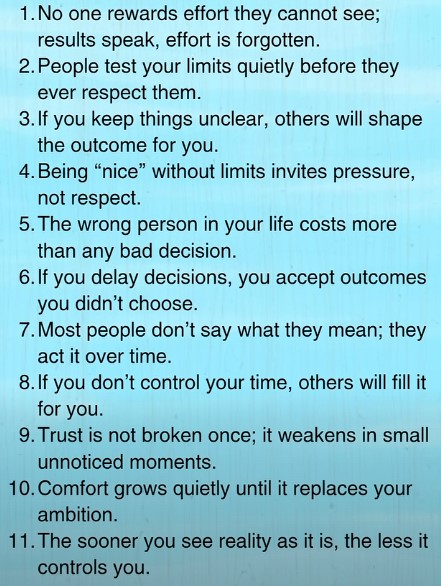
My perception is 9 is not as certain as the others. I observe it can be broken in one incident.

Tom's Blog on Life and Livingness
My perception is 9 is not as certain as the others. I observe it can be broken in one incident.
“Age is a state of mind. Youth and age exist only among the ordinary people. All the more talented and exceptional of us; are sometimes old, just as we are sometimes happy, and sometimes sad.” – Hermann Hesse
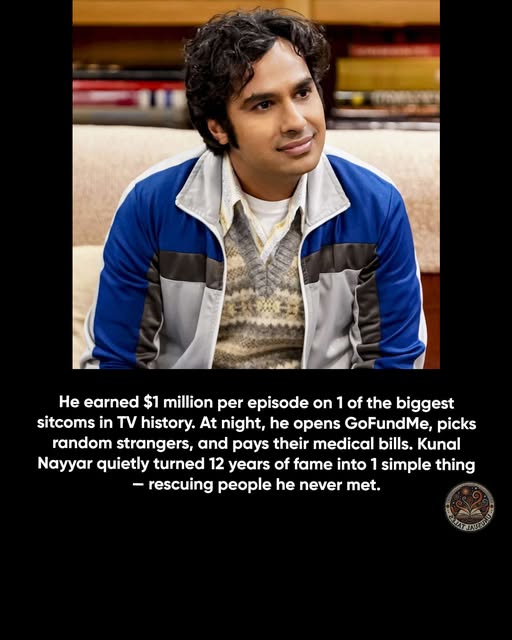
In 2007, a 26-year-old actor from New Delhi walked onto a Hollywood set with almost no experience. His name was Kunal Nayyar. He had been born in London to Indian parents, raised in India from the age of 3, and had come to America for higher education. He had only 2 acting credits to his name. Nobody could have guessed what was about to happen.
The show was called The Big Bang Theory. He was cast as Rajesh Koothrappali, a shy astrophysicist who could not even speak to women without help. His salary in season 1 was $45,000 per episode.
12 seasons and 279 episodes later, the show became one of the most successful sitcoms in television history. By the final seasons, Kunal and his 4 original co-stars were each earning a reported $1 million per episode. Forbes ranked him as the 3rd highest-paid TV actor in the entire world in 2015 and again in 2018, with annual earnings of $20 million and $23.5 million.
Money on a scale most of us cannot really picture.
He could have done what so many do at that level. Bought a fleet of cars. Built a mansion. Lived loudly. Disappeared into the kind of life that magazines love to photograph.
He did not.
Years after the show ended, in a quiet interview with The i Paper in late 2025, Kunal Nayyar revealed what he had really been doing with his money. Sitting calmly, almost as if he were talking about a small hobby, he explained it.
“Money has given me greater freedom,” he said. “And the greatest gift is the ability to give back, to change people’s lives.”
Then he described his nighttime ritual.
After dinner, after the world quiets down, he opens GoFundMe — the crowdfunding platform where families post their final pleas for help with medical bills, surgeries, and treatments they cannot afford. He scrolls. He reads stories of strangers — parents, children, sick people simply asking the internet for help. He picks a few. And then, without ever revealing his name, he pays.
He pays for a child’s chemotherapy. He pays for a surgery. He pays off a cancer bill a family would have spent the rest of their lives trying to clear. They never know it was him.
“That’s my masked vigilante thing,” he said, almost embarrassed by the words.
He does not stop there.
Alongside his wife, the former Miss India and fashion designer Neha Kapur, he quietly funds university scholarships for young people from disadvantaged backgrounds — kids whose families could never afford to send them to college. They also support animal charities, because, in his own words, “we love dogs.”
He does not make a show of any of it. There are no foundations with his face on the wall. No fundraising galas. No press tours. Just a man at home, late at night, choosing a stranger to save.
When asked why, he said something that has stayed with people who heard it.
“Right now people are not happy because we are all expecting someone else to be kind. We are expecting a president or a politician, some leader, to come and bring us world peace. But there is no world peace if your neighbour comes to your door wanting some sugar for their tea and you lock it against them and say, get away.”
In other words — be the neighbour. Open the door. Hand over the sugar.
For Kunal Nayyar, money is not a trophy. It is a tool. It is the rare kind of wealth that does not weigh on him. “It feels like a grace from the universe,” he said.
He still works. He has his own production company, Good Karma Productions. He stars in films — most recently Christmas Karma (2025), a musical reimagining of A Christmas Carol where he plays a modern-day Indian Scrooge whose obsession with wealth is rooted in trauma. The role almost feels like a wink at his own life.
Except in real life, Kunal Nayyar never needed a ghost to teach him the lesson.
He learned it on his own — that the truest measure of what we have is not what we hold on to, but what we quietly give away.
Somewhere tonight, a family is opening an email, looking at a GoFundMe page, and finding that someone they will never meet has paid for their child’s surgery. They will cry. They will not know who. They will whisper a small thank you into an empty room.
And somewhere across the world, the man who paid will already be asleep, ready for the next day.
He does not need to know what happens next.
For him, that is the whole point.
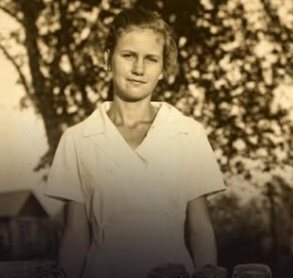
She was sitting at the back of the room.
December 1909. A teachers’ conference in Columbia, South Carolina. A government official at the front was describing a new federal program — young farm boys across the South were being given seed, land, and instruction in modern agriculture. They were producing harvests two and three times larger than their own fathers. It was, by any measure, a success.
The woman at the back was twenty-seven years old. Her name was Marie Cromer. She taught at a one-room schoolhouse in Aiken County — the only teacher, the only principal.
She raised her hand.
But what are we doing for the farm girls?
That question is recorded in the meeting notes. And it may be the most consequential sentence ever spoken at a teachers’ conference in American history.
Marie had watched her female students — girls aged nine to twenty — drop out of school every spring because their families needed their labor in the fields. They had no shoes in summer. They were expected to marry by sixteen, bear children every two years, and own nothing the law allowed a husband to own instead. Their brothers would one day inherit what little land the family had. They would not.
She came home and built something.
On her own initiative, she organized the Aiken County Girls’ Tomato Club — the first organization of its kind in the United States. Each girl who joined received a packet of tomato seeds, a one-tenth-acre plot on her family’s farm, and something more radical than either: instruction in keeping a financial ledger, and the right to keep every single cent she earned.
In the spring of 1910, forty-seven girls enrolled.
They planted. They watered. They weeded. They harvested. They canned. They sold.
And they kept the money.
The prize that first season was a scholarship to Winthrop College. Marie didn’t have the $140 to fund it herself, so she wrote to a wealthy polo enthusiast from New York who wintered in Aiken County. He funded it.
By late summer, a girl named Katie Gunter had canned 512 jars of tomatoes from her tenth of an acre and cleared a $40 profit. The scholarship was hers.
Within a few years, the best-performing girls were clearing $70 and $80 from that same tenth of an acre — more than many of their fathers earned sharecropping cotton for an entire year.
The clubs spread. Virginia. Alabama. Georgia. Mississippi. Tennessee. By 1913, over twenty thousand girls were enrolled across fifteen Southern states.
The U.S. Department of Agriculture appointed Marie one of the first women ever assigned to agricultural field work in the federal civil service.
A girl wrote about the experience in 1915:
“The work was long and sometimes tiresome. But I now have a bank account of sixty dollars.”
In 1915. In rural South Carolina. A teenage girl. A bank account. In her own name.
The Nineteenth Amendment — giving women the right to vote — would not arrive for another five years.
In 1914, the federal Smith-Lever Act folded the tomato clubs, the corn clubs, and related programs into a single national cooperative extension service. That combined program was given a name in 1924.
You know it as 4-H.
Marie Cromer went on to establish the first home economics curriculum in Aiken County. In 1953, President Dwight D. Eisenhower formally recognized her at the National 4-H Camp in Washington, D.C., as one of the founders of the organization.
She died on June 14, 1964, at home in Eureka, South Carolina. She was eighty-one years old.
There is a small historical marker on Highway 191.
Today, approximately six million American children are enrolled in 4-H. It is the largest youth-development organization in the United States.
Marie Cromer never gave a speech.
She raised her hand at the back of a conference room.
She asked one question.
And the country spent the next hundred and fifteen years answering it.
Vienna, Austria. June 3, 1961.
The most dangerous meeting of the Cold War era has just begun.
John F. Kennedy and Nikita Khrushchev — the leaders of the two nuclear superpowers whose weapons are pointed at each other across an ocean — are sitting down to dinner. The world’s future is genuinely uncertain. Diplomats are anxious. Translators are poised. Everyone in the room knows that what is said at this table will matter.
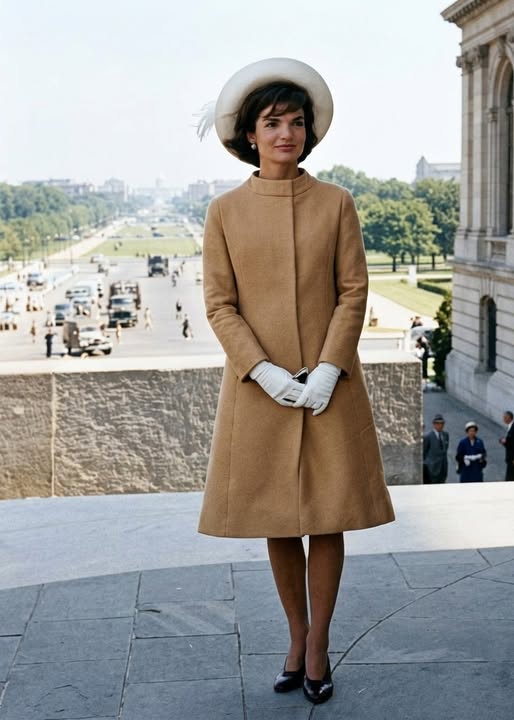
At Khrushchev’s side sits Jacqueline Kennedy.
She is 31 years old, speaks French and Italian and Spanish fluently, and has spent the day so thoroughly charming Paris that French President Charles de Gaulle — a man not known for being charmed — described her as extraordinary. JFK will joke the next day that he is simply “the man who accompanied Jacqueline Kennedy to Paris.”
Now she is seated next to the Soviet Premier at dinner.
They talk. The conversation moves. And then — “She ran out of things to talk about,“ as her daughter Caroline would later tell it, “so she asked about the dog, Strelka, that the Russians had shot into space. During the conversation, my mother asked about Strelka’s puppies.”
A few months later, a package arrived at the White House.
“A few months later, a puppy arrived and my father had no idea where the dog came from and couldn’t believe my mother had done that.“
The puppy’s name was Pushinka.
Russian for “Fluffy.” A white, mixed-breed puppy, the daughter of Strelka — one of two Soviet space dogs who had become the first living creatures to orbit the Earth and return home safely, aboard the Soviet spacecraft Korabl-Sputnik 2 in 1960.
She arrived in the United States with her own Soviet passport, listing her as “a non-breed type.”
Because this was 1961, and because the United States and the Soviet Union were in the middle of a nuclear standoff, the White House was not simply going to let a Russian dog wander in unexamined. Pushinka was taken to Walter Reed Army Medical Center and examined thoroughly before she was permitted to settle into her new home — checked for any listening devices the Soviets might have thought to embed in a puppy.
She was clean.
She was welcomed.
And shortly after settling in, she fell in love with Charlie — the Kennedy family’s Welsh terrier — and eventually produced four puppies of her own. Kennedy, with the dry wit his letters reveal, called them the “pupniks.”
In June 1961, Kennedy wrote to Khrushchev: “Mrs. Kennedy and I were particularly pleased to receive Pushinka. Her flight from the Soviet Union to the United States was not as dramatic as the flight of her mother, nevertheless, it was a long voyage and she stood it well.”
Two men. Enough nuclear weapons between them to end civilization. Writing to each other about a dog’s flight from Moscow.
At its core, the Cold War was fought between governments and ideologies and weapons systems. But its edges were softened, occasionally, by moments like this — accidental, human, and entirely Jackie’s doing.
The puppy was not a one-off.
Jacqueline Kennedy understood something about power that most politicians learn too late, if they learn it at all: that the most durable kind of influence is not exercised through force or position, but through connection. Through language. Through the ability to make someone feel seen and heard and respected.
She spoke French and had it on good authority — from de Gaulle himself — that her command of it was that of an educated native. When she accompanied JFK to Paris in 1961 and addressed the French people in their own language, the reception was unlike anything an American leader had ever received. When she visited India and Pakistan the following year, she drew crowds of hundreds of thousands. Diplomatic handlers struggled to keep up with the goodwill she generated simply by being present, and genuinely fluent, and genuinely interested.
She was not performing interest. That was the thing about her that no one could manufacture. She actually wanted to know about Khrushchev’s dog.
At home, she was rebuilding something else.
When Jackie moved into the White House in January 1961, she found the mansion in a state that she found quietly embarrassing — a residence of the leader of the free world furnished with mismatched pieces and reproductions. She believed that the White House was not merely the president’s house. It was the people’s house — a living museum of American history that deserved to be treated as such.
She formed a committee. She tracked down authentic period furniture that had been sold off over decades. She acquired paintings, chandeliers, manuscripts, and objects that told the story of the nation with the seriousness that story deserved.
And then, in February 1962, she invited the American people inside.
The televised tour of the White House — Jackie moving through room after room, explaining the history of each object with the authority of a trained curator — was watched by approximately 56 million people. It remains one of the highest-rated television broadcasts in history. The Television Academy recognized her with a special Trustees Award, the only time that honor has been given to a First Lady.
She wasn’t just showing people a beautiful house. She was telling them that beauty and history and culture were theirs — that they belonged to everyone, not only to those who happened to live inside the gates.
Then came November 22, 1963.
What Jackie did in the hours, days, and weeks after Dallas is one of the most documented and still most difficult things to fully comprehend. She organized the state funeral with historical precision — modeled on Lincoln’s, because she believed the gravity of the moment required that kind of acknowledgment. She stood at the graveside in the same pink suit she had worn on the plane back from Dallas, because she wanted the world to see what had been done.
And weeks later, she gave one carefully chosen interview — to the journalist Theodore White of Life Magazine — in which she introduced the image that would define her husband’s presidency forever.
She said it reminded her of the musical they both loved: Camelot.
“Don’t let it be forgot, that once there was a spot, for one brief shining moment, that was known as Camelot.”
She chose those words deliberately. She told White she wanted that image preserved. He published it exactly as she asked.
Jackie Kennedy understood that history is not only what happens — it is what is remembered, and how it is framed, and by whom. She spent the rest of her life making sure the story was told right.
There is a version of Jacqueline Kennedy that history sometimes reduces to style — the pillbox hat, the pink suit, the poise under pressure. That version is not wrong, exactly. She had all of those things, and they mattered.
But the fuller picture is this:
A woman who accidentally negotiated a moment of Cold War warmth by asking about a dog at a dinner table. Who checked a Soviet puppy for listening devices and then let her children teach it to slide down the playground slide. Who spoke to the French in their own language and made them love America for an afternoon. Who stood in the East Room and told 56 million people that this house — this history — belonged to them.
And who, in the most devastating moment of her life, made sure that what had happened was not just mourned, but remembered, with the weight it deserved.
She was not a witness to history.
She was, quietly and deliberately, one of its most skillful authors.
In 1993, a file clerk with no college degree, no law training, and three kids to feed was handed a real estate file.
Inside were medical records.
That made no sense.
Her name was Erin Brockovich, and at that point, life had already hit her hard. Married young. Divorced twice before 30. Working retail jobs, waitressing, anything that kept food on the table.
By 1991, she was filing paperwork at a small California law firm, answering phones and barely covering rent.
Then came the file from a tiny desert town called Hinkley.
She kept reading. Then pulled more files. Same town. Different families. Cancer. Tumors. Miscarriages. Far too many for a place that small.
Something was wrong in Hinkley.
Everybody seemed sick.
Erin started calling residents. Every conversation sounded the same. Someone had cancer. Someone had died young. Someone couldn’t have children.
Then she found letters from Pacific Gas and Electric.
PG&E mentioned chromium in the water—chromium 3, they claimed. Harmless. Completely safe.
But Erin got suspicious.
She went to the library and taught herself everything she could about chromium. There were two forms. Chromium 3 was harmless.
Chromium 6 caused cancer.
That discovery changed everything.
Digging through PG&E’s internal records, she uncovered memos between engineers. They knew it was chromium 6 all along. They had known since 1965, while telling the town there was nothing to fear.
For years, PG&E used chromium 6 in cooling towers, dumping contaminated wastewater into open ponds with nothing protecting the groundwater beneath. Hundreds of millions of gallons seeped into the water Hinkley families drank every day.
Engineers raised alarms.
Management buried them.
And for decades, people kept drinking poisoned water without knowing why they were getting sick.
Erin drove to Hinkley herself, knocking door to door. A woman with breast cancer at 30. A man with a brain tumor at 40. Couples shattered by repeated miscarriages. Children suffering constant nosebleeds.
She asked every family one question: do you want to sue?
More than 600 said yes.
PG&E responded with powerful attorneys and endless excuses, blaming smoking, diet, anything except their own deception.
Then, on July 2, 1996, the company settled.
$333 million. The largest direct-action lawsuit settlement in American history at the time.
A single mother with no law degree had uncovered a forty-year cover-up hiding inside an ordinary file.
Erin Brockovich proved that sometimes the most dangerous thing in the world is an ordinary person who refuses to stop asking questions.
(Tom: Yet another exmaple of how if something is too good to be true it probably is and if you trust the system to look after your interests, you are almost certain to be let down.)
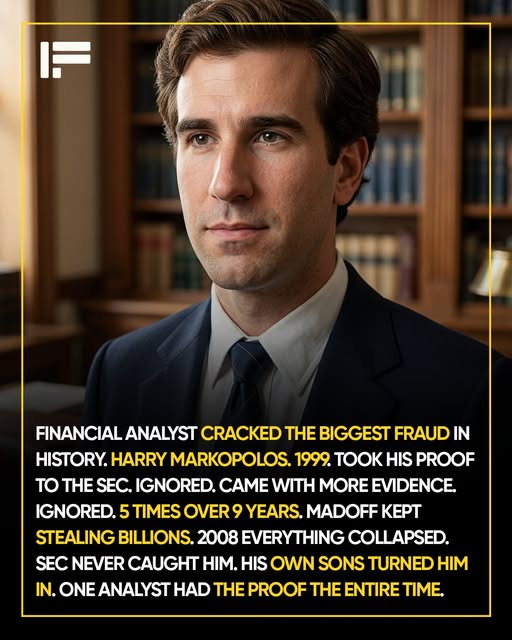
A Boston financial analyst walked into the SEC with ironclad mathematical proof that Bernie Madoff was running the biggest Ponzi scheme in history. He did it five separate times over nine years. They ignored him every single time.
His name was Harry Markopolos.
In 1999, his boss at a small investment firm asked him to analyze Bernie Madoff’s fund. Madoff was a Wall Street legend — former NASDAQ chairman, smooth, connected, and delivering impossibly steady returns no matter what the market did. Up 10-12% every year like clockwork. Harry looked at the numbers for four hours and knew something was deeply wrong.
The returns were mathematically impossible. They looked like a perfect 45-degree line on a graph — something that only exists in textbooks, not real markets. Either Madoff was front-running trades illegally or it was a massive Ponzi scheme. There was no third option.
Harry showed his boss. They brought in colleagues. Everyone agreed: this was fraud. So in May 2000, Harry did what any responsible person would do. He walked into the SEC’s Boston office with an eight-page report full of clear math and told them exactly where to look.
They did nothing.
He submitted again in October 2001. More detail. More proof. Ignored.
In 2005 he sent his strongest report yet — twenty-one pages titled “The World’s Largest Hedge Fund is a Fraud.” Seventeen red flags. Two possible explanations. Both felonies. This time he sent it to SEC headquarters in Washington.
The SEC sent a couple of junior staffers to talk to Madoff. Madoff charmed them. Case closed.
Harry submitted again in 2007. Still ignored.
By 2008 he had delivered five detailed warnings over nine years. He was scared the whole time. He believed Madoff had ties to organized crime. He varied his route to work. He slept with a gun next to his bed.
Then the financial crisis hit. Investors started asking for their money back. Madoff had no real investments — just new money paying off old investors. The whole thing collapsed. On December 10, 2008, Madoff finally confessed to his sons. They called the FBI the next morning.
The SEC didn’t catch Bernie Madoff. His own family did.
The damage was staggering. $65 billion gone. Thousands of victims wiped out — retirees, charities, Holocaust survivors like Elie Wiesel who lost everything. At least two people connected to the fraud died by suicide.
In February 2009, Harry testified before Congress. He laid out exactly how the SEC had failed for nearly a decade. The agency later investigated itself and admitted they had received credible warnings as far back as 1992 but never acted.
If they had listened to Harry’s first report in 2000, Madoff might have been stopped at around $7 billion. By the time his sons turned him in, it was $65 billion.
Five reports. Nine years. Fifty-eight extra billion dollars stolen because regulators couldn’t be bothered to check the math.
Bernie Madoff died in prison in 2021. The SEC officials who ignored Harry Markopolos five times kept their jobs and pensions.
Some of the biggest disasters in history aren’t caused by evil geniuses. They’re caused by people who see the warning signs and simply choose not to look.
“You cannot be a good mountaineer, however great your ability, unless you are cheerful and have the spirit of comradeship. Friends are as important as achievement. …teamwork is the one key to success and that selfishness only makes a man small. No man, on a mountain or elsewhere, gets more out of anything than he puts into it. Be great, make others great.” — Tenzing Norgay Sherpa, Tiger of the Snows.
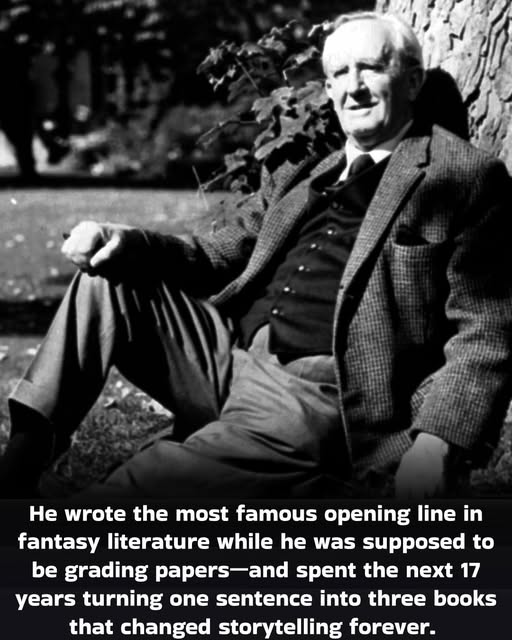
Oxford University, early 1930s. Professor J.R.R. Tolkien sat at his desk with a stack of student examination papers that needed grading.
One student had left a page completely blank.
Tolkien stared at that empty page. Then, instead of writing a grade, he wrote something else:
“In a hole in the ground there lived a hobbit.”
He had no idea what a hobbit was. He’d never heard the word before. It simply appeared in his mind, fully formed, demanding to be written.
The sentence wouldn’t leave him alone.
What kind of hole? What sort of creature was a hobbit? Why did it live underground?
Tolkien was a philologist—a scholar of languages and words. His brain didn’t work like most people’s. When he encountered a word, even one he’d invented, he needed to know its etymology, its grammar, its place in linguistic history.
So he started building backward.
If hobbits existed, they needed a language. If they had a language, it needed rules, structure, historical development. If they lived in holes, those holes needed architecture. If they had architecture, they had culture. If they had culture, they had history.
The hole became a comfortable home called Bag End, built into a hillside in a place called the Shire. The hobbit became Bilbo Baggins. The adventure became The Hobbit, published in 1937.
It was an immediate success. Children loved it. Adults loved it. The publisher wanted more.
“Write us a sequel,” they said.
Tolkien agreed. He thought it would take a year, maybe two.
It took seventeen.
The Lord of the Rings wasn’t written in some isolated writer’s retreat. Tolkien had a full-time job teaching at Oxford. He had a wife and four children. He had lectures to prepare, academic papers to write, departmental meetings to attend.
He wrote in the margins of his life.
Early mornings before breakfast. Late nights after the children were asleep. Weekends when the grading was finally done. He wrote by hand, in ink, because typewriters felt wrong for Middle-earth. He wrote multiple drafts of every chapter because he couldn’t move forward until every sentence was exact.
And he didn’t just write the story. He built the world underneath it.
He drew maps—detailed, to-scale maps—because he needed to know the precise distance from the Shire to Mordor before he could calculate how many days the journey would take. He created timelines that synchronized across multiple storylines happening simultaneously in different locations. He tracked the phases of the moon. He made sure the weather patterns matched the geography.
He invented languages—complete with grammar rules, verb conjugations, phonetic shifts across fictional centuries. Elvish wasn’t a few random phrases; it was a functioning linguistic system with dialects.
He wrote family trees going back thousands of years for characters who appeared in one chapter.
This wasn’t creativity run wild. This was a philologist treating his fictional world with the same rigour he applied to Old English manuscripts.
His friends thought he was insane. C.S. Lewis, who loved the story, begged him to just finish it already. But Tolkien couldn’t. Every time he thought he was done, he’d realize the Second Age of Middle-earth’s history didn’t align properly with events in the Third Age, or that the route the Fellowship took through Moria didn’t match the map, or that the sunset times were wrong for that latitude.
So he’d revise. Again.
The manuscript was finally completed in 1949—twelve years after he’d started.
Then came the next battle: publication.
Post-war paper shortages made printing expensive. Publishers were nervous about a 1,200-page fantasy novel from an Oxford professor. Tolkien wanted all three volumes released together as one work. The publisher insisted on splitting it into three books released separately.
They compromised. Three volumes, released within one year: The Fellowship of the Ring in July 1954, The Two Towers in November 1954, The Return of the King in October 1955.
Initial reviews were mixed. Some critics dismissed it as juvenile escapism. Edmund Wilson, one of America’s most respected literary critics, called it “balderdash.”
Readers disagreed.
The Lord of the Rings sold steadily, then explosively. By the 1960s, it had become a cultural phenomenon on college campuses. By the 1970s, it had created the modern fantasy genre. By the 2000s, it had become a film trilogy that won 17 Academy Awards.
To date, it has sold over 150 million copies and been translated into dozens of languages.
Every fantasy quest written after 1954—every invented world, every dark lord, every fellowship of unlikely heroes—exists because Tolkien spent seventeen years obsessing over a sentence he wrote on a blank exam paper.
Think about that. One moment of distraction. One mysterious sentence with no plan behind it. And the discipline—the almost pathological discipline—to follow that sentence wherever it led, no matter how long it took.
Tolkien didn’t write The Lord of the Rings quickly and hope readers would forgive the inconsistencies. He wrote it slowly, meticulously, with obsessive attention to detail that most people thought was excessive.
But that’s exactly why it worked.
Middle-earth feels real because Tolkien built it the way our world was built—with geography that makes sense, languages that evolved naturally, history that has consequences, cultures that developed from logical origins.
Readers feel the weight of that reality even if they never consciously notice it. They sense they’re visiting a place that existed before the story began and will continue after it ends.
That’s the power of caring about things no one told you to care about.
The maps no one asked for. The languages no one would notice. The timelines no reader would check. Tolkien did all of it anyway because he couldn’t do it any other way.
When asked about his obsessive world-building, Tolkien said: “I wisely started with a map and made the story fit.”
He meant it literally. The map came first. The story had to earn its place in the geography.
Most writers would call that insane. Tolkien called it necessary.
And he was right.
Because seventy years later, people still argue about whether Balrogs have wings, still debate the exact route through Moria, still learn to write in Elvish script, still make pilgrimages to New Zealand to stand where the films were shot.
The world feels that real.
All of it—the entire modern fantasy genre, the films, the games, the endless inspired works—began with seven words written on a page that should have been graded instead.
“In a hole in the ground there lived a hobbit.”
Seventeen years of obsessive work later, the world found out what that meant.
And it’s still finding out.

She knew what was killing her.
She also knew what was killing the birds.
Her name was Rachel Carson. She was born in 1907 on a farm in rural Pennsylvania, the daughter of a woman who gave her a love of nature before she could read. She became a marine biologist at the U.S. Fish and Wildlife Service — a government scientist with a master’s degree in zoology from Johns Hopkins and a gift for writing that made science feel like something alive. Her previous books — Under the Sea Wind, The Sea Around Us, The Edge of the Sea — had stayed on the bestseller lists. She had been called the greatest science writer in America.
In 1958, a letter arrived from a friend in Massachusetts. Large bird kills had occurred on Cape Cod from DDT sprayings. Dead birds everywhere. Songbirds disappearing. Fish dying in otherwise clean rivers.
She had been trying to interest a magazine in this story since 1945. Every time, the editors passed.
This time, she decided to write the book herself.
She spent four years documenting it. Carefully. Quietly. With hundreds of footnotes. In what she referred to as her “poison book,” Carson revealed the damaging effects of the indiscriminate use of chemical pesticides on the environment. She focused mainly on the insecticide DDT, which had been dubbed “one of the greatest discoveries of World War II” by Time magazine for its ability to kill insects that spread malaria and typhus and was routinely sprayed in homes and on crops. CBC News
The pesticides blanketing America were not staying where they were sprayed. They were sinking into soil. Flowing into water. Concentrating in the fat cells of birds, fish, and human beings. Building up, season after season, in ways that no government agency had thought to measure and no chemical company had bothered to study.
If we are living so intimately with these chemicals — eating and drinking them, taking them into the very marrow of our bones — we had better know something about their power. Wikipedia
She called the book Silent Spring — a warning that one day, if nothing changed, there might be a spring morning with no birdsong left in it.
What almost none of the people attacking her knew was that Rachel Carson was dying.
Breast cancer. Already in her bones by the time the book came out. She kept it secret with the kind of discipline that demands attention. She was terrified that if the industry found out, they would use it against her — that they would say her illness had made her irrational, that fear and pain, not data, was behind her warnings. So she said nothing. She underwent radiation treatments. She lost her hair. She kept writing.
She was right to be afraid.
Chemical companies sought to discredit her as a Communist or hysterical woman. Many pulled their ads from the CBS Reports TV special on April 3, 1963, entitled “The Silent Spring of Rachel Carson.” The president of the company that made DDT said Carson wrote “not as a scientist, but as a fanatic defender of the cult of the balance of nature.” Wikipedia
Still, roughly 15 million viewers tuned in to watch that broadcast.
Shortly after her book was published, President Kennedy was asked at a press conference if the government would look into the long-term effects of synthetic pesticides. In May 1963, President Kennedy’s Science Advisory Committee issued its long-awaited pesticide report, which validated Carson’s work. Wikipedia
And then, in June 1963, she went to the Senate.
On June 4, 1963, Rachel Carson sat before five Congressmen in Room 102 of the New Senate Office Building. It was a small, windowless room, packed with reporters. If Rachel was nervous, she didn’t let it show. She folded her hands, adjusted her notecards, and tested the microphone before beginning her statement. NPR
She was wearing a wig. She was managing a level of pain most people wouldn’t get out of bed for. She answered every question clearly and calmly, for hours, without mentioning any of it.
She told the senators something simple. Americans had a right to know what was being sprayed on their food. The government had failed to tell them. And silence, at this point, was no longer a neutral act.
Senator Ernest Gruening, a Democrat from Alaska, said, “Every once in a while in the history of mankind, a book has appeared which has substantially altered the course of history.” Medium
Carson died from breast cancer on April 14, 1964, less than two years after her seminal book was published. She was 56 years old. Wikipedia
She did not live to see DDT banned in 1972. She did not live to see the Environmental Protection Agency created in 1970. She did not live to see the first Earth Day, or the Clean Water Act, or the Clean Air Act — all the legislation her careful, footnoted, unflinching book helped make possible.
She never got to see the world admit she was right.
But the world did.
Slowly. Then all at once.
“Carson changed the conversation about the environment, recasting humankind as part of nature, not above it.” Wikipedia
The bald eagles came back. The peregrine falcons returned. Rivers that had run gray began running clear again. A generation of scientists grew up understanding that their job was not only to discover — it was to warn. To speak, even when speaking was dangerous.
Her last public television interview took place just months before she died. She said: “Man’s attitude toward nature is today critically important simply because we have now acquired a fateful power to alter and destroy nature. But man is a part of nature, and his war against nature is inevitably a war against himself.” CBC News
Sometimes courage doesn’t look like a battlefield.
Sometimes it looks like a woman at a desk, body failing, writing the sentence the whole world is trying to stop her from finishing.
She finished it.
In 1980, she was posthumously awarded the Presidential Medal of Freedom.
And every spring morning you’ve ever heard birds in — that’s partly hers.