With members of societies around the globe becoming more polarised in their viewpoints, with popular discontent mounting over public exposure of the evidence of government corruption, with protest over injustices and with hidden influencers seeking to foment trouble, we have an increasing number of potential flashpoints that could erupt into chaos. Indeed, many have.
This is not good for the majority of the population. Most of us just want to be left in peace to live our lives.
The insane have the intention to harm or destroy. Their product is death and destruction.
The criminal has the intention to obtain without exchange. To get something for nothing. His product is stolen property.
A researcher observed some decades ago that 20-25% of a population are insane. The majority are sane and look to create rather than destroy. The sane people need and deserve protection from the insane and the criminal.
The first priority of a sane government official has to be to preserve order – to protect life and property. Their actions should all lead to the product of a safe and orderly environment. To do any less than that is in violation of the purpose of their position.
The recent civil commotion in many US cities is the result of the actions of the criminal and insane. The fact that this was deliberately facilitated by some governors and mayors is evidence of their insanity.
A governor or mayor telling the police to stand down in the face of impending unrest is facilitating death and destruction. It is acting contrary to the best interest of the majority of the population. This is treason. Not calling for Federal assistance when local resources are deemed inadequate is likewise treason.
Any police chief, on receiving an order for the members of their department to stand down in the face of civil unrest should recognise that order as an illegal order and that to comply would be treason. The police chief’s proper response would be to arrest the person issuing the order on a charge of treason. Following the illegal order to stand down and not perform their duties is treasonous on their part.
Unfortunately there are many elements in this society who profit from chaos. Arms makers and vendors sell more in times of unrest. Bankers lend money to warring factions. The newspapers and digital media increase readers/viewers in times of war and unrest. Consequently the media are always looking for sex, scandal and controversy.
Good works do not “just happen”. They do not spring spontaneously from the ground. To build a house, land and materials need to be procured, skilled labour needs to be hired and instructed. Same with anything you create.
Similarly, bad conditions do not “just happen”. They are created.
Behind every bad condition will be found a psychiatrist.
Psychiatry also profit from people’s anxiety. They get larger government appropriations for “mental health” which they then proceed to destroy with their mind-altering “treatments” that harm and destroy. Do your own homework to confirm this. Nearly every mass shooter over the past few decades was in the hands of psychiatrists prior to their rampage. Many celebrities have died as a result of being fed illegal drugs or toxic cocktails of “medications”.
I spoke to one person who personally knew a chap who conducted some research in this area. He looked into every major crime that had been commited over a 6 month period in a US city. EVERY single one had psychiatrist at the root of it. So it is not hard to see the truth in the statement that behind every bad condition you will find a psychiatrist.
And when you understand a psychiatrist’s basic intent you can see that their product of chaos and destruction aligns perfectly with their intention and actions.
In 1947 the then president of the World Federation of Mental Health, Brock Chisholm, said, “The reinterpretation and eventual eradication of the concept of right and wrong are the belated objectives of nearly all Psychotherapy.”
If we as parents and teachers do not instill in our children respect for one another, tolerance for differences, that there is right and wrong, the difference between right and wrong, that actions have consequences and that regardless of what has happened in the past one has the ultimate responsibility for the actions one takes in the present, then we are, by our neglect, cocreating a society where psychiatry’s evil intentions are widely manifest, as is happening at present.
Unfortunately, those in power are ignorant of psychiatry’s true intentions and are often “advised” or influenced by psychiatrists. As a result we get illogical and insane policies and legislation that harms or reduces freedom.
Proposed legislation could be evaluated on this basis.
Anything that reduces the freedom and ability to live, work and play of a sane, responsible, ethical member of society has negative worth. It is counter-productive.
Anything that restricts the ability of the insane and criminal to harm others is productive and worth-while.
If you look over a history of revolts and revolutions you will find that even those that occurred as a result of heavy suppression by tyrants resulted only in harsher tyranny. The French and Russion revolutions are large, classic examples of this point.
So, despite the tyranny of a current government, revolt against it does not improve conditions but only worsens them. It spawns a greater tyranny.
I am not saying this to preserve any tyranny but to prevent worse.
No, what we need to do as a first action in improving conditions is to maintain order. Anything that leads to less order is to be reduced or eradicated. Anything that leads to greater order is to be enhanced and improved.
Knowledge improves one’s ability to control his envirnment and bring order to it. So spread truth.
Communication improves relations and increases understanding. So increase your level of communication. The world needs more and better communication.
If you see someone working for a greater good, support their efforts.
Arguments don’t work. I have never won an argument. I have never changed another person’s mind by arguing with them. In arguing, all you do is cement the other fellow’s viewpoint. Look over your past arguments and you will probably find the same.
Where a change of mind occurred it was more communication that brought it about, not aguing.
So I am asking you to pour oil on troubled waters whenever you see it.
To promote more communication not censorship.
To promote peace not war.
To promote justice and fairness rather than tyranny.
To promote truth and honesty not lies.
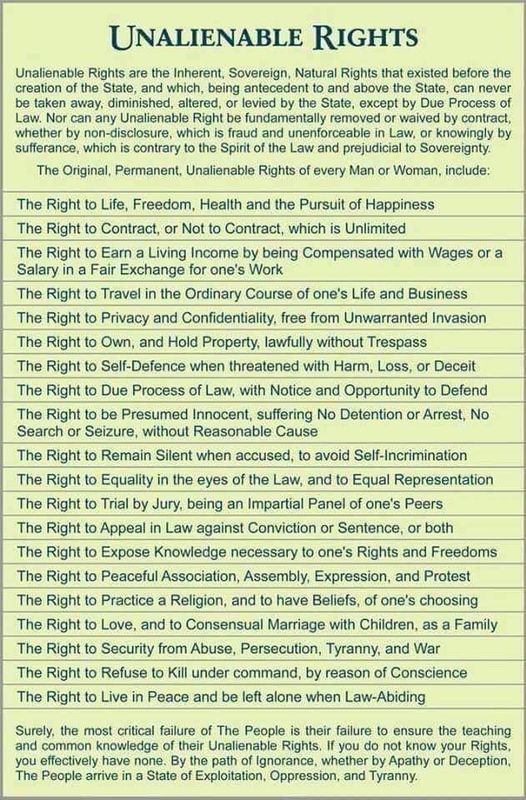
To promote freedom not slavery and oppression.
Any time you see something non-optimum by all means decry it but remember to promote the opposite of it. We get what we resist so it is most important to promote what we want.
And remember, every dollar you spend rewards the actions and intentions of the person who sold you the goods or service you purchased. Most large firms are owned and controlled by a handful of families at the top of the food chain whose objective is to increase and consolidate their power and to eradicate competition.
This increases the potential for tyranny.
So spend wisely.
And if you found value in this article, feel free to share it.
Tom Grimshaw